
Mapa mental
Lipoproteins
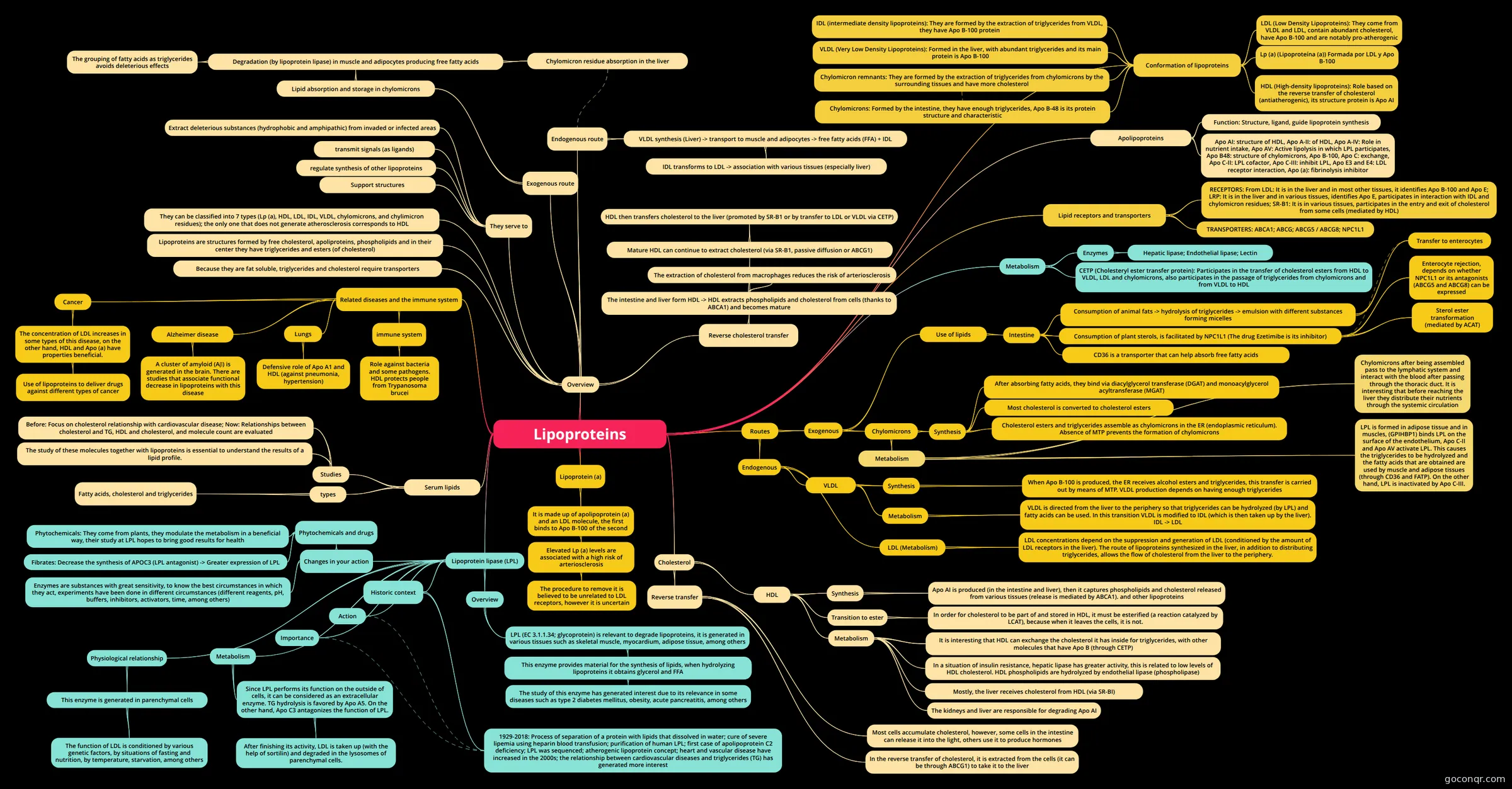
Mind map: Lipoproteins
Contenido del mapa
Lipoproteins
Overview
- Because they are fat soluble, triglycerides and cholesterol require transporters
- Lipoproteins are structures formed by free cholesterol, apoliproteins, phospholipids and in their center they have triglycerides and esters (of cholesterol)
- They can be classified into 7 types (Lp (a), HDL, LDL, IDL, VLDL, chylomicrons, and chylimicron residues); the only one that does not generate atherosclerosis corresponds to HDL
- They serve to
- Support structures
- transmit signals (as ligands)
- regulate synthesis of other lipoproteins
- Extract deleterious substances (hydrophobic and amphipathic) from invaded or infected areas
- Exogenous route
- Lipid absorption and storage in chylomicrons
- Degradation (by lipoprotein lipase) in muscle and adipocytes producing free fatty acids
- Chylomicron residue absorption in the liver
- The grouping of fatty acids as triglycerides avoids deleterious effects
- Degradation (by lipoprotein lipase) in muscle and adipocytes producing free fatty acids
- Lipid absorption and storage in chylomicrons
- Endogenous route
- VLDL synthesis (Liver) -> transport to muscle and adipocytes -> free fatty acids (FFA) + IDL
- IDL transforms to LDL -> association with various tissues (especially liver)
- VLDL synthesis (Liver) -> transport to muscle and adipocytes -> free fatty acids (FFA) + IDL
- Reverse cholesterol transfer
- The intestine and liver form HDL -> HDL extracts phospholipids and cholesterol from cells (thanks to ABCA1) and becomes mature
- Mature HDL can continue to extract cholesterol (via SR-B1, passive diffusion or ABCG1)
- HDL then transfers cholesterol to the liver (promoted by SR-B1 or by transfer to LDL or VLDL via CETP)
- The extraction of cholesterol from macrophages reduces the risk of arteriosclerosis
- Mature HDL can continue to extract cholesterol (via SR-B1, passive diffusion or ABCG1)
- The intestine and liver form HDL -> HDL extracts phospholipids and cholesterol from cells (thanks to ABCA1) and becomes mature
Conformation of lipoproteins
- Chylomicrons: Formed by the intestine, they have enough triglycerides, Apo B-48 is its protein structure and characteristic
- VLDL (Very Low Density Lipoproteins): Formed in the liver, with abundant triglycerides and its main protein is Apo B-100
- IDL (intermediate density lipoproteins): They are formed by the extraction of triglycerides from VLDL, they have Apo B-100 protein
- LDL (Low Density Lipoproteins): They come from VLDL and LDL, contain abundant cholesterol, have Apo B-100 and are notably pro-atherogenic
- HDL (High-density lipoproteins): Role based on the reverse transfer of cholesterol (antiatherogenic), its structure protein is Apo AI
- Lp (a) (Lipoproteína (a)) Formada por LDL y Apo B-100
- Chylomicron remnants: They are formed by the extraction of triglycerides from chylomicrons by the surrounding tissues and have more cholesterol
Apolipoproteins
- Function: Structure, ligand, guide lipoprotein synthesis
- Apo AI: structure of HDL, Apo A-II: of HDL, Apo A-IV: Role in nutrient intake, Apo AV: Active lipolysis in which LPL participates, Apo B48: structure of chylomicrons, Apo B-100, Apo C: exchange, Apo C-II: LPL cofactor, Apo C-III: inhibit LPL, Apo E3 and E4: LDL receptor interaction, Apo (a): fibrinolysis inhibitor
Lipid receptors and transporters
- RECEPTORS: From LDL: It is in the liver and in most other tissues, it identifies Apo B-100 and Apo E; LRP: It is in the liver and in various tissues, identifies Apo E, participates in interaction with IDL and chylomicron residues; SR-B1: It is in various tissues, participates in the entry and exit of cholesterol from some cells (mediated by HDL)
- TRANSPORTERS: ABCA1; ABCG; ABCG5 / ABCG8; NPC1L1
Metabolism
- Enzymes
- Hepatic lipase; Endothelial lipase; Lectin
- CETP (Cholesteryl ester transfer protein): Participates in the transfer of cholesterol esters from HDL to VLDL, LDL and chylomicrons, also participates in the passage of triglycerides from chylomicrons and from VLDL to HDL
- Enzymes
Routes
- Exogenous
- Use of lipids
- Intestine
- Consumption of animal fats -> hydrolysis of triglycerides -> emulsion with different substances forming micelles
- Transfer to enterocytes
- Consumption of plant sterols, is facilitated by NPC1L1 (The drug Ezetimibe is its inhibitor)
- Enterocyte rejection, depends on whether NPC1L1 or its antagonists (ABCG5 and ABCG8) can be expressed
- Sterol ester transformation (mediated by ACAT)
- CD36 is a transporter that can help absorb free fatty acids
- Consumption of animal fats -> hydrolysis of triglycerides -> emulsion with different substances forming micelles
- Intestine
- Chylomicrons
- Synthesis
- After absorbing fatty acids, they bind via diacylglycerol transferase (DGAT) and monoacylglycerol acyltransferase (MGAT)
- Most cholesterol is converted to cholesterol esters
- Cholesterol esters and triglycerides assemble as chylomicrons in the ER (endoplasmic reticulum). Absence of MTP prevents the formation of chylomicrons
- Metabolism
- Chylomicrons after being assembled pass to the lymphatic system and interact with the blood after passing through the thoracic duct. It is interesting that before reaching the liver they distribute their nutrients through the systemic circulation
- LPL is formed in adipose tissue and in muscles, (GPIHBP1) binds LPL on the surface of the endothelium, Apo C-II and Apo AV activate LPL. This causes the triglycerides to be hydrolyzed and the fatty acids that are obtained are used by muscle and adipose tissues (through CD36 and FATP). On the other hand, LPL is inactivated by Apo C-III.
- Synthesis
- Use of lipids
- Endogenous
- VLDL
- Synthesis
- When Apo B-100 is produced, the ER receives alcohol esters and triglycerides, this transfer is carried out by means of MTP. VLDL production depends on having enough triglycerides
- Metabolism
- VLDL is directed from the liver to the periphery so that triglycerides can be hydrolyzed (by LPL) and fatty acids can be used. In this transition VLDL is modified to IDL (which is then taken up by the liver). IDL -> LDL
- Synthesis
- LDL (Metabolísm)
- LDL concentrations depend on the suppression and generation of LDL (conditioned by the amount of LDL receptors in the liver). The route of lipoproteins synthesized in the liver, in addition to distributing triglycerides, allows the flow of cholesterol from the liver to the periphery.
- VLDL
- Exogenous
Cholesterol
- HDL
- Synthesis
- Apo AI is produced (in the intestine and liver), then it captures phospholipids and cholesterol released from various tissues (release is mediated by ABCA1). and other lipoproteins
- Transition to ester
- In order for cholesterol to be part of and stored in HDL, it must be esterified (a reaction catalyzed by LCAT), because when it leaves the cells, it is not.
- Metabolism
- It is interesting that HDL can exchange the cholesterol it has inside for triglycerides, with other molecules that have Apo B (through CETP)
- In a situation of insulin resistance, hepatic lipase has greater activity, this is related to low levels of HDL cholesterol. HDL phospholipids are hydrolyzed by endothelial lipase (phospholipase)
- Mostly, the liver receives cholesterol from HDL (via SR-BI)
- The kidneys and liver are responsible for degrading Apo AI
- Synthesis
- Reverse transfer
- Most cells accumulate cholesterol, however, some cells in the intestine can release it into the light, others use it to produce hormones
- In the reverse transfer of cholesterol, it is extracted from the cells (it can be through ABCG1) to take it to the liver
- HDL
Lipoprotein (a)
- It is made up of apolipoprotein (a) and an LDL molecule, the first binds to Apo B-100 of the second
- Elevated Lp (a) levels are associated with a high risk of arteriosclerosis
- The procedure to remove it is believed to be unrelated to LDL receptors, however it is uncertain
- Elevated Lp (a) levels are associated with a high risk of arteriosclerosis
- It is made up of apolipoprotein (a) and an LDL molecule, the first binds to Apo B-100 of the second
Lipoprotein lipase (LPL)
- Overview
- LPL (EC 3.1.1.34; glycoprotein) is relevant to degrade lipoproteins, it is generated in various tissues such as skeletal muscle, myocardium, adipose tissue, among others
- This enzyme provides material for the synthesis of lipids, when hydrolyzing lipoproteins it obtains glycerol and FFA
- The study of this enzyme has generated interest due to its relevance in some diseases such as type 2 diabetes mellitus, obesity, acute pancreatitis, among others
- This enzyme provides material for the synthesis of lipids, when hydrolyzing lipoproteins it obtains glycerol and FFA
- LPL (EC 3.1.1.34; glycoprotein) is relevant to degrade lipoproteins, it is generated in various tissues such as skeletal muscle, myocardium, adipose tissue, among others
- Historic context
- 1929-2018: Process of separation of a protein with lipids that dissolved in water; cure of severe lipemia using heparin blood transfusion; purification of human LPL; first case of apolipoprotein C2 deficiency; LPL was sequenced; atherogenic lipoprotein concept; heart and vascular disease have increased in the 2000s; the relationship between cardiovascular diseases and triglycerides (TG) has generated more interest
- Action
- Importance
- Metabolism
- Since LPL performs its function on the outside of cells, it can be considered as an extracellular enzyme. TG hydrolysis is favored by Apo A5. On the other hand, Apo C3 antagonizes the function of LPL.
- After finishing its activity, LDL is taken up (with the help of sortilin) and degraded in the lysosomes of parenchymal cells.
- Since LPL performs its function on the outside of cells, it can be considered as an extracellular enzyme. TG hydrolysis is favored by Apo A5. On the other hand, Apo C3 antagonizes the function of LPL.
- Physiological relationship
- This enzyme is generated in parenchymal cells
- The function of LDL is conditioned by various genetic factors, by situations of fasting and nutrition, by temperature, starvation, among others
- This enzyme is generated in parenchymal cells
- Changes in your action
- Enzymes are substances with great sensitivity, to know the best circumstances in which they act, experiments have been done in different circumstances (different reagents, pH, buffers, inhibitors, activators, time, among others)
- Phytochemicals and drugs
- Fibrates: Decrease the synthesis of APOC3 (LPL antagonist) -> Greater expression of LPL
- Phytochemicals: They come from plants, they modulate the metabolism in a beneficial way, their study at LPL hopes to bring good results for health
- Overview
Serum lipids
- types
- Fatty acids, cholesterol and triglycerides
- Studies
- The study of these molecules together with lipoproteins is essential to understand the results of a lipid profile.
- Before: Focus on cholesterol relationship with cardiovascular disease; Now: Relationships between cholesterol and TG, HDL and cholesterol, and molecule count are evaluated
- types
Related diseases and the immune system
- Alzheimer disease
- A cluster of amyloid (Aβ) is generated in the brain. There are studies that associate functional decrease in lipoproteins with this disease
- Cancer
- The concentration of LDL increases in some types of this disease, on the other hand, HDL and Apo (a) have properties beneficial.
- Use of lipoproteins to deliver drugs against different types of cancer
- The concentration of LDL increases in some types of this disease, on the other hand, HDL and Apo (a) have properties beneficial.
- Lungs
- Defensive role of Apo A1 and HDL (against pneumonia, hypertension)
- immune system
- Role against bacteria and some pathogens. HDL protects people from Trypanosoma brucei
- Alzheimer disease
Información
- Descripción
- Mapa Mental sobre Lipoproteins, creado por David Ricardo Guerra Quintero el 14/10/2020.
- Creado por
- David Ricardo Guerra Quintero
- Visitas
- 0
- Valoración
Más sobre Lipoprotein Metabolism and Lipid Transport