
Mapa mental
Chapter 9 - Employee Development
Contenido del mapa
Chapter 9 - Employee Development
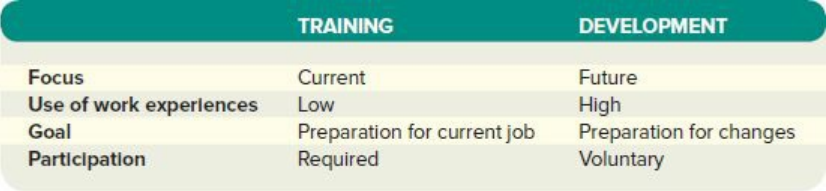
Development & Training
- development
- formal education, job experiences, relationships, & assessment of personality & abilities that help employees prepare for the future
- prepare employees for other positions in the company
- increase their ability to move into jobs that may not yet exist
- help employees prepare for changes in their current jobs that may result from new technology, work designs, new customers, or new product markets
- formal education, job experiences, relationships, & assessment of personality & abilities that help employees prepare for the future
- training
- a planned effort by a company to facilitate employees’ learning of job-related competencies, knowledge, skills, & behaviors
- help employees’ performance in their current jobs
- a planned effort by a company to facilitate employees’ learning of job-related competencies, knowledge, skills, & behaviors
- development
Development & Careers
- protean career
- based on self-direction with the goal of psychological success in one’s work
- goal
- psychological success
- the feeling of pride & accomplishment that comes from achieving life goals that are not limited to achievements at work (e.g. raising a family & having good physical health)
- psychological success
- goal
- based on self-direction with the goal of psychological success in one’s work
- boundaryless
- careers may involve identifying more with a job or profession than with the present employer
- career plans or goals are influenced by personal or family demands and values
- protean career
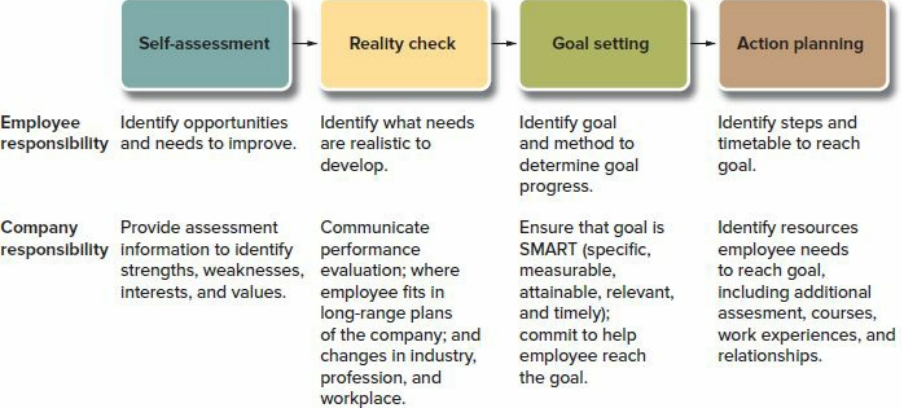
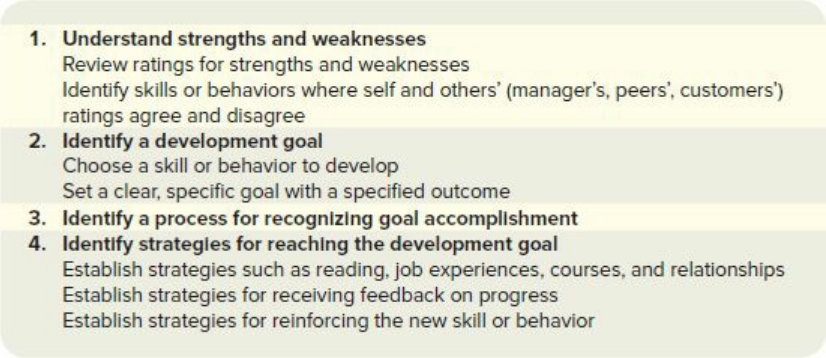
Development Planning Systems
- Career Management Systems
4 Approaches to Employee Development
- Formal education
- off-site & on-site programs designed specifically for the company’s employees, short courses offered by consultants or universities, executive MBA programs, & university programs in which participants live at the university while taking classes
- Assessment
- collecting info. & providing feedback to employees about their behavior, communication style, or skills
- 5 reasons
- identify employees with managerial potential & measure current managers’ strengths & weaknesses
- identify managers with the potential to move into higher-level executive positions
- identify the strengths & weaknesses of individual team members &the decision processes or communication styles that inhibit the team’s productivity
- help employees understand their tendencies, their needs, the type of work environment they prefer, the type of work they might prefer to do
- help employees decide what type of development goals might be most appropriate for them
- Personality tests & inventories
- Personality tests
- 5 dimensions
- extraversion
- adjustment
- agreeableness
- conscientiousness
- openness to experience
- 5 dimensions
- Myers-Briggs Type Inventories (MBTI)
- 16 personality types
- introversion (I) ≠ extraversion (E)
- preferences for energy
- sensing (S) ≠ intuition (N)
- info. gathering
- thinking (T) ≠ feeling (F)
- decision making
- judging (J) ≠ perceiving (P)
- lifestyle
- introversion (I) ≠ extraversion (E)
- 16 personality types
- Personality tests
- Assessment center
- where multiple raters or evaluators (assessors) evaluate employees’ performance on a number of exercises
- leaderless group discussion
- interview
- in-basket
- a simulation of the administrative tasks of the manager’s job
- role play
- designed to measure employees’ administrative & interpersonal skills
- where multiple raters or evaluators (assessors) evaluate employees’ performance on a number of exercises
- Performance appraisal & 360-degree feedback
- performance appraisal
- process of measuring employees’ performance
- must tell employees specifically about their performance problems & how they can improve their performance
- process of measuring employees’ performance
- upward feedback
- collecting subordinates’ evaluations of managers’ behaviors or skills
- 360-degree feedback
- evaluation of employees’ behaviors or skills by subordinates, peers, customers, their bosses, the employees themselves
- 4 activities involved
- evaluation of employees’ behaviors or skills by subordinates, peers, customers, their bosses, the employees themselves
- performance appraisal
- 5 reasons
- collecting info. & providing feedback to employees about their behavior, communication style, or skills
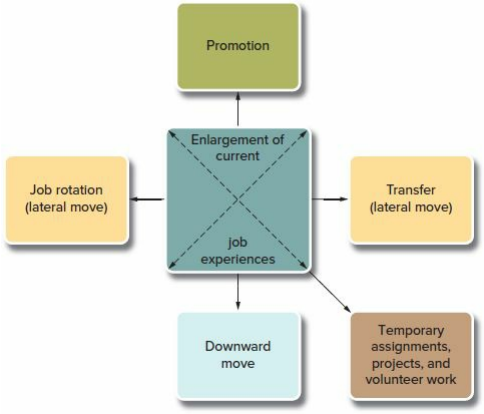
- Job experiences
- Job experiences
- relationships, problems, demands, tasks, or other features that employees face in their jobs
- stretch assignment
- a mismatch between the employee’s skills & past experiences & the skills required for success on the job
- stretch assignment
- relationships, problems, demands, tasks, or other features that employees face in their jobs
- job enlargement
- adding challenges or new responsibilities to employees’ current jobs
- job rotation & lateral moves
- job rotation
- give employees a series of job assignments in various functional areas of the company or movement among jobs in a single functional area or dept.
- involve a planned sequence of jobs that the employee is expected to hold
- pros
- help employees gain an overall appreciation of the company’s goals, increases their understanding of different company functions, develops a network of contacts, increases employees’ skills
- provide the opportunity for another employee to move into the vacated position, creating a system that helps employees to continuously develop skills
- cons
- may cause employees to adopt a short-term perspective when problem solving
- employees’ satisfaction and motivation may be adversely affected because they find it difficult to develop functional specialties & they don’t spend enough time in one position to receive a challenging assignment
- productivity losses & workload increases
- lateral moves
- not necessarily involve a predetermined sequence of jobs or positions
- job rotation
- Transfers, promotions, downward moves
- transfer
- an employee is assigned a job in a different area of the company; a move to a job with similar responsibilities
- promotion
- advancements into positions with greater challenges, more responsibility, more authority than in the previous job
- pay increase
- advancements into positions with greater challenges, more responsibility, more authority than in the previous job
- downward move
- when an employee is given less responsibility and authority
- a move to another position at the same level (lateral demotion)
- a temporary cross-functional move
- a demotion because of poor performance
- when an employee is given less responsibility and authority
- transfer
- Temporary assignments, projects, volunteer work, sabbaticals
- temporary assignment
- job tryouts such as employees taking on a position to help them determine if they are interested in working in a new role, employee exchanges, sabbaticals, & voluntary assignments
- employee exchange
- 2 organizations swap their employees with one another
- sabbatical
- a leave of absence from the company for personal reflection, renewal, & skill development
- volunteer assignment
- temporary assignment
- Job experiences
- Interpersonal relationships
- Mentoring
- mentor
- experienced, productive senior employee who helps develop a less experienced employee (the protégé)
- most mentoring relationships develop informally as a result of interests or values shared by the mentor & the protégé
- mentoring relationships can also develop as part of a formal mentoring program, that is, a planned company effort to bring together successful senior employees with less experienced employees
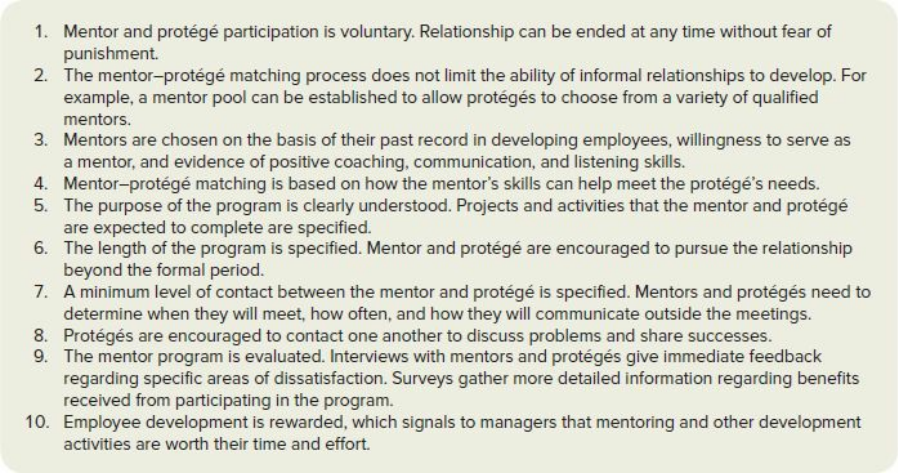
- Developing successful mentoring programs
- Benefits of mentoring relationships
- For the protégés
- career support
- coaching; protection; sponsorship; providing challenging assignments, exposure, & visibility
- psychosocial support
- serving as a friend & a role model, providing positive regard & acceptance, & creating an outlet for the protégé to talk about anxieties & fears
- higher rates of promotion, higher salaries, greater organizational influence
- career support
- For the mentors
- develop interpersonal skills & increase feelings of self-esteem & worth to the organization
- gain knowledge about important new scientific developments in their field
- For the protégés
- mentor
- Coaching
- Coach
- a peer or manager who works with employees to motivate them, help them develop skills, provide reinforcement and feedback
- 3 roles
- give feedback
- help employees learn for themselves
- provide resources such as mentors, courses, or job experiences that employees may not be able to gain access to without the coach’s help
- 3 roles
- a peer or manager who works with employees to motivate them, help them develop skills, provide reinforcement and feedback
- Coach
- Mentoring
- Formal education
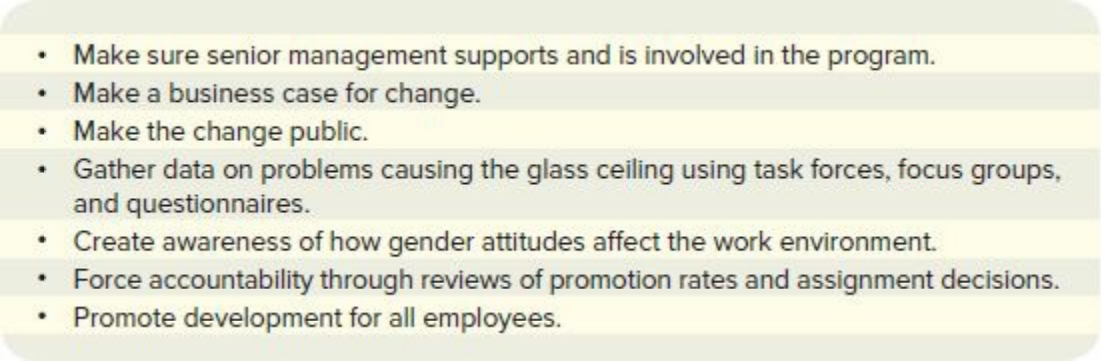
Melting the Glass Ceiling
- how to get women and minorities into upper-level management positions
- recommendations
Succession planning
- the process of identifying and tracking high-potential employees who are capable of moving into different positions in the company resulting from planned or unplanned job openings due to turnover, promotion, or business growth
- often discussed when considering company’s managers or top leaders
- pros
- require senior management to systematically review leadership talent in the company
- ensure that top-level managerial talent is available
- provide a set of development experiences that managers must complete to be considered for top management positions
- avoid premature promotion of managers who are not ready for upper management ranks
- help attract and retain managerial employees by providing them with development opportunities that they can complete if upper management is a career goal for them
- bench strength
- having a pool of talented employees who are ready when needed
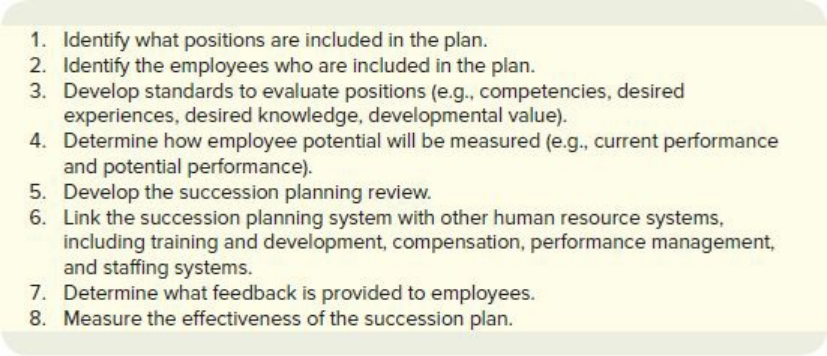
- Process of developing a succession plan
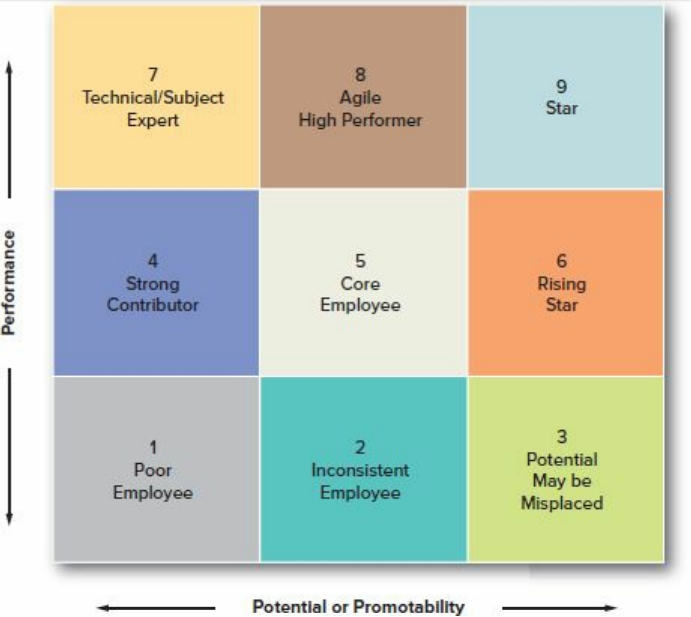
- Succession plan review
- 9-box grid
Imágenes y archivos del mapa
Información
- Descripción
- Mapa Mental sobre Chapter 9 - Employee Development, creado por Huong Huynh el 05/11/2020.
- Creado por
- Huong Huynh
- Visitas
- 0
- Valoración