
Mapa mental
Congressional Reconstruction
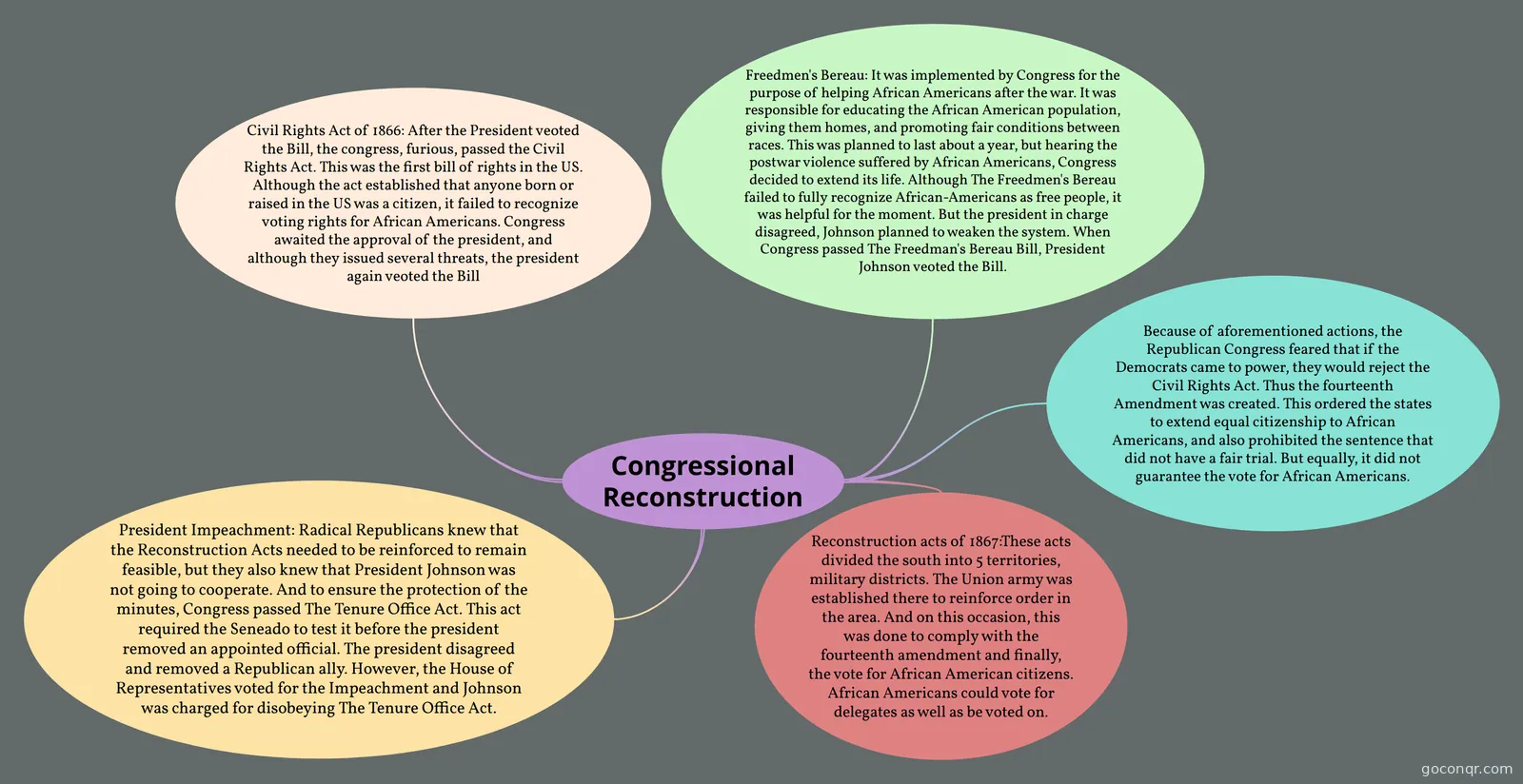
Mind map: Congressional Reconstruction
Contenido del mapa
Congressional Reconstruction
Because of aforementioned actions, the Republican Congress feared that if the Democrats came to power, they would reject the Civil Rights Act. Thus the fourteenth Amendment was created. This ordered the states to extend equal citizenship to African Americans, and also prohibited the sentence that did not have a fair trial. But equally, it did not guarantee the vote for African Americans.
Reconstruction acts of 1867:These acts divided the south into 5 territories, military districts. The Union army was established there to reinforce order in the area. And on this occasion, this was done to comply with the fourteenth amendment and finally, the vote for African American citizens. African Americans could vote for delegates as well as be voted on.
President Impeachment: Radical Republicans knew that the Reconstruction Acts needed to be reinforced to remain feasible, but they also knew that President Johnson was not going to cooperate. And to ensure the protection of the minutes, Congress passed The Tenure Office Act. This act required the Seneado to test it before the president removed an appointed official. The president disagreed and removed a Republican ally. However, the House of Representatives voted for the Impeachment and Johnson was charged for disobeying The Tenure Office Act.
Freedmen's Bereau: It was implemented by Congress for the purpose of helping African Americans after the war. It was responsible for educating the African American population, giving them homes, and promoting fair conditions between races. This was planned to last about a year, but hearing the postwar violence suffered by African Americans, Congress decided to extend its life. Although The Freedmen's Bereau failed to fully recognize African-Americans as free people, it was helpful for the moment. But the president in charge disagreed, Johnson planned to weaken the system. When Congress passed The Freedman's Bereau Bill, President Johnson veoted the Bill.
Civil Rights Act of 1866: After the President veoted the Bill, the congress, furious, passed the Civil Rights Act. This was the first bill of rights in the US. Although the act established that anyone born or raised in the US was a citizen, it failed to recognize voting rights for African Americans. Congress awaited the approval of the president, and although they issued several threats, the president again veoted the Bill
Información
- Descripción
- Mapa Mental sobre Congressional Reconstruction, creado por Leah Martinez el 03/12/2020.
- Creado por
- Leah Martinez
- Visitas
- 0
- Valoración
Más sobre Congressional Reconstruction and Politics