
Mapa mental
Edward Jackson
Contenido del mapa
Edward Jackson
Key Information
- 50 years old
- He has been worrying for some time that something isn’t quite right, but has only just become certain enough to “bother” the doctor
- He has been having difficulty using the mouse on his computer – it has become increasingly hard to get the pointer to go exactly where he wants it to
- He has also started to have problems with things like shaving, brushing his teeth and doing up buttons
- His hand is shaking slightly when it is resting in his lap
- He started to notice it when relaxing in front of the TV, and finds that it disappears when he moves the hand, it is more annoying and doesn't interfere with daily tasks
- His handwriting has also got smaller
- The GP notices that Mr Jackson speaks very softly, and that his face shows surprisingly little emotion as he describes these difficulties
GP Investigations
- The GP gets Mr Jackson to walk across the consulting room, and notes that his right arm shows a reduced swing compared to the left and that the hand shakes
- This is assessing his gait, and shows a resting tremor and bradykinesia (reduced swing)
- The GP does the finger nose test and his right arm moves rather slowly, but the movement is smooth and accurate and the shaking stops
- No past pointing or intention tremor so unlikely to be cerebellar ataxia
- Mr Jackson to place his hands on her desk, and to tap his fingers as fast as he can in a sequence from the little finger to the index finger. and it shows that the finger movements of his right hand appear slower and of lower amplitude than those of his left hand
- Bradykinesia in the fingers and signs of pinrolling
- The GP takes hold of Mr Jackson’s left arm and alternately flexes and extends the elbow and wrist joints, when repeating the same test on his right arm she fit is stiffer, and that the stiffness fluctuates so that the movement is jerky
- Testing active and passive movements, shows cog wheel rigidity
- Reflexes are normal
- Edward has not suffered from any major illness in the past, has never been on long-term medication, and is currently taking nothing stronger than an occasional aspirin and a daily over-the-counter multivitamin
- He is diagnosed with mild right sided idiopathic Parkinson’s disease, explaining that this is due to the loss of a particular type of cell in a region of the brain called the basal ganglia
- It is arranged for Edward to have a CT brain scan and routine blood tests
- Both are normal, but this doesn’t change the diagnosis
- This may be due to the diagnosis may be very early on so the damage is not showing up yet, the fact that Parkinson's only affects one cell type (dopaminergic) so it will not form an obvious lesion or where the damage has occurred that is won’t be picked up through the image
- Both are normal, but this doesn’t change the diagnosis
- The GP explains that there is nothing they can do at this stage of the disease, but they will take action if the symptoms worsen
- It is arranged for Edward to have a CT brain scan and routine blood tests
- The GP gets Mr Jackson to walk across the consulting room, and notes that his right arm shows a reduced swing compared to the left and that the hand shakes
Parkinson's Disease
- Risk Factors
- Males
- Environmental exposure to insecticides, pesticides and herbicides
- Genetics
- More common in white people
- Age
- Cause of Parkinson's Disease
- Parkinson's disease is caused by the degeneration of the pars compacta in the substantia nigra
- The substantia nigra is a large pigmented nucleus that is found inside the cerebral peduncle of the midbrain, lying between the crus cerebri in front and the tegmentum behind
- The pars compacta is the part of the substantia nigra that projects to the basal ganglia
- The dopamine produced is secreted to the putamen and the caudate nucleus of the basal ganglia
- The putamen and caudate nucleus are the parts of the basal ganglia that are involved in cognition and motor function
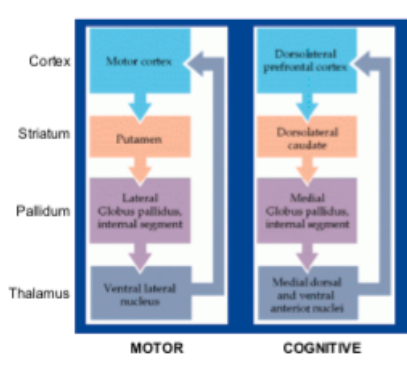
- Theses basal ganglia loops begin and project into the caudate nucleus and putamen (both dark parts) and these project to the globus pallidus which projects to the thalamus to then go back to the cerebral cortex to make a closed loop
- The putamen and caudate nucleus are the parts of the basal ganglia that are involved in cognition and motor function
- The dopamine produced is secreted to the putamen and the caudate nucleus of the basal ganglia
- The neurons of the substantia nigra pars compacta are described as dopaminergic since they synthesise the neurotransmitter dopamine
- The dark brown pigmentation is due to the accumulation of neuromelanin which is a by-product of dopamine synthesis and degradation
- In certain neurodegenerative disorders, such as idiopathic Parkinson’s disease, selective death of dopaminergic neurons in the pars compacta leads to marked pallor of the substantia nigra, which can be seen at post-mortem examination of the brain
- The dark brown pigmentation is due to the accumulation of neuromelanin which is a by-product of dopamine synthesis and degradation
- Parkinson's disease is caused by the degeneration of the pars compacta in the substantia nigra
- Symptoms
- Tremor
- Muscle rigidity
- Bradykinesia
- Balance problems
- Loss of sense of smell
- Nerve pain
- Excessive sweating
- Difficulty swallowing
- Urinary problems
- Constipation
- Dizziness, blurred vision and fainting
- Depression and anxiety
- Mild cognitive imparement
- Diagnosis
- If someone has two of the following: tremor, bradykinesia or muscle rigidity, it is likely that they have Parkinson's Disease
- If these improve with the use of Levodopa this confirms the diagnosis
- Scans
- MRI and CT scans can be done but these usually appear normal
- DaTSCAN
- This is a test to look at the level of dopamine receptor cells in the brain using a small amount of an iodine based radioactive material
- On arrival, they will be given two tablets of a medicine to block the uptake of the iodine by the thyroid
- About 20 minutes later, they will be given an injection of the radioactive tracer in the arm
- The images are taken about three hours after the injection
- An abnormal DaTSCAN result cannot give a definitive diagnosis of Parkinson’s, but in most cases it is due to Parkinson’s
- A normal DaTSCAN can be helpful in showing that a person’s symptoms, particularly tremor, are not caused by Parkinson’s
- The images are taken about three hours after the injection
- About 20 minutes later, they will be given an injection of the radioactive tracer in the arm
- If someone has two of the following: tremor, bradykinesia or muscle rigidity, it is likely that they have Parkinson's Disease
- Risk Factors
Treatment for Parkinson's Disease
- Ropinirole
- Given in the early stages of Parkinson's Disease to delay the need for the use of Levodopa (more side effects)
- Mr Jackson is given this 9 months after his diagnosis
- Acts as a D2 agonist to mimic the role of dopamine in the pathways that are disrupted in Parkinson's
- Side effects
- Generally has less side effects than other Parkinson's drugs
- Postural hypotension
- Drowsiness
- Restless leg syndrome
- Dosage
- The maximum recommended dose is 24 mg per day, taken in three separate doses spread throughout the day
- Initially given as a low dose and gradually increased
- Given in the early stages of Parkinson's Disease to delay the need for the use of Levodopa (more side effects)
- Levodopa
- Levodopa is converted to dopamine via the action of a naturally occurring enzyme called DOPA decarboxylase
- This occurs both in the peripheral circulation and in the central nervous system after levodopa has crossed the blood brain barrier
- The activation of central dopamine receptors can help reduce the symptoms of Parkinson's but the activation of the peripheral receptors can cause nausea and vomiting
- It is usually given with a DOPA decarboxylase inhibitor (DDCI), in this case carbidopa, which can't cross the BBB and prevents the peripheral action
- The activation of central dopamine receptors can help reduce the symptoms of Parkinson's but the activation of the peripheral receptors can cause nausea and vomiting
- This occurs both in the peripheral circulation and in the central nervous system after levodopa has crossed the blood brain barrier
- It can take two to three weeks of treatment before benefits are seen
- Each dose then begins working in about ten minutes to two hours depending on the formulation, with a duration of effect of about five hours
- Levodopa is converted to dopamine via the action of a naturally occurring enzyme called DOPA decarboxylase
- Madopar 125
- Benserazide is used in the management of Parkinson's disease in combination with L-DOPA (levodopa) as co-beneldopa (BAN)
- Most levodopa is decarboxylated to dopamine before it reaches the brain, and since dopamine is unable to cross the blood–brain barrier, this translates to little therapeutic gain with strong peripheral side effects
- Benserazide inhibits the decarboxylation, and since it cannot cross the blood–brain barrier itself, this allows dopamine to build up solely in the brain, instead
- Most levodopa is decarboxylated to dopamine before it reaches the brain, and since dopamine is unable to cross the blood–brain barrier, this translates to little therapeutic gain with strong peripheral side effects
- It helps to minimise the Adverse effects caused by peripheral dopamine, such as vasoconstriction, nausea, and arrhythmia
- However, benserazide cannot reduce the centrally mediated side effects of levodopa, particularly dyskinesia
- Mr Jackson was given this 12 months after diagnosis
- Benserazide is used in the management of Parkinson's disease in combination with L-DOPA (levodopa) as co-beneldopa (BAN)
- Deep Brain stimulation
- Deep brain stimulation is the main type of surgery used to treat Parkinson’s
- Usually, it is most effective at improving motor symptoms
- A pulse generator is placed under the skin around the chest or stomach area and is connected to one or two fine wires that are inserted into specific areas of the brain
- When the pulse generator is switched on, the electrodes deliver high frequency stimulation to the targeted area which changes some of the electrical signals in the brain that cause the symptoms of Parkinson’s
- Well-established DBS targets include the subthalamic nucleus (STN), the globus pallidus pars interna (GPi), and to a lesser degree the ventral intermediate nucleus (VIM) of the thalamus
- Deep brain stimulation for Parkinson’s may be an option for people whose symptoms are no longer controlled well by the best available medication for their condition
- In many cases it has given people with the condition better control of their motor (movement) symptoms including tremor, speed of movements and involuntary movements (dyskinesia)
- Deep brain stimulation is unlikely to improve any movement symptoms that levodopa does not improve
- May also make the balance, speech and cognition issues worse
- Side effects
- Tingling or pins and needles
- Diziness
- Changes in speech or language, such as problems articulating words, a soft voice or difficulty finding words
- Involuntary muscle contractions (dystonia or dyskinesia)
- Problems with balance and falls
- Movement problems or reduced co-ordination
- Jolting or shocking sensations
- Problems associated with the pulse generator and leads, including wound breakdown and infection
- Deep brain stimulation is the main type of surgery used to treat Parkinson’s
- Ropinirole
Mr Jackson's Progression Over Time
- 9 months after diagnosis
- During a routine follow-up, the GP notes that Edward’s symptoms have all become worse, and that the same problems have started to appear in his left arm
- He is referred to a consultant neurologist
- The neurologist, Dr Fredricks, starts treatment with Ropinirole and arranges for Mr Jackson to have a DaT scan
- The DaT scan shows a loss of dopamine uptake in the region of the putamen, confirming the diagnosis of a Parkinsonian disorder
- Mr Jackson is assigned a specialist Parkinson’s nurse, who will act as his main point of contact for future help, information and access to speech and occupational therapy when needed
- The DaT scan shows a loss of dopamine uptake in the region of the putamen, confirming the diagnosis of a Parkinsonian disorder
- The neurologist, Dr Fredricks, starts treatment with Ropinirole and arranges for Mr Jackson to have a DaT scan
- He is referred to a consultant neurologist
- During a routine follow-up, the GP notes that Edward’s symptoms have all become worse, and that the same problems have started to appear in his left arm
- 12 months after diagnosis
- He says that his symptoms improved in the first instance, and he was very relieved, but that the tremor in his right hand has now got worse and is interfering with all activities involving the use of that hand
- He may have built up a tolerance so madopar 125 is added to his medication
- He says that his symptoms improved in the first instance, and he was very relieved, but that the tremor in his right hand has now got worse and is interfering with all activities involving the use of that hand
- 18 Months after diagnosis
- Edward experiences worsening problems in both hands and he has begun to develop the classical Parkinsonian gait
- The consultant increases the dose of Edward’s Madopar regime
- 24 months after diagnosis
- Edward complains that the tablets that used to work all day now start to wear off after about 3 hours, leaving a two hour gap before the next dose has time to become effective
- He has to put up with severe symptoms for large chunks of the day – the consultant calls these “off” periods
- About half way through the period when the medication is working he now gets some involuntary writhing movements of his arms, neck and head
- Peak dose dyskinesia, it is a side effect of L-DOPA due to the brain trying to compensate by adjusting the dopamine receptors in other parts of the brain
- It becomes clear that Edward's wife does not want him to continue his medications
- She believes the medications are doing more harm than good but there is evidently some difference of opinion between the couple
- The GP tries to get Edward's point of view but his wife keeps interrupting Edward as he tries to speak and after a while he stops trying
- She believes the medications are doing more harm than good but there is evidently some difference of opinion between the couple
- Edward complains that the tablets that used to work all day now start to wear off after about 3 hours, leaving a two hour gap before the next dose has time to become effective
- 30 months after diagnosis
- Despite various attempts at changing medications and dose, Edward remains seriously disabled and can only work some of the time
- The consultant feels that he has gone as far as he can with pharmacological treatments, and that it is now time to consider deep brain stimulation
- His drug regime allows prolonged “off” periods and he is still increasingly troubled by periods of marked involuntary movements
- 9 months after diagnosis
Imágenes y archivos del mapa
Información
- Descripción
- Mapa Mental sobre Edward Jackson, creado por Laura Maynard el 12/01/2021.
- Creado por
- Laura Maynard
- Visitas
- 0
- Valoración