
Mapa mental
HUMAN MEMORY
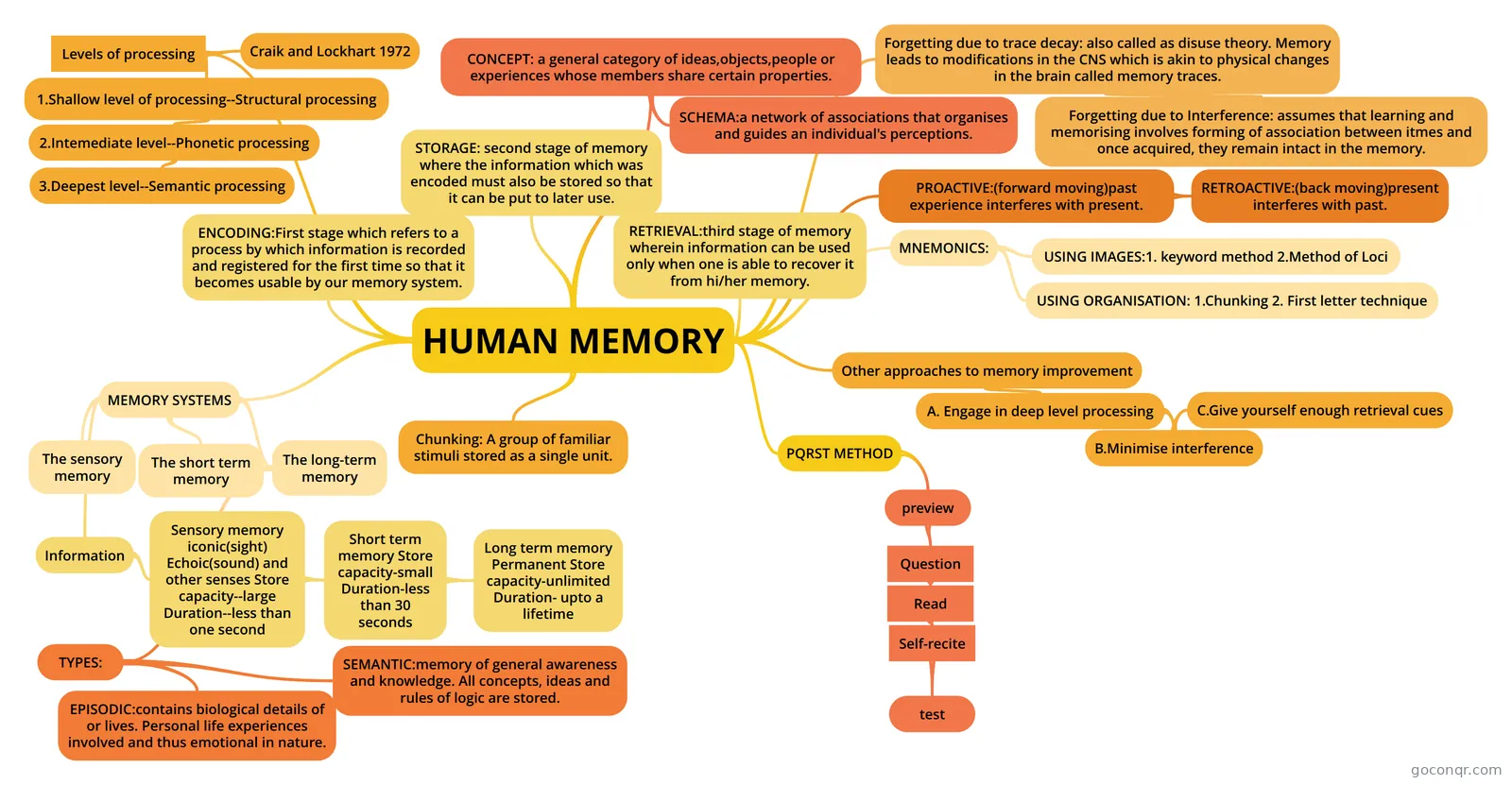
Mind map: human memory
Contenido del mapa
HUMAN MEMORY
ENCODING:First stage which refers to a process by which information is recorded and registered for the first time so that it becomes usable by our memory system.
STORAGE: second stage of memory where the information which was encoded must also be stored so that it can be put to later use.
RETRIEVAL:third stage of memory wherein information can be used only when one is able to recover it from hi/her memory.
MEMORY SYSTEMS
- The sensory memory
- The short term memory
- The long-term memory
- TYPES:
- EPISODIC:contains biological details of or lives. Personal life experiences involved and thus emotional in nature.
- SEMANTIC:memory of general awareness and knowledge. All concepts, ideas and rules of logic are stored.
- TYPES:
- Information
- Sensory memory iconic(sight) Echoic(sound) and other senses Store capacity--large Duration--less than one second
- Short term memory Store capacity-small Duration-less than 30 seconds
- Long term memory Permanent Store capacity-unlimited Duration- upto a lifetime
- Short term memory Store capacity-small Duration-less than 30 seconds
- Sensory memory iconic(sight) Echoic(sound) and other senses Store capacity--large Duration--less than one second
Chunking: A group of familiar stimuli stored as a single unit.
Levels of processing
- 1.Shallow level of processing--Structural processing
- 2.Intemediate level--Phonetic processing
- 3.Deepest level--Semantic processing
- 2.Intemediate level--Phonetic processing
- Craik and Lockhart 1972
- 1.Shallow level of processing--Structural processing
CONCEPT: a general category of ideas,objects,people or experiences whose members share certain properties.
- SCHEMA:a network of associations that organises and guides an individual's perceptions.
Forgetting due to trace decay: also called as disuse theory. Memory leads to modifications in the CNS which is akin to physical changes in the brain called memory traces.
- Forgetting due to Interference: assumes that learning and memorising involves forming of association between itmes and once acquired, they remain intact in the memory.
PROACTIVE:(forward moving)past experience interferes with present.
- RETROACTIVE:(back moving)present interferes with past.
MNEMONICS:
- USING IMAGES:1. keyword method 2.Method of Loci
- USING ORGANISATION: 1.Chunking 2. First letter technique
Other approaches to memory improvement
- A. Engage in deep level processing
- B.Minimise interference
- C.Give yourself enough retrieval cues
- B.Minimise interference
- A. Engage in deep level processing
PQRST METHOD
- preview
- Question
- Read
- Self-recite
- test
- Self-recite
- Read
- Question
- preview
Información
- Descripción
- Mapa Mental sobre HUMAN MEMORY, creado por Aparna Anilraj el 25/01/2021.
- Creado por
- Aparna Anilraj
- Visitas
- 0
- Valoración