
Mapa mental
Multiple - Access Protocols
Contenido del mapa
Multiple - Access Protocols
Channelization Protocols
Random Access Protocols
- .In this, all stations have same superiority that is no station has more priority than another station. However, if more than one station tries to send, there is an access conflict—collision—and the frames will be either destroyed or modified.
- .Any station can send data depending on medium’s state( idle or busy ) .
- It has two features :
- 1. There is no fixed time for sending data ( Transmission is random among the stations )
- 2.There is no fixed sequence of stations sending data.Stations compite with one another to access the medium
- 1. There is no fixed time for sending data ( Transmission is random among the stations )
- It has two features :
- .Any station can send data depending on medium’s state( idle or busy ) .
- ALOHA
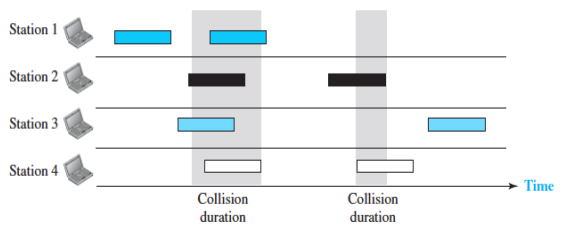
- .It was designed for wireless LAN but is also applicable for shared medium. In this, multiple stations can transmit data at the same time and can hence lead to collision and data being garbled.
- Pure ALOHA
- Pure ALOHA is the original ALOHA protocol. When a station sends data it waits for an acknowledgement. If the acknowledgement doesn’t come after time-Out period , then the station waits for a random amount of time called back-off time (Tb) and re-sends the data. Since different stations wait for different amount of time, the probability of further collision decreases.
- The maximum throughput of pure ALOHA is 18% which means 18% of transmitted frame arrive successfully.
- In pure ALOHA it can send the frame anytime, there is no control , the collision occurs between two station each one of them try to send a frame at the same time .
- The maximum throughput of pure ALOHA is 18% which means 18% of transmitted frame arrive successfully.
- Pure ALOHA is the original ALOHA protocol. When a station sends data it waits for an acknowledgement. If the acknowledgement doesn’t come after time-Out period , then the station waits for a random amount of time called back-off time (Tb) and re-sends the data. Since different stations wait for different amount of time, the probability of further collision decreases.
- Slotted ALOHA
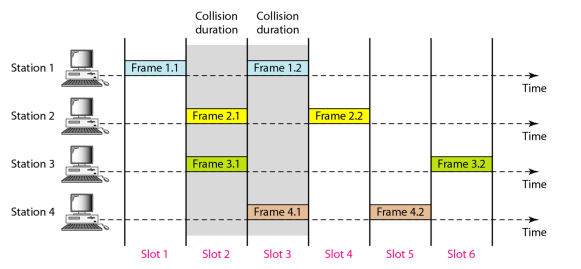
- It is similar to pure ALOHA, except that we divide time into equal slots and sending of data is allowed only at the beginning of these slots only . If a station misses out the allowed time, it must wait for the next slot. This reduces the probability of collision. A central clock or station about the start of each slots.
- The maximum throughput of pure ALOHA is 37% which means 37% of transmitted frame arrive successfully.
- In slotted ALOHA the time is divide into equal slots. no station send at the same time of another station , there is a control and it is commit to the start time of each slots.
- The maximum throughput of pure ALOHA is 37% which means 37% of transmitted frame arrive successfully.
- It is similar to pure ALOHA, except that we divide time into equal slots and sending of data is allowed only at the beginning of these slots only . If a station misses out the allowed time, it must wait for the next slot. This reduces the probability of collision. A central clock or station about the start of each slots.
- Pure ALOHA
- CSMA
- Carrier Sense Multiple Access ensures fewer collisions as the station is required to first sense the medium (for idle or busy) before transmitting data. If it is idle then it sends data, otherwise it waits till the channel becomes idle. However there is still chance of collision in CSMA due to propagation delay. CSMA is based on the principle " sense before transmit " or "listen before talk" .
- CSMA access models :
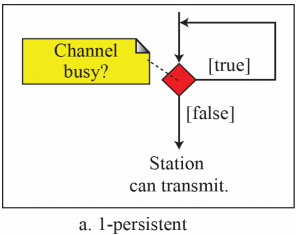
- 1-Persistent • It is simple and straighforward. • In this method, after the station finds the line idle, it sends its frame immediately (with probability 1). • This method has the highest chance of collision because two or more stations may find the line idle and send their frames immediately.
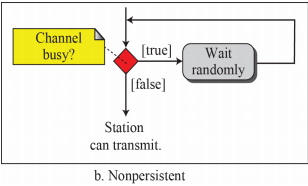
- 2-Nonpersistent • A station that has a frame to send senses the line. If the line is idle, it sends immediately. If the line is not idle, it waits a random amount of time and then senses the line again. It reduces the chance of collision because it is unlikely that two or more station will wait the same amount of time and retry to send simultaneously. However, this method reduces the efficiency of the network because the medium remains idle when there may be stations with frames to send.
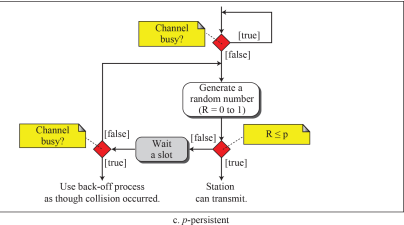
- 3- p -Persistent • Its is used if the channel has time slots with a slot duration equal to or greater than the maximum propagation time. • It combines the advantages of the other two strategies. It reduces the chance of collision and improves efficiency. • After the station finds the line idle it follows these steps: 1. With probability p, the station sends its frame. 2. With probability q = 1 − p, the station waits for the beginning of the next time slot and checks the line again. a. If the line is idle, it goes to step 1. b. If the line is busy, it acts as though a collision has occurred and uses the backoff procedure
- 3- p -Persistent • Its is used if the channel has time slots with a slot duration equal to or greater than the maximum propagation time. • It combines the advantages of the other two strategies. It reduces the chance of collision and improves efficiency. • After the station finds the line idle it follows these steps: 1. With probability p, the station sends its frame. 2. With probability q = 1 − p, the station waits for the beginning of the next time slot and checks the line again. a. If the line is idle, it goes to step 1. b. If the line is busy, it acts as though a collision has occurred and uses the backoff procedure
- 2-Nonpersistent • A station that has a frame to send senses the line. If the line is idle, it sends immediately. If the line is not idle, it waits a random amount of time and then senses the line again. It reduces the chance of collision because it is unlikely that two or more station will wait the same amount of time and retry to send simultaneously. However, this method reduces the efficiency of the network because the medium remains idle when there may be stations with frames to send.
- 1-Persistent • It is simple and straighforward. • In this method, after the station finds the line idle, it sends its frame immediately (with probability 1). • This method has the highest chance of collision because two or more stations may find the line idle and send their frames immediately.
- CSMA/CA
- Carrier sense multiple access with collision avoidance (CSMA/CA) was invented for wireless networks. The process of collisions detection involves sender receiving acknowledgement signals. If there is just one signal(its own) then the data is successfully sent but if there are two signals(its own and the one with which it has collided) then it means a collision has occurred. To distinguish between these two cases, collision must have a lot of impact on received signal. However it is not so in wired networks, so CSMA/CA is used in this case.
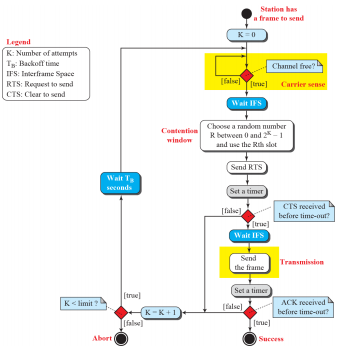
- CSMA/CA avoids collision by:
- 1.Interframe space – Station waits for medium to become idle and if found idle it does not immediately send data (to avoid collision due to propagation delay) rather it waits for a period of time called Interframe space or IFS. After this time it again checks the medium for being idle. The IFS duration depends on the priority of station
- 2.Contention Window – It is the amount of time divided into slots. If the sender is ready to send data, it chooses a random number of slots as wait time which doubles every time medium is not found idle. If the medium is found busy it does not restart the entire process, rather it restarts the timer when the channel is found idle again.
- 3.Acknowledgement – The sender re-transmits the data if acknowledgement is not received before time-out.
- 2.Contention Window – It is the amount of time divided into slots. If the sender is ready to send data, it chooses a random number of slots as wait time which doubles every time medium is not found idle. If the medium is found busy it does not restart the entire process, rather it restarts the timer when the channel is found idle again.
- 1.Interframe space – Station waits for medium to become idle and if found idle it does not immediately send data (to avoid collision due to propagation delay) rather it waits for a period of time called Interframe space or IFS. After this time it again checks the medium for being idle. The IFS duration depends on the priority of station
- CSMA/CA avoids collision by:
- Carrier sense multiple access with collision avoidance (CSMA/CA) was invented for wireless networks. The process of collisions detection involves sender receiving acknowledgement signals. If there is just one signal(its own) then the data is successfully sent but if there are two signals(its own and the one with which it has collided) then it means a collision has occurred. To distinguish between these two cases, collision must have a lot of impact on received signal. However it is not so in wired networks, so CSMA/CA is used in this case.
- CSMA/CD
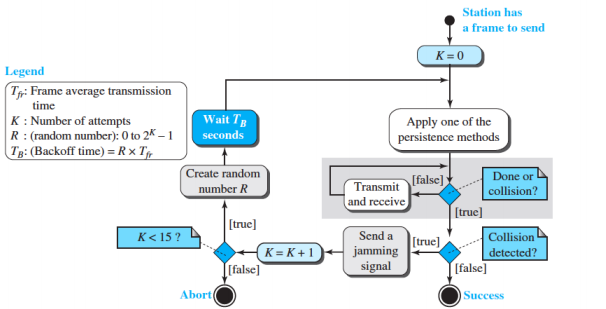
- Carrier sense multiple access with collision detection. Stations can terminate transmission of data if collision is detected. IN this method, a station monitors the medium after it sends a frame to see if the transmission was successful. If so, the station is finished. If, however, there is a collision, the frame is sent again.
- CSMA/CA
- ALOHA
- .In this, all stations have same superiority that is no station has more priority than another station. However, if more than one station tries to send, there is an access conflict—collision—and the frames will be either destroyed or modified.
Controlled-Access protocols
Is broadcast link used in LAN consist of Multiple Sending and receving nodes connected to or use a single shared link
By : Ameerah Ahmad Ali Hazzazi , 2190004354
Imágenes y archivos del mapa
Información
- Descripción
- Mapa Mental sobre Multiple - Access Protocols, creado por AMEERH 900 el 05/02/2021.
- Creado por
- AMEERH 900 · feb 2021
- Actualizado
- 6 feb 2021
- Visitas
- 1
- Valoración