
Mapa mental
QUESTION RESPONSE
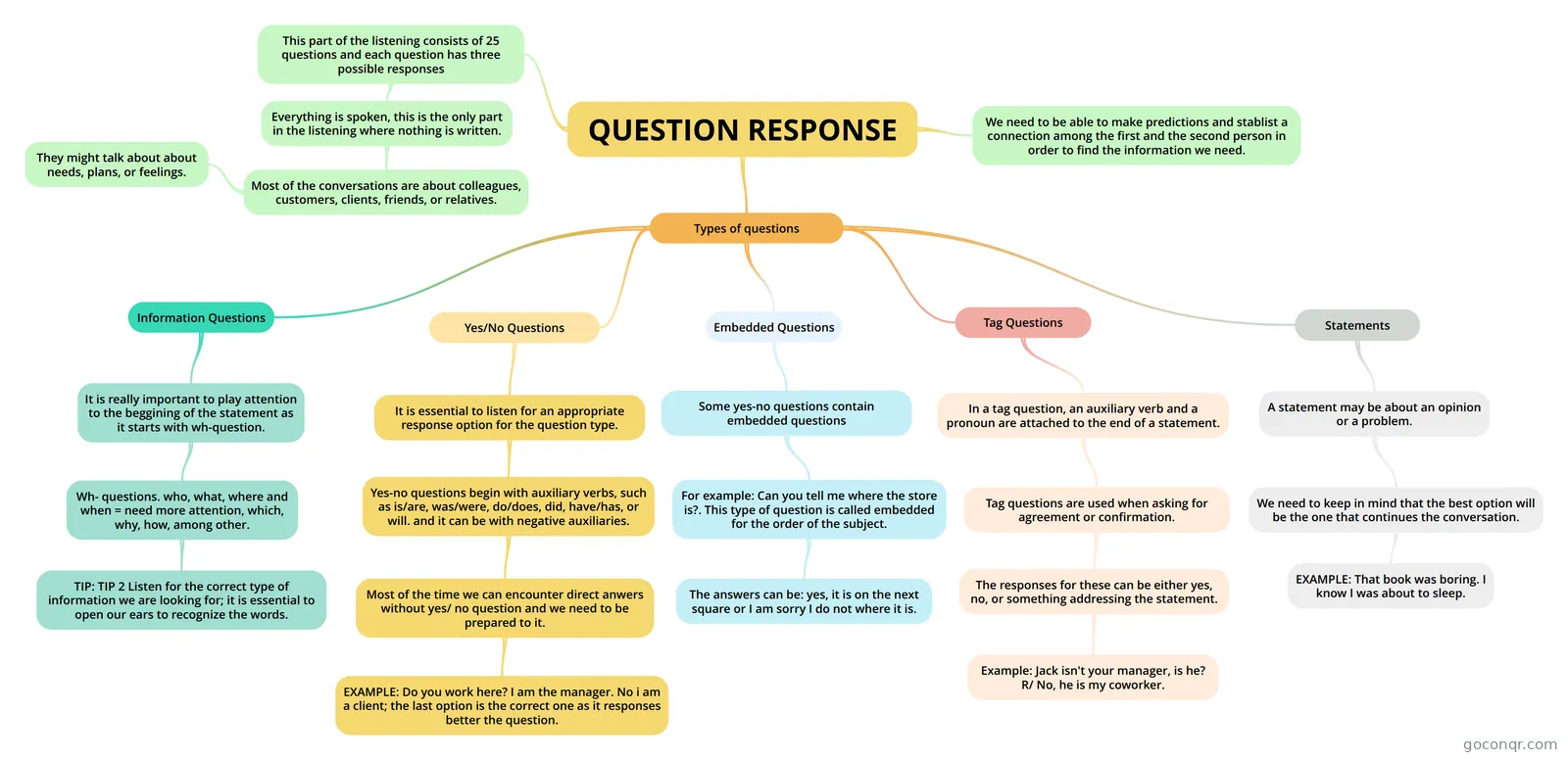
Mind map: question response listening
Contenido del mapa
QUESTION RESPONSE
This part of the listening consists of 25 questions and each question has three possible responses
- Everything is spoken, this is the only part in the listening where nothing is written.
- Most of the conversations are about colleagues, customers, clients, friends, or relatives.
- They might talk about about needs, plans, or feelings.
- Most of the conversations are about colleagues, customers, clients, friends, or relatives.
- Everything is spoken, this is the only part in the listening where nothing is written.
Types of questions
- Information Questions
- It is really important to play attention to the beggining of the statement as it starts with wh-question.
- Wh- questions. who, what, where and when = need more attention, which, why, how, among other.
- TIP: TIP 2 Listen for the correct type of information we are looking for; it is essential to open our ears to recognize the words.
- Wh- questions. who, what, where and when = need more attention, which, why, how, among other.
- It is really important to play attention to the beggining of the statement as it starts with wh-question.
- Yes/No Questions
- It is essential to listen for an appropriate response option for the question type.
- Yes-no questions begin with auxiliary verbs, such as is/are, was/were, do/does, did, have/has, or will. and it can be with negative auxiliaries.
- Most of the time we can encounter direct anwers without yes/ no question and we need to be prepared to it.
- EXAMPLE: Do you work here? I am the manager. No i am a client; the last option is the correct one as it responses better the question.
- Most of the time we can encounter direct anwers without yes/ no question and we need to be prepared to it.
- Yes-no questions begin with auxiliary verbs, such as is/are, was/were, do/does, did, have/has, or will. and it can be with negative auxiliaries.
- It is essential to listen for an appropriate response option for the question type.
- Embedded Questions
- Some yes-no questions contain embedded questions
- For example: Can you tell me where the store is?. This type of question is called embedded for the order of the subject.
- The answers can be: yes, it is on the next square or I am sorry I do not where it is.
- For example: Can you tell me where the store is?. This type of question is called embedded for the order of the subject.
- Some yes-no questions contain embedded questions
- Tag Questions
- In a tag question, an auxiliary verb and a pronoun are attached to the end of a statement.
- Tag questions are used when asking for agreement or confirmation.
- The responses for these can be either yes, no, or something addressing the statement.
- Example: Jack isn't your manager, is he? R/ No, he is my coworker.
- The responses for these can be either yes, no, or something addressing the statement.
- Tag questions are used when asking for agreement or confirmation.
- In a tag question, an auxiliary verb and a pronoun are attached to the end of a statement.
- Statements
- A statement may be about an opinion or a problem.
- We need to keep in mind that the best option will be the one that continues the conversation.
- EXAMPLE: That book was boring. I know I was about to sleep.
- We need to keep in mind that the best option will be the one that continues the conversation.
- A statement may be about an opinion or a problem.
- Information Questions
We need to be able to make predictions and stablist a connection among the first and the second person in order to find the information we need.