
Mapa mental
Differences between the political parties in terms of economic policy?
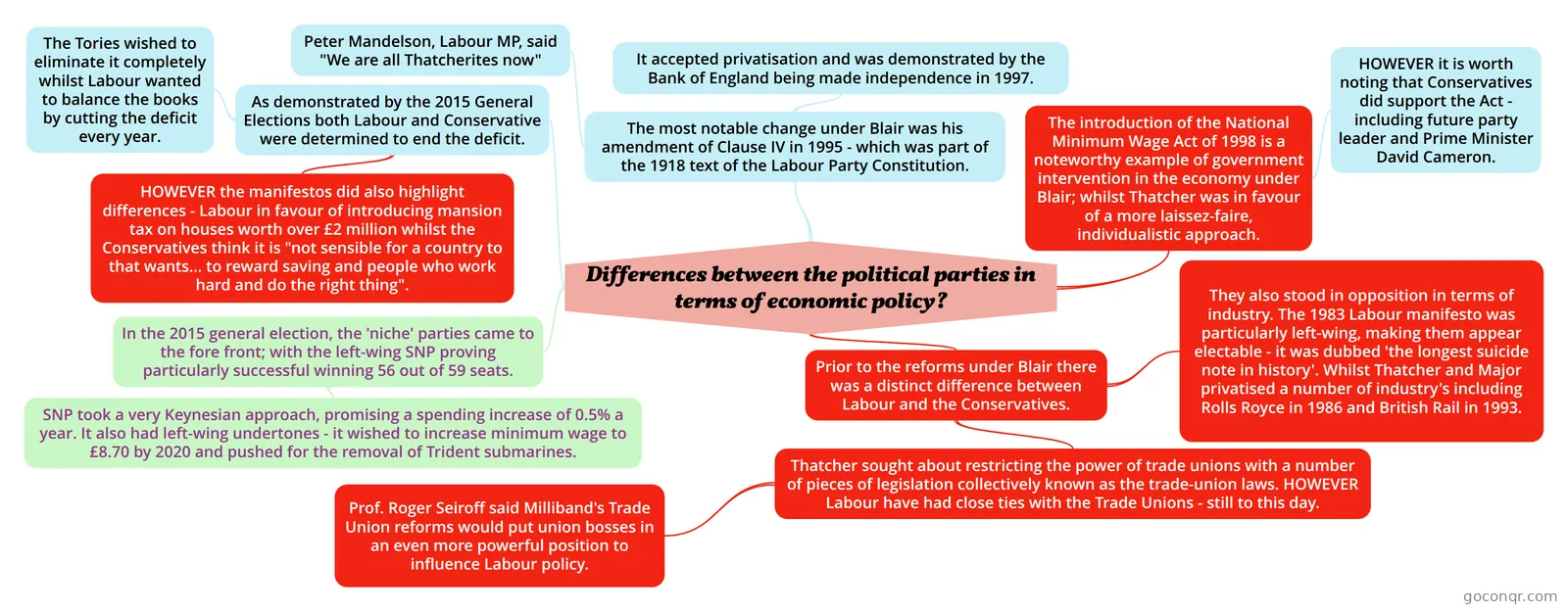
Mind map: UK political parties economic policy differences
Contenido del mapa
Differences between the political parties in terms of economic policy?
Prior to the reforms under Blair there was a distinct difference between Labour and the Conservatives.
- Thatcher sought about restricting the power of trade unions with a number of pieces of legislation collectively known as the trade-union laws. HOWEVER Labour have had close ties with the Trade Unions - still to this day.
- Prof. Roger Seiroff said Milliband's Trade Union reforms would put union bosses in an even more powerful position to influence Labour policy.
- They also stood in opposition in terms of industry. The 1983 Labour manifesto was particularly left-wing, making them appear electable - it was dubbed 'the longest suicide note in history'. Whilst Thatcher and Major privatised a number of industry's including Rolls Royce in 1986 and British Rail in 1993.
- Thatcher sought about restricting the power of trade unions with a number of pieces of legislation collectively known as the trade-union laws. HOWEVER Labour have had close ties with the Trade Unions - still to this day.
The introduction of the National Minimum Wage Act of 1998 is a noteworthy example of government intervention in the economy under Blair; whilst Thatcher was in favour of a more laissez-faire, individualistic approach.
- HOWEVER it is worth noting that Conservatives did support the Act - including future party leader and Prime Minister David Cameron.
The most notable change under Blair was his amendment of Clause IV in 1995 - which was part of the 1918 text of the Labour Party Constitution.
- It accepted privatisation and was demonstrated by the Bank of England being made independence in 1997.
- Peter Mandelson, Labour MP, said "We are all Thatcherites now"
As demonstrated by the 2015 General Elections both Labour and Conservative were determined to end the deficit.
- The Tories wished to eliminate it completely whilst Labour wanted to balance the books by cutting the deficit every year.
- HOWEVER the manifestos did also highlight differences - Labour in favour of introducing mansion tax on houses worth over £2 million whilst the Conservatives think it is "not sensible for a country to that wants... to reward saving and people who work hard and do the right thing".
In the 2015 general election, the 'niche' parties came to the fore front; with the left-wing SNP proving particularly successful winning 56 out of 59 seats.
- SNP took a very Keynesian approach, promising a spending increase of 0.5% a year. It also had left-wing undertones - it wished to increase minimum wage to £8.70 by 2020 and pushed for the removal of Trident submarines.
Información
- Descripción
- A mind-map on whether the main political parties in the UK are different in regard to economic policy.
- Creado por
- Joe Brown
- Visitas
- 54
- Etiquetas
- Valoración