
Mapa mental
Cattle Farming
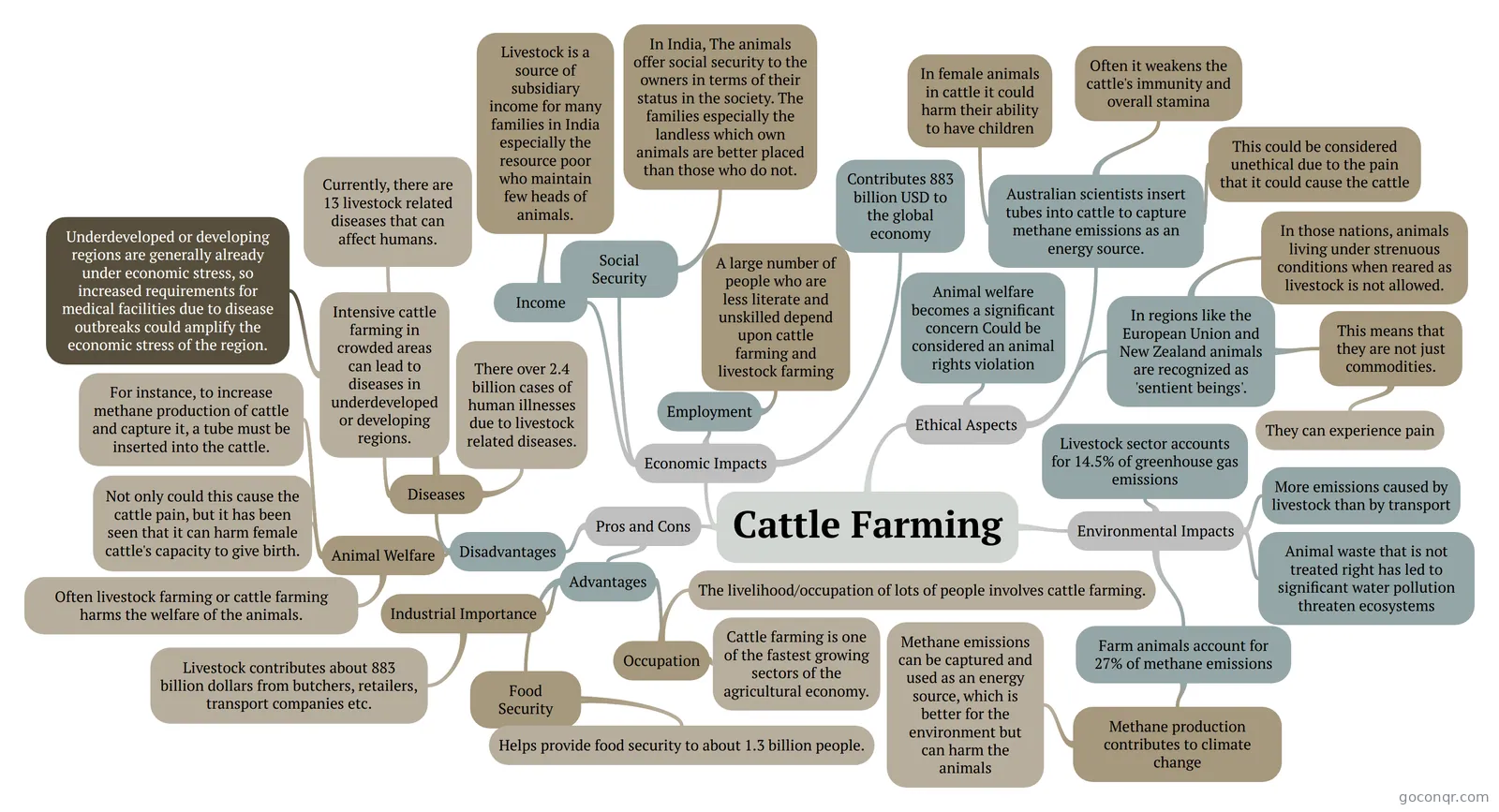
Mind map: Cattle farming
Contenido del mapa
Cattle Farming
Ethical Aspects
- In regions like the European Union and New Zealand animals are recognized as 'sentient beings'.
- In those nations, animals living under strenuous conditions when reared as livestock is not allowed.
- This means that they are not just commodities.
- They can experience pain
- Animal welfare becomes a significant concern Could be considered an animal rights violation
- Australian scientists insert tubes into cattle to capture methane emissions as an energy source.
- This could be considered unethical due to the pain that it could cause the cattle
- Often it weakens the cattle's immunity and overall stamina
- In female animals in cattle it could harm their ability to have children
- In regions like the European Union and New Zealand animals are recognized as 'sentient beings'.
Environmental Impacts
- Farm animals account for 27% of methane emissions
- Methane production contributes to climate change
- Methane emissions can be captured and used as an energy source, which is better for the environment but can harm the animals
- Methane production contributes to climate change
- Livestock sector accounts for 14.5% of greenhouse gas emissions
- More emissions caused by livestock than by transport
- Animal waste that is not treated right has led to significant water pollution threaten ecosystems
- Farm animals account for 27% of methane emissions
Economic Impacts
- Income
- Livestock is a source of subsidiary income for many families in India especially the resource poor who maintain few heads of animals.
- Employment
- A large number of people who are less literate and unskilled depend upon cattle farming and livestock farming
- Social Security
- In India, The animals offer social security to the owners in terms of their status in the society. The families especially the landless which own animals are better placed than those who do not.
- Contributes 883 billion USD to the global economy
- Income
Pros and Cons
- Advantages
- Occupation
- The livelihood/occupation of lots of people involves cattle farming.
- Cattle farming is one of the fastest growing sectors of the agricultural economy.
- Industrial Importance
- Livestock contributes about 883 billion dollars from butchers, retailers, transport companies etc.
- Food Security
- Helps provide food security to about 1.3 billion people.
- Occupation
- Disadvantages
- Animal Welfare
- For instance, to increase methane production of cattle and capture it, a tube must be inserted into the cattle.
- Not only could this cause the cattle pain, but it has been seen that it can harm female cattle's capacity to give birth.
- Often livestock farming or cattle farming harms the welfare of the animals.
- Diseases
- Intensive cattle farming in crowded areas can lead to diseases in underdeveloped or developing regions.
- Underdeveloped or developing regions are generally already under economic stress, so increased requirements for medical facilities due to disease outbreaks could amplify the economic stress of the region.
- Currently, there are 13 livestock related diseases that can affect humans.
- There over 2.4 billion cases of human illnesses due to livestock related diseases.
- Intensive cattle farming in crowded areas can lead to diseases in underdeveloped or developing regions.
- Animal Welfare
- Advantages
Información
- Descripción
- Mapa Mental sobre Cattle Farming, creado por Seiya Mutreja el 26/03/2021.
- Creado por
- Seiya Mutreja
- Visitas
- 4
- Valoración