
Mapa mental
Elimination
Contenido del mapa
Elimination
Definition: Irreversible loss of chemically unchanged DRUG or METABOLLITES from body
- Renal
- Depends on
- Glomerular Filtration
- GF occurs to:
- Low molecular weight drugs
- Ionized and Unionized drugs
- Free drugs
- Low volume of distribution drugs
- Determined by:
- Creatinine
- Insulin
- INFOS
- Filtration affected by:
- Renal blood flow
- Health of kidney
- Patients with impaired kidney function
- GFR (RATE) maybe significantly lower than normal
- Filtration affected by:
- Glomerular Filtration Rate (GFR): Amount of blood filtered by Glomerulus in a given time (GFR=about 125 ml/min)
- GF occurs to:
- Active Tubular secretion
- INFOS
- Drugs that are not transferred into the glomerular filtrate, leave the glomeruli
- divide to form:
- a capillary plexus surrounding the nephric lumen in the proximal convoluted tubule.
- divide to form:
- Nitrogenous waste product such as uric acid along with several organic acids are secreted in Proximal convoluted tubule
- Small amounts of sodium and potassium ions are secreted in distal convoluted tubule
- Hydrogen ion is secreted into collecting duct
- Drugs that are not transferred into the glomerular filtrate, leave the glomeruli
- Needs Energy
- Secretion takes place my two energy dependant active transport systems:
- Organic Acids/anions (DEPROTONATED form of weak acids)
- Penicillin, Salicylates, Probenecid, Uric acid
- PS PU
- Organic Base/cations (PROTONATED form of weak bases)
- Morphine, Atropine, Cathecholamine, Quinine
- MACQ
- Organic Acids/anions (DEPROTONATED form of weak acids)
- Secretion takes place my two energy dependant active transport systems:
- requires carrier (transporter) and the process is saturable
- Active Process
- INFOS
- Active/Passive Tubular reabsorption
- INFOS
- It takes place along all the renal tubules (80% of the solute reabsorbed in Proximal convoluted tubules, the rest in loop of Henle, Distal convoluted tubule and Collecting duct)
- It increases the half life of a drug.
- Depends on ionization and lipid solubility.
- Ionization depends on pH of urine and pKa of a drug.
- Lipid soluble and unionized drugs are reabsorbed back.
- Ionized drugs cannot be reabsorbed. They will be excreted
- Changing the urine pH
- increase the fraction of ionized drug in the lumen
- reduces back diffusion
- increase the clearance of an undesirable drug
- increase the fraction of ionized drug in the lumen
- Passive tubular reabsorption:
- Only lipid soluble drugs undergo passive reabsorption
- Ionized drugs are poorly reabsorbed.
- Active tubular reabsorption:
- It occurs with endogenous substances or nutrients
- (e.g., glucose, electrolyte, amino acids, uric acid, vitamins etc.
- It occurs with endogenous substances or nutrients
- INFOS
- Glomerular Filtration
- INFOS
- Kidney + Most drugs are excreted in Urine as UNCHANGED or POLAR metabollites
- Driving force: Hydrostatic pressure of blood
- Most drugs filtered through Glomerulus
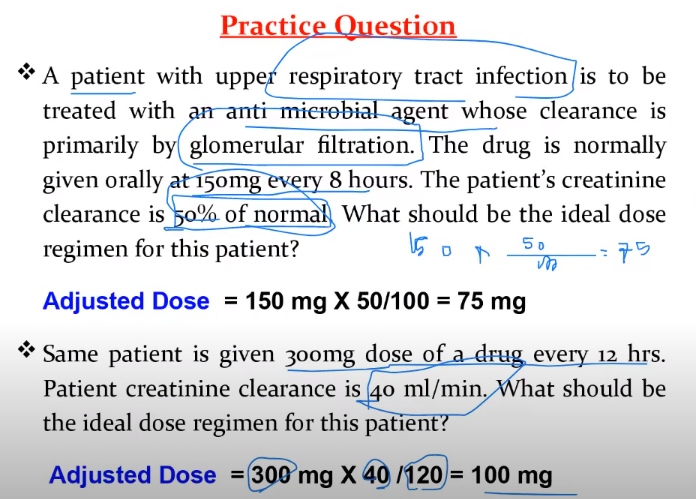
- Dose adjustment for patients with renal failure:
- Adjusted dose = average dose X CCp/CCn
- Creatinine clearance of the patient should be determined.
- CCp = Creatinine Clearance of Patient
- CCn = Creatinine Clearance of Normal
- Creatinine clearance of the patient should be determined.
- Adjusted dose = average dose X CCp/CCn
- Application of ionization
- Weak acids can be eliminated by alkalinization of the urine, whereas elimination of weak bases may be increased by acidification of the urine.
- Therapeutics advantage of competition:
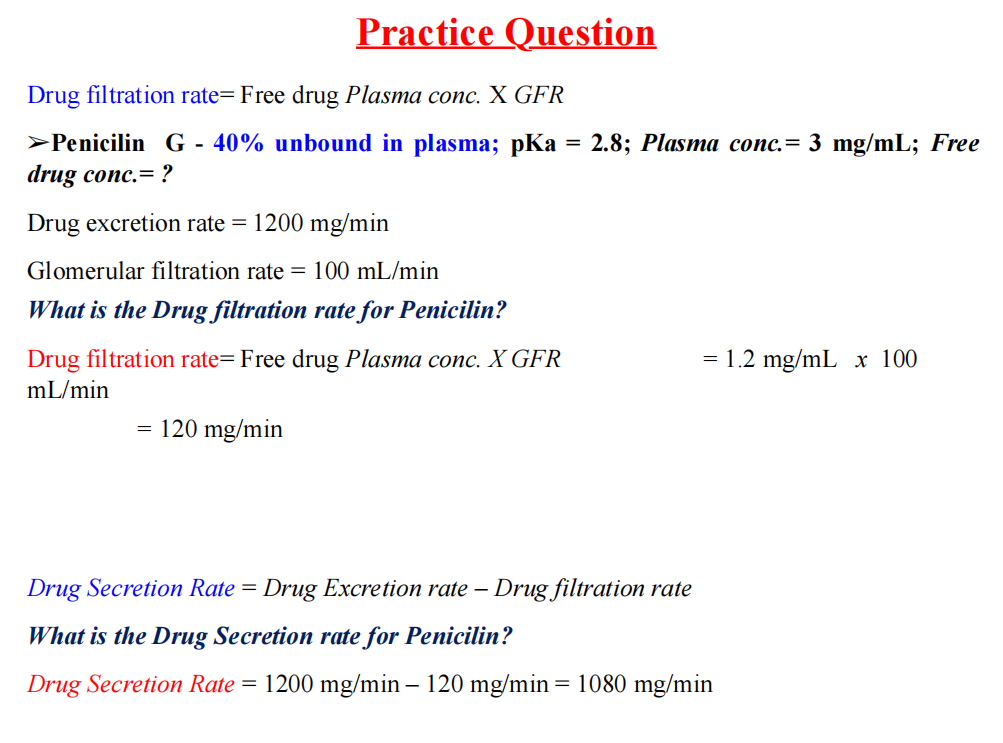
- Probenecid is used to block renal tubular secretion of some acidic drugs (e.g., penicillin) and thus prolong its duration of action.
- A 50% reduction in penicillin G dose is suggested especially when the drug is given in large doses as in gonococcal infection.
- Active secretion of anionic drugs (probenecid) suppress carrier mediated reabsorption of the endogenous metabolite, uric acid and is thus of therapeutic value as a uricosuric agent in the treatment of gout
- A 50% reduction in penicillin G dose is suggested especially when the drug is given in large doses as in gonococcal infection.
- Probenecid is used to block renal tubular secretion of some acidic drugs (e.g., penicillin) and thus prolong its duration of action.
- Therapeutic disadvantage of competition:
- Probenecid inhibits renal tubular secretion of nitrofurantoin, thus decreases its efficacy in urinary tract infection (UTIs)
- Practice Question
- Therapeutics advantage of competition:
- Weak acids can be eliminated by alkalinization of the urine, whereas elimination of weak bases may be increased by acidification of the urine.
- Depends on
- Non-Renal
- Biliary excretion (bile acid)
- Chloromphenicol, indomethacin
- Pulmonary excretion (exhaled air)
- General anesthetics (Halothane)
- Salivary excretion (saliva)
- Caffeine, Theophylline
- Mammary excretion (breast)
- Tetracycline
- Skin / Dermal excretion (sweat)
- Benzoic acid, salicylic acid
- Gastrointestinal excretion (feces)
- Nicotine and quinine
- Factors affecting renal excretion
- Physicochemical properties of drug:
- Physicochemical factors affecting renal excretion are – molecular size, pKa and lipid solubility
- Compounds between 300 - 500 daltons (if water soluble) are readily excreted by the kidney
- Urinary excretion of unchanged drug is inversely related to lipid solubility.
- Plasma concentration of drug:
- Drugs that are actively secreted, the rate of excretion increases with increase in plasma concentration upto a saturation level.
- In case of actively reabsorbed drugs, excretion is negligible at low plasma concentrations.
- Blood flow to kidney:
- Renal perfusion increases the clearance of drugs (for both glomerular filtration and active secretion).
- Biological factor:
- Renal excretion is approximately 10% lower in females than males. ● The renal function of newborns is 30 to 40% less in comparison to adults. ● In old age GFR is reduced and tubular function is altered.
- Drug interaction:
- Any drug interaction that alters binding characteristics, renal blood flow, active secretion, urine pH and forced diuresis would alter renal clearance.
- Disease state:
- Renal dysfunction, uremia
- Physicochemical properties of drug:
- Biliary excretion (bile acid)
- Renal
Imágenes y archivos del mapa
Información
- Descripción
- Mapa Mental sobre Elimination, creado por Meshal Dagriri el 09/04/2021.
- Creado por
- Meshal Dagriri · abr 2021
- Actualizado
- 9 abr 2021
- Visitas
- 0
- Valoración