
Mapa mental
PRESENT PERFECT x SIMPLE PAST
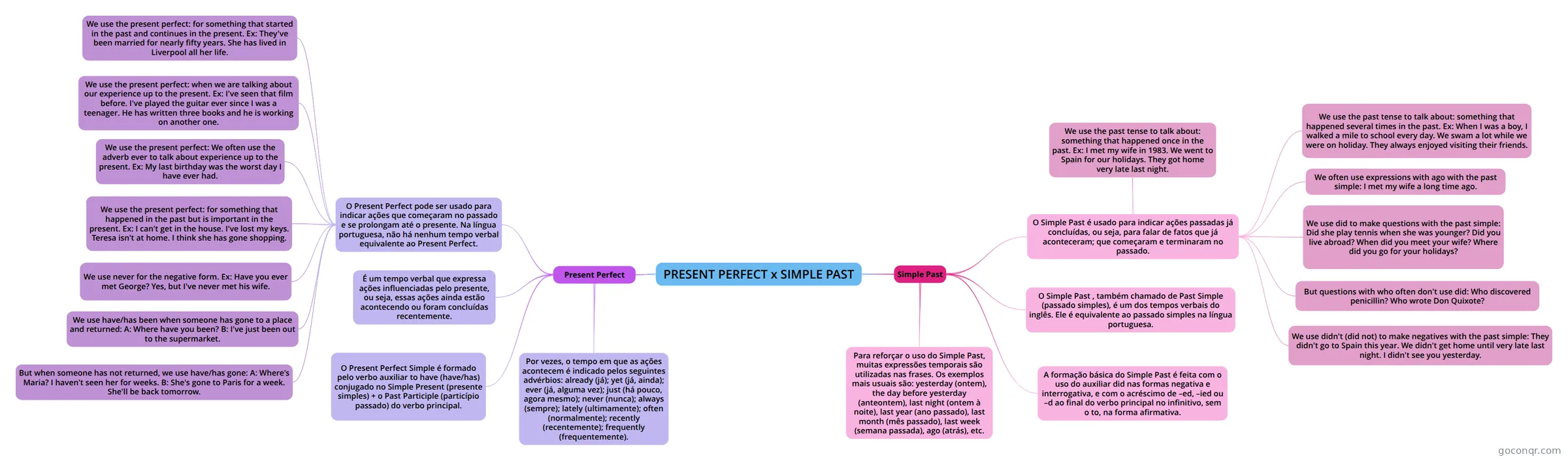
Mapa mental: Present perfect x simple past
Contenido del mapa
PRESENT PERFECT x SIMPLE PAST
Simple Past
- Para reforçar o uso do Simple Past, muitas expressões temporais são utilizadas nas frases. Os exemplos mais usuais são: yesterday (ontem), the day before yesterday (anteontem), last night (ontem à noite), last year (ano passado), last month (mês passado), last week (semana passada), ago (atrás), etc.
- A formação básica do Simple Past é feita com o uso do auxiliar did nas formas negativa e interrogativa, e com o acréscimo de –ed, –ied ou –d ao final do verbo principal no infinitivo, sem o to, na forma afirmativa.
- O Simple Past , também chamado de Past Simple (passado simples), é um dos tempos verbais do inglês. Ele é equivalente ao passado simples na língua portuguesa.
- O Simple Past é usado para indicar ações passadas já concluídas, ou seja, para falar de fatos que já aconteceram; que começaram e terminaram no passado.
- We use the past tense to talk about: something that happened once in the past. Ex: I met my wife in 1983. We went to Spain for our holidays. They got home very late last night.
- We use the past tense to talk about: something that happened several times in the past. Ex: When I was a boy, I walked a mile to school every day. We swam a lot while we were on holiday. They always enjoyed visiting their friends.
- We often use expressions with ago with the past simple: I met my wife a long time ago.
- We use did to make questions with the past simple: Did she play tennis when she was younger? Did you live abroad? When did you meet your wife? Where did you go for your holidays?
- But questions with who often don't use did: Who discovered penicillin? Who wrote Don Quixote?
- We use didn't (did not) to make negatives with the past simple: They didn't go to Spain this year. We didn't get home until very late last night. I didn't see you yesterday.
Present Perfect
- É um tempo verbal que expressa ações influenciadas pelo presente, ou seja, essas ações ainda estão acontecendo ou foram concluídas recentemente.
- O Present Perfect pode ser usado para indicar ações que começaram no passado e se prolongam até o presente. Na língua portuguesa, não há nenhum tempo verbal equivalente ao Present Perfect.
- We use the present perfect: for something that started in the past and continues in the present. Ex: They've been married for nearly fifty years. She has lived in Liverpool all her life.
- We use the present perfect: when we are talking about our experience up to the present. Ex: I've seen that film before. I've played the guitar ever since I was a teenager. He has written three books and he is working on another one.
- We use the present perfect: We often use the adverb ever to talk about experience up to the present. Ex: My last birthday was the worst day I have ever had.
- We use the present perfect: for something that happened in the past but is important in the present. Ex: I can't get in the house. I've lost my keys. Teresa isn't at home. I think she has gone shopping.
- We use never for the negative form. Ex: Have you ever met George? Yes, but I've never met his wife.
- We use have/has been when someone has gone to a place and returned: A: Where have you been? B: I've just been out to the supermarket.
- But when someone has not returned, we use have/has gone: A: Where's Maria? I haven't seen her for weeks. B: She's gone to Paris for a week. She'll be back tomorrow.
- Por vezes, o tempo em que as ações acontecem é indicado pelos seguintes advérbios: already (já); yet (já, ainda); ever (já, alguma vez); just (há pouco, agora mesmo); never (nunca); always (sempre); lately (ultimamente); often (normalmente); recently (recentemente); frequently (frequentemente).
- O Present Perfect Simple é formado pelo verbo auxiliar to have (have/has) conjugado no Simple Present (presente simples) + o Past Participle (particípio passado) do verbo principal.
Información
- Descripción
- Mapa Mental sobre PRESENT PERFECT x SIMPLE PAST, creado por Lohanny Granado el 30/04/2021.
- Creado por
- Lohanny Granado
- Visitas
- 1
- Valoración
Más sobre Present perfect e present perfect continuous