
Mapa mental
Auditing
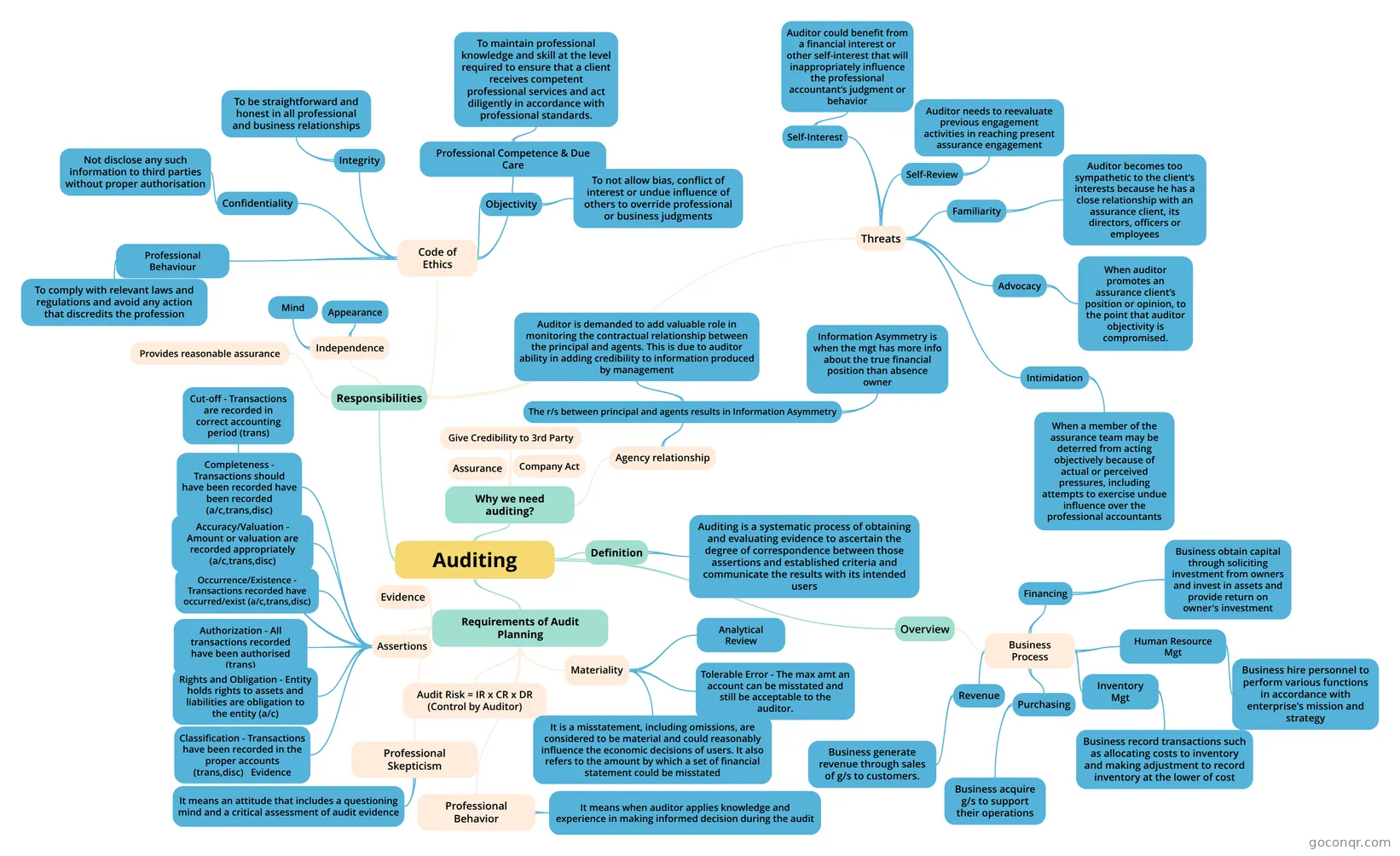
Mind map: Auditing
Contenido del mapa
Auditing
Definition
- Auditing is a systematic process of obtaining and evaluating evidence to ascertain the degree of correspondence between those assertions and established criteria and communicate the results with its intended users
Why we need auditing?
- Assurance
- Company Act
- Give Credibility to 3rd Party
- Agency relationship
- The r/s between principal and agents results in Information Asymmetry
- Auditor is demanded to add valuable role in monitoring the contractual relationship between the principal and agents. This is due to auditor ability in adding credibility to information produced by management
- Information Asymmetry is when the mgt has more info about the true financial position than absence owner
- The r/s between principal and agents results in Information Asymmetry
Requirements of Audit Planning
- Audit Risk = IR x CR x DR (Control by Auditor)
- Materiality
- It is a misstatement, including omissions, are considered to be material and could reasonably influence the economic decisions of users. It also refers to the amount by which a set of financial statement could be misstated
- Tolerable Error - The max amt an account can be misstated and still be acceptable to the auditor.
- Analytical Review
- Assertions
- Cut-off - Transactions are recorded in correct accounting period (trans)
- Completeness - Transactions should have been recorded have been recorded (a/c,trans,disc)
- Accuracy/Valuation - Amount or valuation are recorded appropriately (a/c,trans,disc)
- Occurrence/Existence - Transactions recorded have occurred/exist (a/c,trans,disc)
- Authorization - All transactions recorded have been authorised (trans)
- Rights and Obligation - Entity holds rights to assets and liabilities are obligation to the entity (a/c)
- Classification - Transactions have been recorded in the proper accounts (trans,disc) Evidence
- Evidence
- Professional Skepticism
- It means an attitude that includes a questioning mind and a critical assessment of audit evidence
- Professional Behavior
- It means when auditor applies knowledge and experience in making informed decision during the audit
Responsibilities
- Provides reasonable assurance
- Independence
- Mind
- Appearance
- Code of Ethics
- Professional Behaviour
- To comply with relevant laws and regulations and avoid any action that discredits the profession
- Confidentiality
- Not disclose any such information to third parties without proper authorisation
- Integrity
- To be straightforward and honest in all professional and business relationships
- Professional Competence & Due Care
- To maintain professional knowledge and skill at the level required to ensure that a client receives competent professional services and act diligently in accordance with professional standards.
- Objectivity
- To not allow bias, conflict of interest or undue influence of others to override professional or business judgments
- Professional Behaviour
- Threats
- Self-Interest
- Auditor could benefit from a financial interest or other self-interest that will inappropriately influence the professional accountant’s judgment or behavior
- Self-Review
- Auditor needs to reevaluate previous engagement activities in reaching present assurance engagement
- Familiarity
- Auditor becomes too sympathetic to the client’s interests because he has a close relationship with an assurance client, its directors, officers or employees
- Advocacy
- When auditor promotes an assurance client’s position or opinion, to the point that auditor objectivity is compromised.
- Intimidation
- When a member of the assurance team may be deterred from acting objectively because of actual or perceived pressures, including attempts to exercise undue influence over the professional accountants
- Self-Interest
Overview
- Business Process
- Revenue
- Business generate revenue through sales of g/s to customers.
- Purchasing
- Business acquire g/s to support their operations
- Inventory Mgt
- Business record transactions such as allocating costs to inventory and making adjustment to record inventory at the lower of cost
- Human Resource Mgt
- Business hire personnel to perform various functions in accordance with enterprise's mission and strategy
- Financing
- Business obtain capital through soliciting investment from owners and invest in assets and provide return on owner's investment
- Revenue
- Business Process