
Mapa mental
FEEDBACK WEEK #2
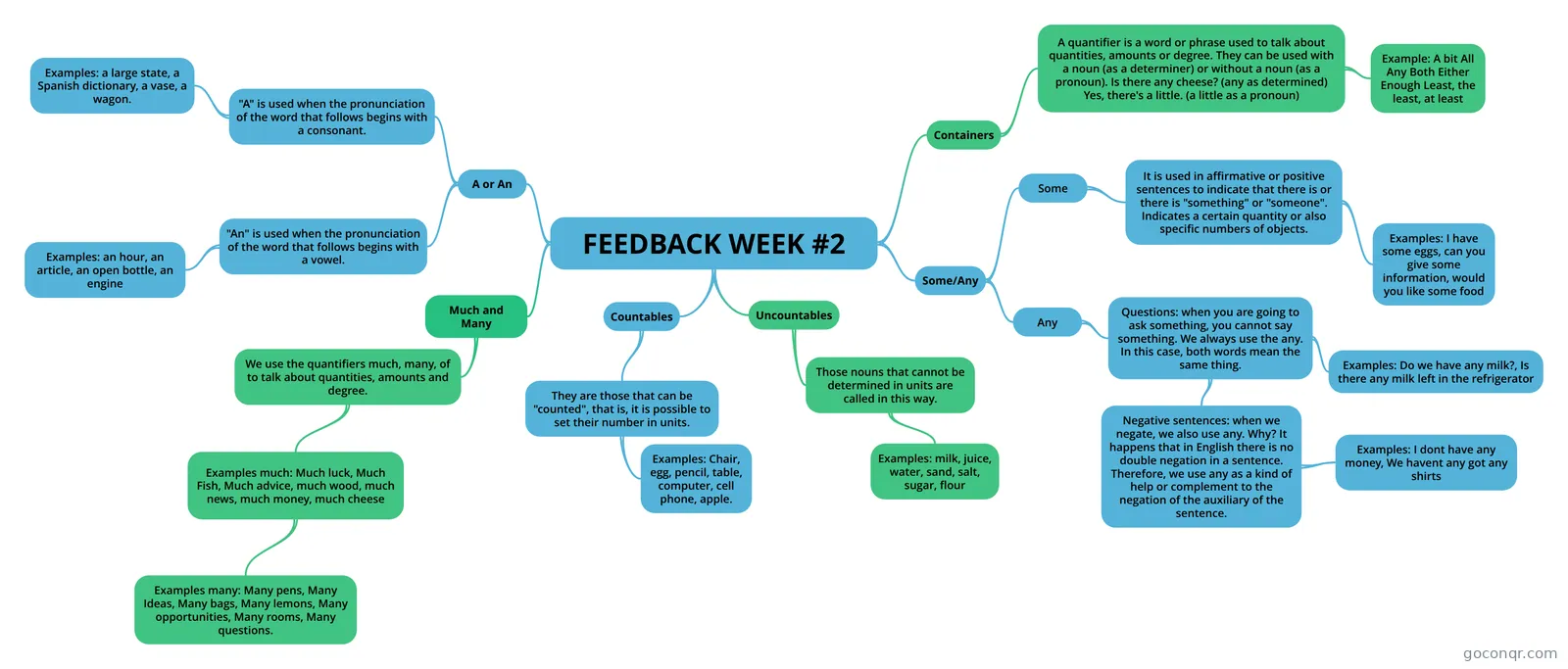
Mind map: countable and uncountable nouns
Contenido del mapa
FEEDBACK WEEK #2
Countables
- They are those that can be "counted", that is, it is possible to set their number in units.
- Examples: Chair, egg, pencil, table, computer, cell phone, apple.
- They are those that can be "counted", that is, it is possible to set their number in units.
Uncountables
- Those nouns that cannot be determined in units are called in this way.
- Examples: milk, juice, water, sand, salt, sugar, flour
- Those nouns that cannot be determined in units are called in this way.
Much and Many
- We use the quantifiers much, many, of to talk about quantities, amounts and degree.
- Examples much: Much luck, Much Fish, Much advice, much wood, much news, much money, much cheese
- Examples many: Many pens, Many Ideas, Many bags, Many lemons, Many opportunities, Many rooms, Many questions.
- Examples much: Much luck, Much Fish, Much advice, much wood, much news, much money, much cheese
- We use the quantifiers much, many, of to talk about quantities, amounts and degree.
A or An
- "A" is used when the pronunciation of the word that follows begins with a consonant.
- Examples: a large state, a Spanish dictionary, a vase, a wagon.
- "An" is used when the pronunciation of the word that follows begins with a vowel.
- Examples: an hour, an article, an open bottle, an engine
- "A" is used when the pronunciation of the word that follows begins with a consonant.
Containers
- A quantifier is a word or phrase used to talk about quantities, amounts or degree. They can be used with a noun (as a determiner) or without a noun (as a pronoun). Is there any cheese? (any as determined) Yes, there's a little. (a little as a pronoun)
- Example: A bit All Any Both Either Enough Least, the least, at least
- A quantifier is a word or phrase used to talk about quantities, amounts or degree. They can be used with a noun (as a determiner) or without a noun (as a pronoun). Is there any cheese? (any as determined) Yes, there's a little. (a little as a pronoun)
Some/Any
- Some
- It is used in affirmative or positive sentences to indicate that there is or there is "something" or "someone". Indicates a certain quantity or also specific numbers of objects.
- Examples: I have some eggs, can you give some information, would you like some food
- It is used in affirmative or positive sentences to indicate that there is or there is "something" or "someone". Indicates a certain quantity or also specific numbers of objects.
- Any
- Questions: when you are going to ask something, you cannot say something. We always use the any. In this case, both words mean the same thing.
- Negative sentences: when we negate, we also use any. Why? It happens that in English there is no double negation in a sentence. Therefore, we use any as a kind of help or complement to the negation of the auxiliary of the sentence.
- Examples: I dont have any money, We havent any got any shirts
- Examples: Do we have any milk?, Is there any milk left in the refrigerator
- Negative sentences: when we negate, we also use any. Why? It happens that in English there is no double negation in a sentence. Therefore, we use any as a kind of help or complement to the negation of the auxiliary of the sentence.
- Questions: when you are going to ask something, you cannot say something. We always use the any. In this case, both words mean the same thing.
- Some
Información
- Descripción
- Mapa Mental sobre FEEDBACK WEEK #2, creado por Stiven Aroca el 14/10/2022.
- Creado por
- Stiven Aroca
- Visitas
- 1
- Valoración
Más sobre Determiners and quantifiers