
Mapa mental
Managing people
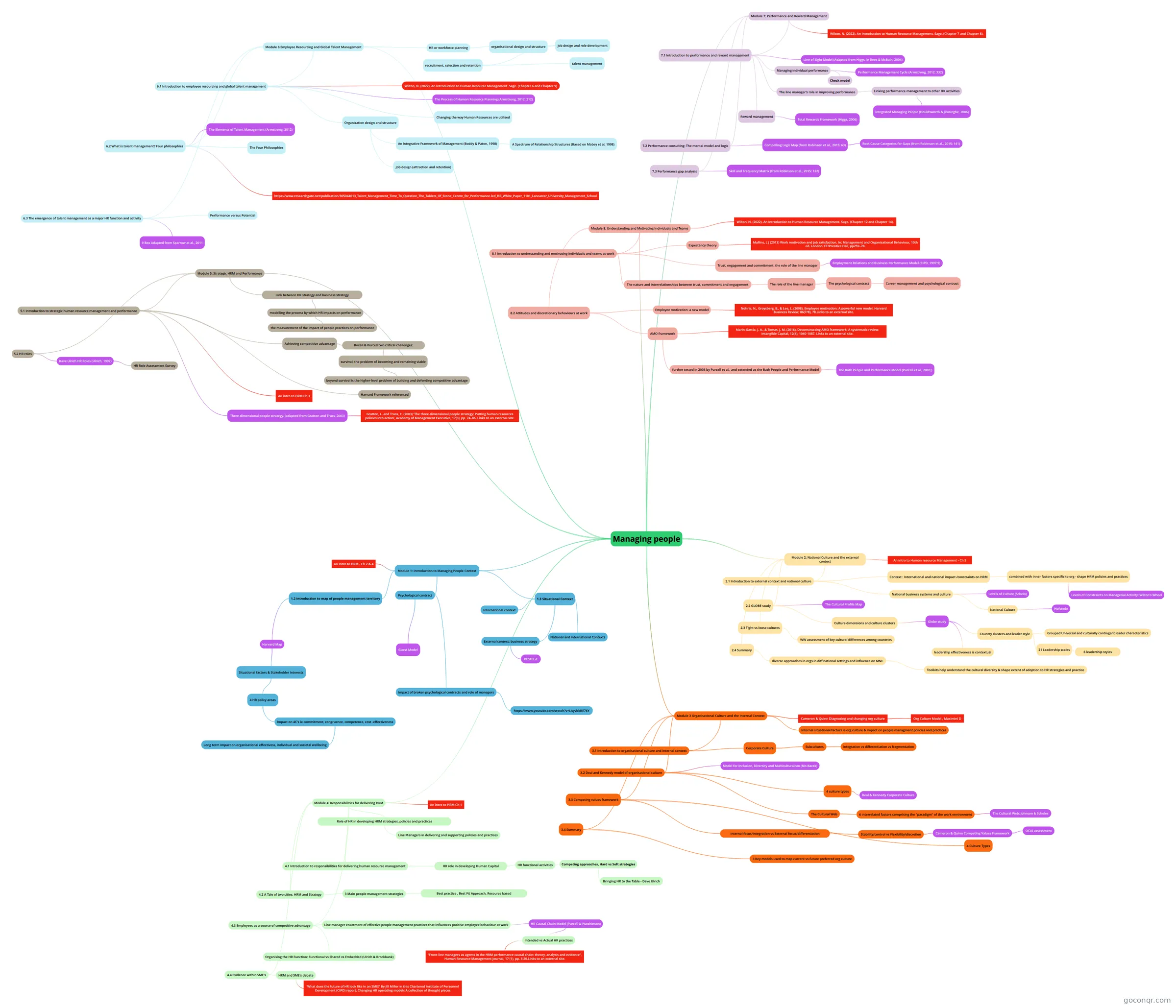
Mind map: Managing people
Contenido del mapa
Managing people
Module 1: Introduction to Managing People Context
- 1.2 Introduction to map of people management territory
- Harvard Map
- Situational factors & Stakeholder Interests
- 4 HR policy areas
- Impact on 4C's ie commitment, congruence, competence, cost -effectiveness
- Long term Impact on organisational effectivess, individual and societal wellbeing
- Impact on 4C's ie commitment, congruence, competence, cost -effectiveness
- 4 HR policy areas
- Situational factors & Stakeholder Interests
- Harvard Map
- 1.3 Situational Context
- International context
- National and international Contexts
- External context: business strategy
- PESTEL-E
- Psychological contract
- Impact of broken psychological contracts and role of managers
- https://www.youtube.com/watch?v=LAyvbkBE76Y
- Guest Model
- Impact of broken psychological contracts and role of managers
- An Intro to HRM - Ch 2 & 4
- 1.2 Introduction to map of people management territory
Module 2: National Culture and the external context
- 2.1 Introduction to external context and national culture
- Context : International and national impact /constraints on HRM
- combined with inner factors specific to org - shape HRM policies and practices
- Levels of Constraints on Managerial Activity: Wilton's Wheel
- combined with inner factors specific to org - shape HRM policies and practices
- National business systems and culture
- Levels of Culture (Schein)
- National Culture
- Hofstede
- Context : International and national impact /constraints on HRM
- 2.2 GLOBE study
- Culture dimensions and culture clusters
- Globe study
- Country clusters and leader style
- Grouped Universal and culturally contingent leader characteristics
- 21 Leadership scales
- 6 leadership styles
- leadership effectiveness is contextual
- Country clusters and leader style
- Globe study
- The Cultural Profile Map
- Culture dimensions and culture clusters
- 2.3 Tight vs loose cultures
- WW assessment of key cultural differences among countries
- 2.4 Summary
- diverse approaches in orgs in diff national settings and influence on MNC
- Toolkits help understand the cultural diversity & shape extent of adoption to HR strategies and practice
- diverse approaches in orgs in diff national settings and influence on MNC
- An intro to Human resource Management - Ch 5
- 2.1 Introduction to external context and national culture
Module 3 Organisational Culture and the Internal Context
- Internal situational factors ie org culture & impact on people managment policies and practices
- 3.1 Introduction to organisational culture and internal context
- Corporate Culture
- Subcultures
- integration vs differentiation vs fragmentation
- Subcultures
- Corporate Culture
- 3.2 Deal and Kennedy model of organisational culture
- 4 culture types
- Deal & Kennedy Corporate Culture
- The Cultural Web
- 6 interrelated factors comprising the "paradigm" of the work environment
- The Cultural Web: Johnson & Scholes
- 6 interrelated factors comprising the "paradigm" of the work environment
- Model for Inclusion, Diversity and Multiculturalism (Mo Barak)
- 4 culture types
- 3.3 Competing values framework
- Internal focus/integration vs External focus/differentiation
- Stability/control vs Flexibility/discretion
- Cameron & Quinn Competing Values Framework
- OCAI assessment
- Cameron & Quinn Competing Values Framework
- Stability/control vs Flexibility/discretion
- 4 Culture Types
- Internal focus/integration vs External focus/differentiation
- 3.4 Summary
- 3 Key models used to map current vs future preferred org culture
- Cameron & Quinn Diagnosing and changing org culture
- Org Culture Model , Maximini D
Module 4: Responsibilities for delivering HRM
- Role of HR in developing HRM strategies, policies and practices
- Line Managers in delivering and supporting policies and practices
- 4.1 Introduction to responsibilities for delivering human resource management
- HR role in developing Human Capital
- HR functional activities
- Competing approaches, Hard vs Soft strategies
- Bringing HR to the Table - Dave Ulrich
- Competing approaches, Hard vs Soft strategies
- HR functional activities
- HR role in developing Human Capital
- 4.2 A Tale of two cities: HRM and Strategy
- 3 Main people management strategies
- Best practice , Best Fit Approach, Resource based
- 3 Main people management strategies
- 4.3 Employees as a source of competitive advantage
- Line manager enactment of effective people management practices that influences positive employee behaviour at work
- HR Causal Chain Model (Purcell & Hutchinson)
- Intended vs Actual HR practices
- “Front-line managers as agents in the HRM performance causal chain: theory, analysis and evidence”, Human Resource Management Journal, 17 (1), pp. 3-20.Links to an external site.
- Intended vs Actual HR practices
- HR Causal Chain Model (Purcell & Hutchinson)
- Organising the HR Function: Functional vs Shared vs Embedded (Ulrich & Brockbank)
- Line manager enactment of effective people management practices that influences positive employee behaviour at work
- 4.4 Evidence within SME's
- HRM and SME's debate
- ‘What does the future of HR look like in an SME?’ By Jill Miller in this Chartered Institute of Personnel Development (CIPD) report, Changing HR operating models A collection of thought pieces
- HRM and SME's debate
- An intro to HRM Ch 1
- Role of HR in developing HRM strategies, policies and practices
Module 5: Strategic HRM and Performance
- Link between HR strategy and business strategy
- modelling the process by which HR impacts on performance
- the measurement of the impact of people practices on performance
- modelling the process by which HR impacts on performance
- 5.1 Introduction to strategic human resource management and performance
- An intro to HRM Ch 3
- Achieving competitive advantage
- Boxall & Purcell two critical challenges:
- survival: the problem of becoming and remaining viable
- beyond survival is the higher-level problem of building and defending competitive advantage
- survival: the problem of becoming and remaining viable
- Boxall & Purcell two critical challenges:
- Three-dimensional people strategy. (adapted from Gratton and Truss, 2003)
- Gratton, L. and Truss, C. (2003) ‘The three-dimensional people strategy: Putting human resources policies into action’, Academy of Management Executive, 17(3), pp. 74–86. Links to an external site.
- Harvard Framework referenced
- 5.2 HR roles
- Dave Ulrich HR Roles (Ulrich, 1997)
- HR Role Assessment Survey
- Dave Ulrich HR Roles (Ulrich, 1997)
- Link between HR strategy and business strategy
Module 6:Employee Resourcing and Global Talent Management
- HR or workforce planning
- organisational design and structure
- job design and role development
- recruitment, selection and retention
- talent management
- recruitment, selection and retention
- job design and role development
- organisational design and structure
- 6.1 Introduction to employee resourcing and global talent management
- Wilton, N. (2022). An Introduction to Human Resource Management. Sage. (Chapter 6 and Chapter 9)
- The Process of Human Resource Planning (Armstrong, 2012: 212)
- Changing the way Human Resources are utilised
- Organisation design and structure
- An Integrative Framework of Management (Boddy & Paton, 1998)
- A Spectrum of Relationship Structures (Based on Mabey et al, 1998)
- Job design (attraction and retention)
- An Integrative Framework of Management (Boddy & Paton, 1998)
- 6.2 What is talent management? Four philosophies
- The Elements of Talent Management (Armstrong, 2012)
- The Four Philosophies
- https://www.researchgate.net/publication/305044013_Talent_Management_Time_To_Question_The_Tablets_Of_Stone_Centre_for_Performance-led_HR_White_Paper_1101_Lancaster_University_Management_School
- 6.3 The emergence of talent management as a major HR function and activity
- 9 Box Adapted from Sparrow at al., 2011
- Performance versus Potential
- HR or workforce planning
Module 7: Performance and Reward Management
- 7.1 Introduction to performance and reward management
- Line of Sight Model (Adapted from Higgs, in Rees & McBain, 2004)
- Managing individual performance
- Performance Management Cycle (Armstrong, 2012: 332)
- Check model
- The line manager’s role in improving performance
- Linking performance management to other HR activities
- Integrated Managing People (Houldsworth & Jirasinghe, 2006)
- Linking performance management to other HR activities
- Reward management
- Total Rewards Framework (Higgs, 2006)
- Wilton, N. (2022). An Introduction to Human Resource Management. Sage. (Chapter 7 and Chapter 8).
- 7.2 Performance consulting: The mental model and logic
- Compelling Logic Map (from Robinson et al., 2015: 63)
- Root Cause Categories for Gaps (from Robinson et al., 2015: 141)
- Compelling Logic Map (from Robinson et al., 2015: 63)
- 7.3 Performance gap analysis
- Skill and Frequency Matrix (from Robinson et al., 2015: 122)
- 7.1 Introduction to performance and reward management
Module 8: Understanding and Motivating Individuals and Teams
- 8.1 Introduction to understanding and motivating individuals and teams at work
- Expectancy theory
- Mullins, L J (2013) Work motivation and job satisfaction. In: Management and Organisational Behaviour, 10th ed. London: FT/Prentice Hall, pp259–78.
- Trust, engagement and commitment: the role of the line manager
- Employment Relations and Business Performance Model (CIPD, 1997:5)
- The nature and interrelationships between trust, commitment and engagement
- The role of the line manager
- The psychological contract
- Career management and psychological contract
- The psychological contract
- The role of the line manager
- Expectancy theory
- Wilton, N. (2022). An Introduction to Human Resource Management. Sage. (Chapter 12 and Chapter 14).
- 8.2 Attitudes and discretionary behaviours at work
- Employee motivation: a new model
- Nohria, N., Groysberg, B., & Lee, L. (2008). Employee motivation: A powerful new model. Harvard Business Review, 86(7/8), 78.Links to an external site.
- AMO framework
- Marin-Garcia, J. A., & Tomas, J. M. (2016). Deconstructing AMO framework: A systematic review. Intangible Capital, 12(4), 1040-1087. Links to an external site.
- further tested in 2003 by Purcell et al., and extended as the Bath People and Performance Model
- The Bath People and Performance Model (Purcell et al., 2003,)
- Employee motivation: a new model
- 8.1 Introduction to understanding and motivating individuals and teams at work
Información
- Descripción
- Mapa Mental sobre Managing people, creado por Marilyn van der Kooij el 28/10/2024.
- Creado por
- Marilyn van der Kooij
- Visitas
- 13
- Valoración