
Mapa mental
lecture 1 - ageing mindmap
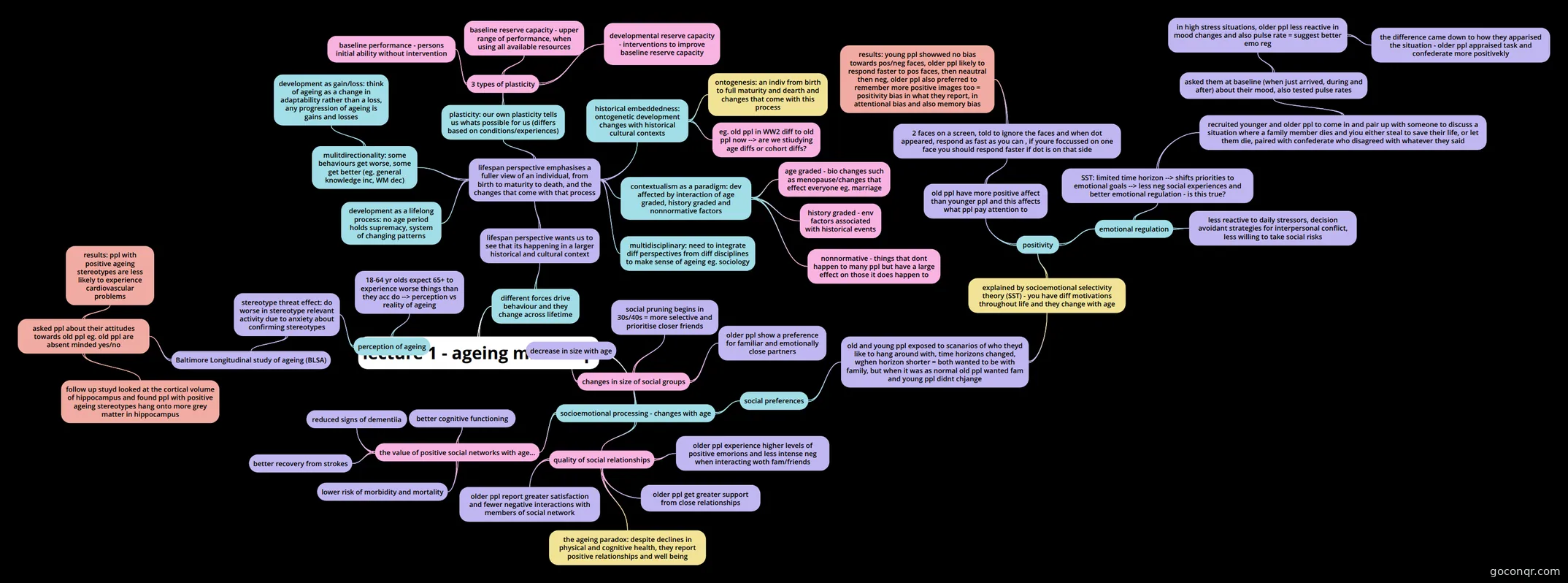
Mind map: Ageing
Contenido del mapa
lecture 1 - ageing mindmap
perception of ageing
- 18-64 yr olds expect 65+ to experience worse things than they acc do --> perception vs reality of ageing
- stereotype threat effect: do worse in stereotype relevant activity due to anxiety about confirming stereotypes
- Baltimore Longitudinal study of ageing (BLSA)
- asked ppl about their attitudes towards old ppl eg. old ppl are absent minded yes/no
- results: ppl with positive ageing stereotypes are less likely to experience cardiovascular problems
- follow up stuyd looked at the cortical volume of hippocampus and found ppl with positive ageing stereotypes hang onto more grey matter in hippocampus
- asked ppl about their attitudes towards old ppl eg. old ppl are absent minded yes/no
- Baltimore Longitudinal study of ageing (BLSA)
different forces drive behaviour and they change across lifetime
- lifespan perspective wants us to see that its happening in a larger historical and cultural context
- lifespan perspective emphasises a fuller view of an individual, from birth to maturity to death, and the changes that come with that process
- development as a lifelong process: no age period holds supremacy, system of changing patterns
- mulitdirectionality: some behaviours get worse, some get better (eg. general knowledge inc, WM dec)
- development as gain/loss: think of ageing as a change in adaptability rather than a loss, any progression of ageing is gains and losses
- plasticity: our own plasticity tells us whats possible for us (differs based on conditions/experiences)
- 3 types of plasticity
- baseline performance - persons initial ability without intervention
- baseline reserve capacity - upper range of performance, when using all available resources
- developmental reserve capacity - interventions to improve baseline reserve capacity
- 3 types of plasticity
- historical embeddedness: ontogenetic development changes with historical cultural contexts
- ontogenesis: an indiv from birth to full maturity and dearth and changes that come with this process
- eg. old ppl in WW2 diff to old ppl now --> are we stiudying age diffs or cohort diffs?
- contextualism as a paradigm: dev affected by interaction of age graded, history graded and nonnormative factors
- age graded - bio changes such as menopause/changes that effect everyone eg. marriage
- history graded - env factors associated with historical events
- nonnormative - things that dont happen to many ppl but have a large effect on those it does happen to
- multidisciplinary: need to integrate diff perspectives from diff disciplines to make sense of ageing eg. sociology
- lifespan perspective emphasises a fuller view of an individual, from birth to maturity to death, and the changes that come with that process
- lifespan perspective wants us to see that its happening in a larger historical and cultural context
socioemotional processing - changes with age
- changes in size of social groups
- decrease in size with age
- social pruning begins in 30s/40s = more selective and prioritise closer friends
- older ppl show a preference for familiar and emotionally close partners
- the value of positive social networks with age...
- better cognitive functioning
- reduced signs of dementiia
- better recovery from strokes
- lower risk of morbidity and mortality
- quality of social relationships
- older ppl experience higher levels of positive emorions and less intense neg when interacting woth fam/friends
- older ppl get greater support from close relationships
- older ppl report greater satisfaction and fewer negative interactions with members of social network
- the ageing paradox: despite declines in physical and cognitive health, they report positive relationships and well being
- social preferences
- old and young ppl exposed to scanarios of who theyd like to hang around with, time horizons changed, wghen horizon shorter = both wanted to be with family, but when it was as normal old ppl wanted fam and young ppl didnt chjange
- explained by socioemotional selectivity theory (SST) - you have diff motivations throughout life and they change with age
- positivity
- old ppl have more positive affect than younger ppl and this affects what ppl pay attention to
- 2 faces on a screen, told to ignore the faces and when dot appeared, respond as fast as you can , if youre foccussed on one face you should respond faster if dot is on that side
- results: young ppl showwed no bias towards pos/neg faces, older ppl likely to respond faster to pos faces, then neautral then neg, older ppl also preferred to remember more positive images too = positivity bias in what they report, in attentional bias and also memory bias
- 2 faces on a screen, told to ignore the faces and when dot appeared, respond as fast as you can , if youre foccussed on one face you should respond faster if dot is on that side
- emotional regulation
- SST: limited time horizon --> shifts priorities to emotional goals --> less neg social experiences and better emotional regulation - is this true?
- recruited younger and older ppl to come in and pair up with someone to discuss a situation where a family member dies and yiou either steal to save their life, or let them die, paired with confederate who disagreed with whatever they said
- asked them at baseline (when just arrived, during and after) about their mood, also tested pulse rates
- in high stress situations, older ppl less reactive in mood changes and also pulse rate = suggest better emo reg
- the difference came down to how they apparised the situation - older ppl appraised task and confederate more positivekly
- in high stress situations, older ppl less reactive in mood changes and also pulse rate = suggest better emo reg
- asked them at baseline (when just arrived, during and after) about their mood, also tested pulse rates
- recruited younger and older ppl to come in and pair up with someone to discuss a situation where a family member dies and yiou either steal to save their life, or let them die, paired with confederate who disagreed with whatever they said
- less reactive to daily stressors, decision avoidant strategies for interpersonal conflict, less willing to take social risks
- SST: limited time horizon --> shifts priorities to emotional goals --> less neg social experiences and better emotional regulation - is this true?
- old ppl have more positive affect than younger ppl and this affects what ppl pay attention to
- positivity
- explained by socioemotional selectivity theory (SST) - you have diff motivations throughout life and they change with age
- old and young ppl exposed to scanarios of who theyd like to hang around with, time horizons changed, wghen horizon shorter = both wanted to be with family, but when it was as normal old ppl wanted fam and young ppl didnt chjange
- changes in size of social groups
Información
- Descripción
- uni Y2 S1 dev Y2 S1 Mapa Mental sobre lecture 1 - ageing mindmap, creado por Jessica Edmiston el 19/12/2024.
- Creado por
- Jessica Edmiston
- Visitas
- 1
- Valoración