
Mapa mental
Dalai Lama
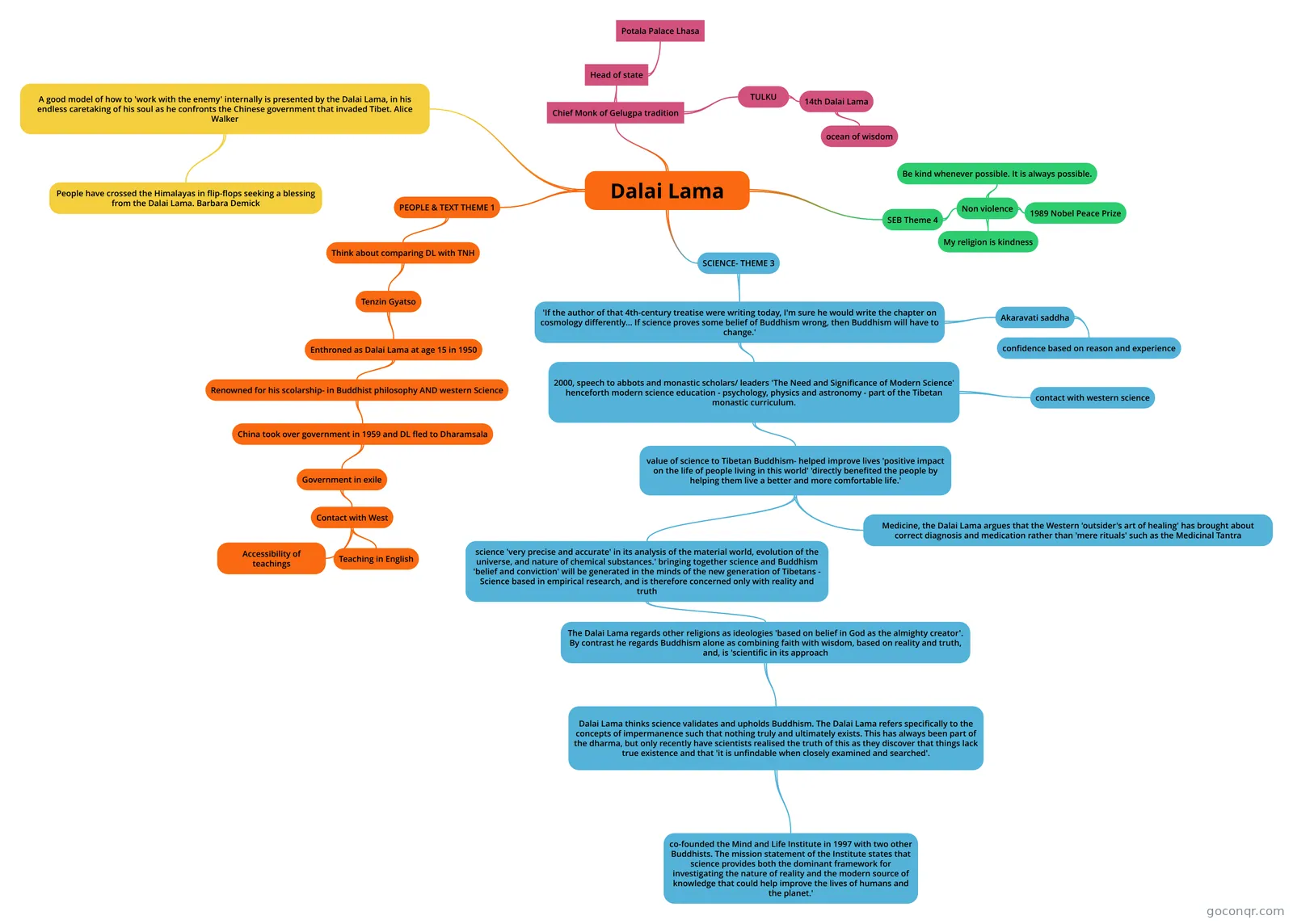
Mind map: Dalai Lama
Contenido del mapa
Dalai Lama
SCIENCE- THEME 3
- 'If the author of that 4th-century treatise were writing today, I'm sure he would write the chapter on cosmology differently... If science proves some belief of Buddhism wrong, then Buddhism will have to change.'
- 2000, speech to abbots and monastic scholars/ leaders 'The Need and Significance of Modern Science' henceforth modern science education - psychology, physics and astronomy - part of the Tibetan monastic curriculum.
- value of science to Tibetan Buddhism- helped improve lives 'positive impact on the life of people living in this world' 'directly benefited the people by helping them live a better and more comfortable life.'
- science 'very precise and accurate' in its analysis of the material world, evolution of the universe, and nature of chemical substances.' bringing together science and Buddhism 'belief and conviction' will be generated in the minds of the new generation of Tibetans - Science based in empirical research, and is therefore concerned only with reality and truth
- The Dalai Lama regards other religions as ideologies 'based on belief in God as the almighty creator'. By contrast he regards Buddhism alone as combining faith with wisdom, based on reality and truth, and, is 'scientific in its approach
- Dalai Lama thinks science validates and upholds Buddhism. The Dalai Lama refers specifically to the concepts of impermanence such that nothing truly and ultimately exists. This has always been part of the dharma, but only recently have scientists realised the truth of this as they discover that things lack true existence and that 'it is unfindable when closely examined and searched'.
- co-founded the Mind and Life Institute in 1997 with two other Buddhists. The mission statement of the Institute states that science provides both the dominant framework for investigating the nature of reality and the modern source of knowledge that could help improve the lives of humans and the planet.'
- Dalai Lama thinks science validates and upholds Buddhism. The Dalai Lama refers specifically to the concepts of impermanence such that nothing truly and ultimately exists. This has always been part of the dharma, but only recently have scientists realised the truth of this as they discover that things lack true existence and that 'it is unfindable when closely examined and searched'.
- The Dalai Lama regards other religions as ideologies 'based on belief in God as the almighty creator'. By contrast he regards Buddhism alone as combining faith with wisdom, based on reality and truth, and, is 'scientific in its approach
- Medicine, the Dalai Lama argues that the Western 'outsider's art of healing' has brought about correct diagnosis and medication rather than 'mere rituals' such as the Medicinal Tantra
- science 'very precise and accurate' in its analysis of the material world, evolution of the universe, and nature of chemical substances.' bringing together science and Buddhism 'belief and conviction' will be generated in the minds of the new generation of Tibetans - Science based in empirical research, and is therefore concerned only with reality and truth
- contact with western science
- value of science to Tibetan Buddhism- helped improve lives 'positive impact on the life of people living in this world' 'directly benefited the people by helping them live a better and more comfortable life.'
- Akaravati saddha
- confidence based on reason and experience
- 2000, speech to abbots and monastic scholars/ leaders 'The Need and Significance of Modern Science' henceforth modern science education - psychology, physics and astronomy - part of the Tibetan monastic curriculum.
- 'If the author of that 4th-century treatise were writing today, I'm sure he would write the chapter on cosmology differently... If science proves some belief of Buddhism wrong, then Buddhism will have to change.'
PEOPLE & TEXT THEME 1
- Think about comparing DL with TNH
- Tenzin Gyatso
- Enthroned as Dalai Lama at age 15 in 1950
- Renowned for his scolarship- in Buddhist philosophy AND western Science
- China took over government in 1959 and DL fled to Dharamsala
- Government in exile
- Contact with West
- Teaching in English
- Accessibility of teachings
- Contact with West
- Government in exile
- China took over government in 1959 and DL fled to Dharamsala
- Renowned for his scolarship- in Buddhist philosophy AND western Science
- Enthroned as Dalai Lama at age 15 in 1950
- Tenzin Gyatso
- Think about comparing DL with TNH
Chief Monk of Gelugpa tradition
- TULKU
- 14th Dalai Lama
- ocean of wisdom
- 14th Dalai Lama
- Head of state
- Potala Palace Lhasa
- TULKU
SEB Theme 4
- Non violence
- My religion is kindness
- Be kind whenever possible. It is always possible.
- 1989 Nobel Peace Prize
- Non violence
A good model of how to 'work with the enemy' internally is presented by the Dalai Lama, in his endless caretaking of his soul as he confronts the Chinese government that invaded Tibet. Alice Walker
- People have crossed the Himalayas in flip-flops seeking a blessing from the Dalai Lama. Barbara Demick
Información
- Descripción
- Mapa Mental sobre Dalai Lama, creado por Nick Purches-Knab el 08/09/2026.
- Creado por
- Nick Purches-Knab
- Visitas
- 1
- Valoración
Más sobre Compatibility of Faith and Science