
Mapa mental
In the Classroom
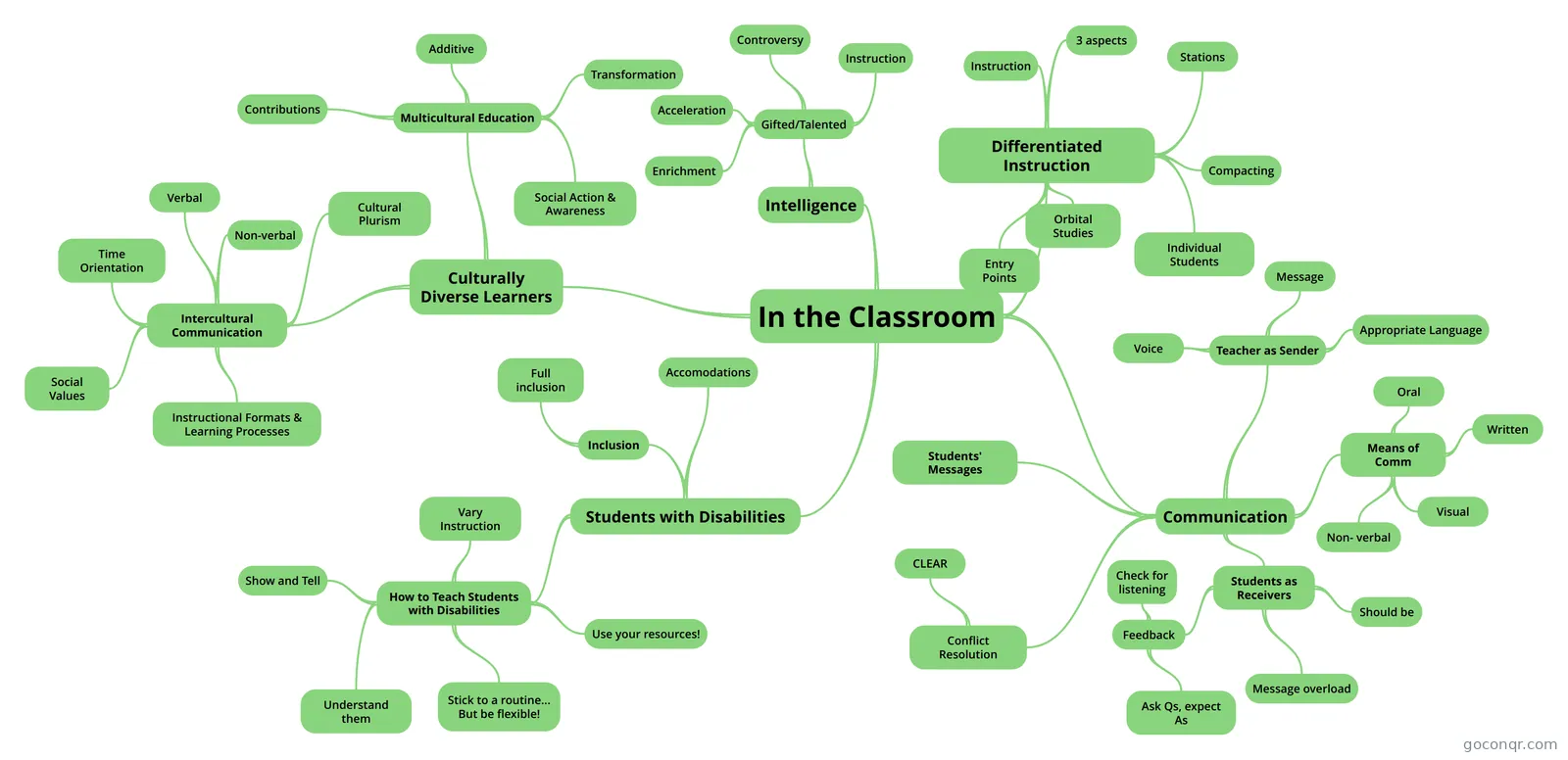
Mind map: In the classroom
Contenido del mapa
In the Classroom
Culturally Diverse Learners
- Intercultural Communication
- 5 aspects of culture that present the potential for misunderstanding
- Verbal
- Connotations - meanings beyond dictionary definition e.g. derogatory remark from AA to AA may not be offensive as if from white student e.g. "Good-work" might have +ve or -ve connotations for different students
- Discourse patterns - styles of talking can be direct or circuitous Classroom discourse usually quite direct - can be jarring to children unaccustomed
- Topics Different ideas of what is appropriate or respectful
- Non-verbal
- includes gestures, facial expressions, postures, pauses and silences - many sociolinguists believe we communicate more non-verbally than verbally
- Personal & Physical Space Americans like personal space and generally remain 2-3ft from partner in conversation. Non-Americans do not and can make Americans feel uncomfortable This can translate into physical space in the classroom with some students more willing to share desks/cubbies etc
- Physical Contact Goes along with proximity Americans tend to shun but more accepted in other cultures e.g. in S. American or Middle-Eastern cities heterosexual males often hold hands Non-American students may find physical contact with the teacher appropriate
- Eye contact Common Perception that is allows assessment of validity. In American culture is important part of honest, open com. In many non-Western however it is a sign of disrespect
- Gestures Can change dramatically e.g. "come here" beckoning with 1 finger and palm up can be insulting in many Asian/ Middle-Eastern countries e.g. OK in USA can be an obscenity in other places or worthlessness "0" in others Never assume students understand non-verbal gestures - spend time at beginning of year to introduce students and change any that seem surprising/troubling
- Time Orientation
- Americans take particular interest in time-keeping Non-American students may not understand -ve reaction to tardiness or slowness on classroom activities Should make sure all students know expectations
- Social Values
- American cultures tends to specifically value individualism and competition rather than cooperation and collaboration Some Native American. Asian and African cultures taught loyalty is more important than individual gain Many Asian cultures encourage students to work together so may not understand punishment for copying etc
- Instructional Formats & Learning Processes
- Most common instructional approach is teacher-directed large-group lessons Cultural differences as discussed can be an area for confusion for students of other cultures e.g. many not be used to manipulatives in maths/ may be shocked to 'watch TV in school' when watching video's
- Must perform a balancing act - Should clearly explain expectations for behavior and performance but should also be willing to make allowances for differences that do not compromise students' academic performance or the stability of the classroom (e.g. eye-contact)
- Cultural Plurism
- Calls for understanding and appreciation of different cultures. Aims for sense of society's wholeness based on the unique strengths of each of its parts Rejects assimilation and separatism
- Multicultural Education
- Many proponents believe that the dominant model of schools in US is biased to favor students from white, middle-class upbringing
- Gap in achievement between white students and those of color remains despite advances of AA and Hispanic Approx 50% AA, NA and Hispanic students graduate high school (75-80% white & Asian Americans) AfAms are under-represented in enrichment programs and over-represented in special ed AfAms nearly 3x more likely than whites to be suspended or expelled
- Little research on effects of MCE but some has reported improved self-image, +ve racial attitudes, and increased academic acheivement
- Criticisms include It may undermine a sense of common traditions, values, purposes in our country It may divert schools from focussing on basic purposes and core curriculum It encourages self-esteem rather than hard-work in minority students Can create reverse discrimination and lead to greater misunderstanding among social groups Some simply believe that assimilation is preferable
- Contributions
- Add-on approach - students celebrate contributions of culturally different groups/ind Most activities and curriculum are unchanged e.g. Black History Month
- Additive
- Teacher adds units of study on nondominant groups to the basic curriculum (e.g. role of AfAm soldiers in WWs) Although this adds content beyond dominant culture, this approach remains a supplemental one
- Transformation
- Requires a change in the curriculum to weave in new content and perspectives e.g. in Mexican-American War teacher would incorporate Mexican perspectives such as resentment over loss of land to USA
- Social Action & Awareness
- Educator seeks to bring about significant long-term change not just to school env. but to greater society. Social issues are addressed directly through the curriculum e.g. racism, sexism, classism
- Intercultural Communication
Students with Disabilities
- Accomodations
- Adapting regular activities so that students with disabilities can benefit to the same extent from educational programs. May include: Adaptive equipment in athletics Special seating arrangment Hiring or working with signers Adaptive technology - e-readers Creating a distraction free work area
- Inclusion
- Advocates say that taking students out of class for special ed led to segregation and led to even lower academic achievement and social skills. Also can benefit regular children who gain greater understanding of disabilities
- Opponents argue that needs of students are compromised and there are little social development gains to compensate. Argue that services are less effective due to classroom distractions They argue that stigma persists as students are stills seen receiving assistance
- Full inclusion
- Some inclusion classrooms combine pull-out services but some practise full-inclusion - students receive all services in the classroom
- How to Teach Students with Disabilities
- Understand them
- Do not stereotype students but instead get the know their individual strengths and limitations
- Vary Instruction
- use hands on activities, cooperative learning strategies and peer mentoring, find a way for students to succeed Pairing students can be beneficial for those with or without disabilities
- Use your resources!
- Consult the special education teacher, co-teach when possible speak to more experiences staff members. Educate yourself with researchINSIST services are provided - ITS THE LAW
- Show and Tell
- Try and make all lessons and instructions accessible by 2 different senses at least
- Stick to a routine... But be flexible!
- All students benefit from routings but especially those with disabilities Can help them develop organizational skills and provides security in the classroom
- However... You may need to change or make exceptions to classroom policies to accommodate students with disabilities e.g. no-calculator policy/pair work policy Be prepared to explain or defend this 'unfairness' to other students
- Understand them
- Accomodations
Differentiated Instruction
- Teaching philosophy based on idea that teachers should adapt to student differences in reading readiness, learning preferences and interests rather than imposing a standardized approach
- Instruction
- students are all expected to master the same concepts but have choices among learning activities There is no single way to address student differences - simply a commitment to start with students and match the learner and the material to be learned
- Primary goal is to maximize learning of each student Secondary goal is to give students training in ways of thinking that don't come naturally - stretches students and increases their capacity to grow and learn
- Balancing act - need to develop routine of predictable activities that incorporate different learning styles and intelligences Should also strike a balance between playing to students' strengths and stretching them into new, important ways of learning
- 3 aspects
- 3 aspects of curriculum that teachers can differentiate Content, Process, Products
- Content is made up of the concepts, principles and skills that students should learn. All students should have same core content but teachers can provide different means of access to skills and knowledge e.g. texts, lectures, demonstration
- Process - activities that help students make sense of and 'own' the knowledge being taught. Can be varied to provide some students access to more complexity and others more support, some may work in groups and some alone
- Products - the projects students develop to demonstrate the extent of their learning. Can vary depending on students' interests and learning styles e.g. group creating a play or an individual term paper
- Stations
- Different spots set up in the classroom for students to work on different tasks pertaining to the same topic at the same time Allows for flexibility - not all students have to go to all the stations all the time
- Compacting
- Assessing students before beginning a unit of study to see what they already know so they won't have to waste time or be overwhelmed
- Entry Points
- Using MI theory, students explore a topic through up to 5 avenues Narrational (presenting a story) Logical-Quantitative (using numbers or deduction) Foundational (examining philosophy and vocabulary) Aesthetic (focusing on sensory properties) Experiential (hands on)
- Orbital Studies
- Consists of independent investigations, usually lasting several weeks. Students select topics related to the curriculum and teacher guides them through an investigation tailored to individual learning styles
- Individual Students
- May need help developing techniques using their individual learning styles - may have been discouraged in the past e.g. told not to draw pictures, or made to take notes rather than just listen
Intelligence
- Intelligence goes beyond traditional IQ Lessons should address all kinds of intelligences to help students develop them and also give students who excel in other areas the chance to experience success Using students' individual intelligences can help them master material e.g. kinesthetic, musical
- Gifted/Talented
- GIFTED - exceptional intellectual ability TALENTED - may excel in another ability e.g. music Some students may be both Need to be thought of as much as much as struggling students - students not challenged may become bored/unmotivated and are even more likely to drop out Gifted students are not protected by federal legislature so schools are not required by law to have a program for them
- Possible approaches Separate classrooms or even schools in districts with enough children Students grouped away from regular class for some of the day/week Tailored one-on-one instruction in area of greatest strength
- Acceleration
- Students cover more material and more advanced material than classmates
- Enrichment
- Students have opportunity to explore curricular topics in more depth or to engage in independent enquiry on a topic that interests them
- Controversy
- Criteria for identification as gifted/talented has been accused of being biased against bilingual and minority students - they are under-represented Opposition to programs often claims that they are classist/elitist and cater to students that are already advantaged over other students
- Instruction
- Each one is different - again take time to get to know. Most are very curious - anticipate their questions and don't get frustrated - have resources for them to use Don't assume that because they learn quickly they can learn effectively and efficiently - may still need guidance in developing skills for self directed learning May be perfectionists and become easily frustrated - need to be taught that mistakes are a natural part of life and lead to new knowledge
Communication
- Source (sender) Message Channel Receiver
- Teacher as Sender
- Voice
- Project your voice - don't shout If students are loud - lower your voice Pitch should be medium - easier to hear
- Message
- Clarity is important - don't assume students will understand you - think about misunderstandings
- Appropriate Language
- Formality - you are modelling sophisticated speech - no slang or incorrect grammar - also conveys authority - how will you address students how will they address you? - NO FILLER WORDS!
- Age-appropriateness - use words that are not insulting but not overly complex - take time to get this right and err on side of simplicity
- Neutral vocab - don't offend anyone because of religion, ethnic identity, sexual orientation, politics or cultural background - be gender neutral in language e.g. you guys
- Voice
- Means of Comm
- Oral
- requires good listening skills and adequate auditory memory - students must hear and internalize message and retain
- Written
- Greater permanency, less memory demands but requires adequate reading skills to decode
- Visual
- Pictures, symbols, graphs - offers permanence but doesn't require reading BUT high potential for misunderstanding as message can be ambiguous so use in conjunction with other means or explain symbols you might use in your classroom
- Non- verbal
- Can be very effective but again open to interpretation - be aware of non-verbal messages you might be sending and explain gestures you might use in c.room
- Oral
- Students as Receivers
- Should be
- For students to be receivers of instruction, should be ready, able and willing
- Ready - minimize or eliminate competing messages and distractions Able - students are able to understand Willing - students are convinced message is important/interesting - make them believe this
- Message overload
- Students inundated with messages on daily basis - may experience sensory overload - many have learned to filter messages and yours may not be going in!
- Remove distractions and help students improve listening skills - help improve attentional stamina
- Feedback
- Important to confirm message has been delivered and understood
- Check for listening
- Don't assume students are good listeners - look for signs of active listening - eye contact, nodding,
- Ask Qs, expect As
- Maintain communication protocol - call on students if necessary - establish practise of students answering questions not you!
- Should be
- Students' Messages
- Listen to students and pay attention to non-verbal cues - don't take everything they say at face value - work out what they really mean e.g. Math is stupid, it's a waste of time - is student struggling or overwhelmed?
- Conflict Resolution
- CLEAR
- Check your own attitude - maintain calm and even temper - be objective and analytical
- Lower the stress levels - encourage those involved to breath, lower voices, sit down etc
- Establish ground rules - develop process for discussing and resolving that is fair and appears fair to all parties
- Restate and Rephrase - help parties understand eachother
- Suggest solutions - Propose resolutions and ask parties if they are willing to accept - if compromise is reached have parties restate what they have committed to
- CLEAR
Información
- Descripción
- Mapa Mental sobre In the Classroom, creado por Erica Miller el 02/12/2015.
- Creado por
- Erica Miller
- Visitas
- 4
- Valoración