
Mapa mental
Question 14 (1)
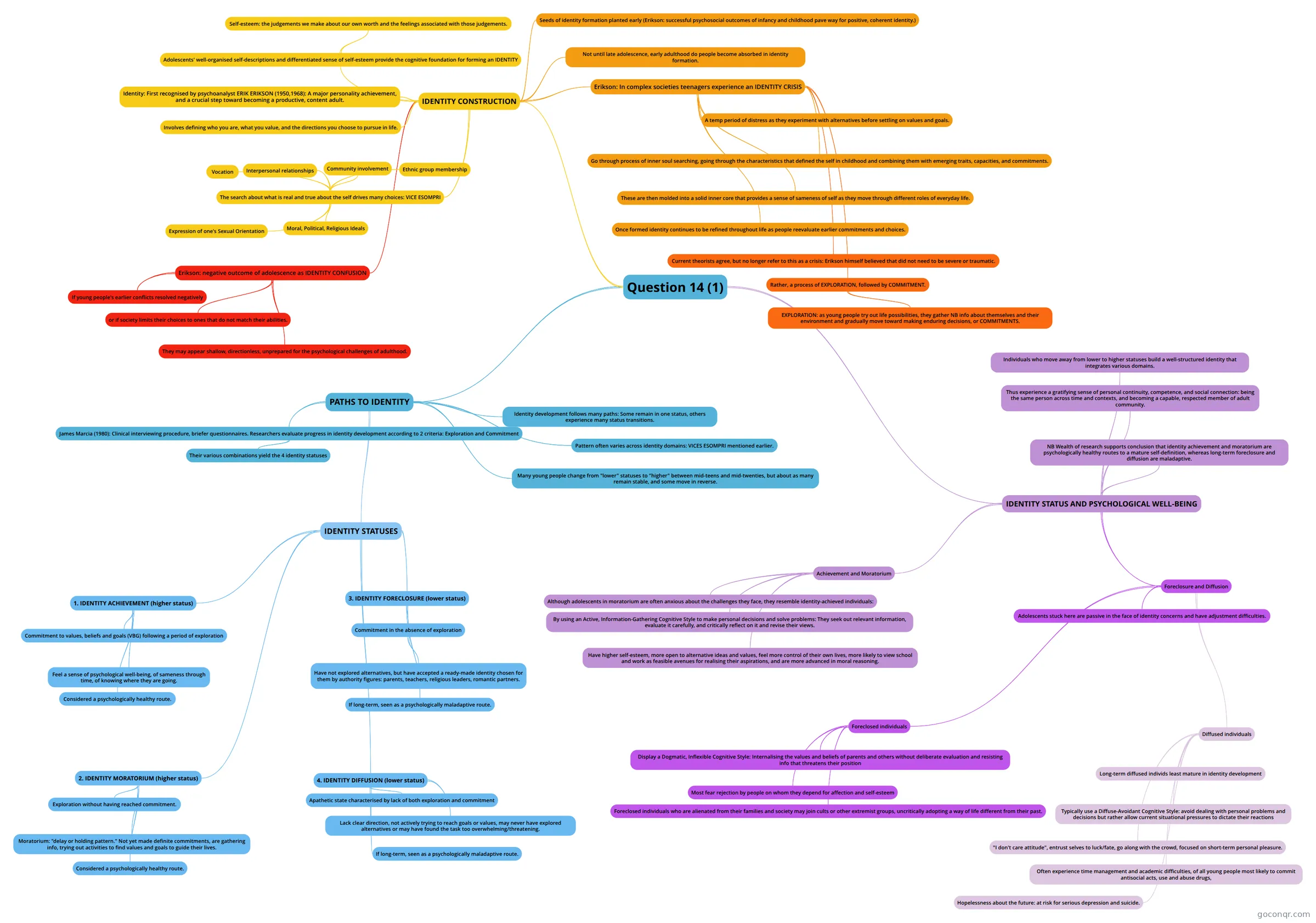
Mind map: Identity construction
Contenido del mapa
Question 14 (1)
IDENTITY CONSTRUCTION
- Adolescents' well-organised self-descriptions and differentiated sense of self-esteem provide the cognitive foundation for forming an IDENTITY
- Self-esteem: the judgements we make about our own worth and the feelings associated with those judgements.
- Identity: First recognised by psychoanalyst ERIK ERIKSON (1950,1968): A major personality achievement, and a crucial step toward becoming a productive, content adult.
- Involves defining who you are, what you value, and the directions you choose to pursue in life.
- The search about what is real and true about the self drives many choices: VICE ESOMPRI
- Vocation
- Interpersonal relationships
- Community involvement
- Ethnic group membership
- Expression of one's Sexual Orientation
- Moral, Political, Religious Ideals
- Seeds of identity formation planted early (Erikson: successful psychosocial outcomes of infancy and childhood pave way for positive, coherent identity.)
- Not until late adolescence, early adulthood do people become absorbed in identity formation.
- Erikson: In complex societies teenagers experience an IDENTITY CRISIS
- A temp period of distress as they experiment with alternatives before settling on values and goals.
- Go through process of inner soul searching, going through the characteristics that defined the self in childhood and combining them with emerging traits, capacities, and commitments.
- These are then molded into a solid inner core that provides a sense of sameness of self as they move through different roles of everyday life.
- Once formed identity continues to be refined throughout life as people reevaluate earlier commitments and choices.
- Current theorists agree, but no longer refer to this as a crisis: Erikson himself believed that did not need to be severe or traumatic.
- Rather, a process of EXPLORATION, followed by COMMITMENT.
- EXPLORATION: as young people try out life possibilities, they gather NB info about themselves and their environment and gradually move toward making enduring decisions, or COMMITMENTS.
- Erikson: negative outcome of adolescence as IDENTITY CONFUSION
- If young people's earlier conflicts resolved negatively
- or if society limits their choices to ones that do not match their abilities.
- They may appear shallow, directionless, unprepared for the psychological challenges of adulthood.
- Adolescents' well-organised self-descriptions and differentiated sense of self-esteem provide the cognitive foundation for forming an IDENTITY
PATHS TO IDENTITY
- James Marcia (1980): Clinical interviewing procedure, briefer questionnaires. Researchers evaluate progress in identity development according to 2 criteria: Exploration and Commitment
- Their various combinations yield the 4 identity statuses
- IDENTITY STATUSES
- 1. IDENTITY ACHIEVEMENT (higher status)
- Commitment to values, beliefs and goals (VBG) following a period of exploration
- Feel a sense of psychological well-being, of sameness through time, of knowing where they are going.
- Considered a psychologically healthy route.
- 2. IDENTITY MORATORIUM (higher status)
- Exploration without having reached commitment.
- Moratorium: "delay or holding pattern." Not yet made definite commitments, are gathering info, trying out activities to find values and goals to guide their lives.
- Considered a psychologically healthy route.
- 4. IDENTITY DIFFUSION (lower status)
- Apathetic state characterised by lack of both exploration and commitment
- Lack clear direction, not actively trying to reach goals or values, may never have explored alternatives or may have found the task too overwhelming/threatening.
- If long-term, seen as a psychologically maladaptive route.
- 3. IDENTITY FORECLOSURE (lower status)
- Commitment in the absence of exploration
- Have not explored alternatives, but have accepted a ready-made identity chosen for them by authority figures: parents, teachers, religious leaders, romantic partners.
- If long-term, seen as a psychologically maladaptive route.
- Commitment in the absence of exploration
- 1. IDENTITY ACHIEVEMENT (higher status)
- Identity development follows many paths: Some remain in one status, others experience many status transitions.
- Pattern often varies across identity domains: VICES ESOMPRI mentioned earlier.
- Many young people change from "lower" statuses to "higher" between mid-teens and mid-twenties, but about as many remain stable, and some move in reverse.
- James Marcia (1980): Clinical interviewing procedure, briefer questionnaires. Researchers evaluate progress in identity development according to 2 criteria: Exploration and Commitment
IDENTITY STATUS AND PSYCHOLOGICAL WELL-BEING
- Individuals who move away from lower to higher statuses build a well-structured identity that integrates various domains.
- Thus experience a gratifying sense of personal continuity, competence, and social connection: being the same person across time and contexts, and becoming a capable, respected member of adult community.
- NB Wealth of research supports conclusion that identity achievement and moratorium are psychologically healthy routes to a mature self-definition, whereas long-term foreclosure and diffusion are maladaptive.
- Achievement and Moratorium
- Although adolescents in moratorium are often anxious about the challenges they face, they resemble identity-achieved individuals:
- By using an Active, Information-Gathering Cognitive Style to make personal decisions and solve problems: They seek out relevant information, evaluate it carefully, and critically reflect on it and revise their views.
- Have higher self-esteem, more open to alternative ideas and values, feel more control of their own lives, more likely to view school and work as feasible avenues for realising their aspirations, and are more advanced in moral reasoning.
- Foreclosure and Diffusion
- Adolescents stuck here are passive in the face of identity concerns and have adjustment difficulties.
- Foreclosed individuals
- Display a Dogmatic, Inflexible Cognitive Style: Internalising the values and beliefs of parents and others without deliberate evaluation and resisting info that threatens their position
- Most fear rejection by people on whom they depend for affection and self-esteem
- Foreclosed individuals who are alienated from their families and society may join cults or other extremist groups, uncritically adopting a way of life different from their past.
- Diffused individuals
- Long-term diffused individs least mature in identity development
- Typically use a Diffuse-Avoidant Cognitive Style: avoid dealing with personal problems and decisions but rather allow current situational pressures to dictate their reactions
- "I don't care attitude", entrust selves to luck/fate, go along with the crowd, focused on short-term personal pleasure.
- Often experience time management and academic difficulties, of all young people most likely to commit antisocial acts, use and abuse drugs,
- Hopelessness about the future: at risk for serious depression and suicide.
Información
- Descripción
- Mapa Mental sobre Question 14 (1), creado por Debbie R el 31/01/2016.
- Creado por
- Debbie R
- Visitas
- 0
- Valoración