
Mapa mental
Curriculum models and types
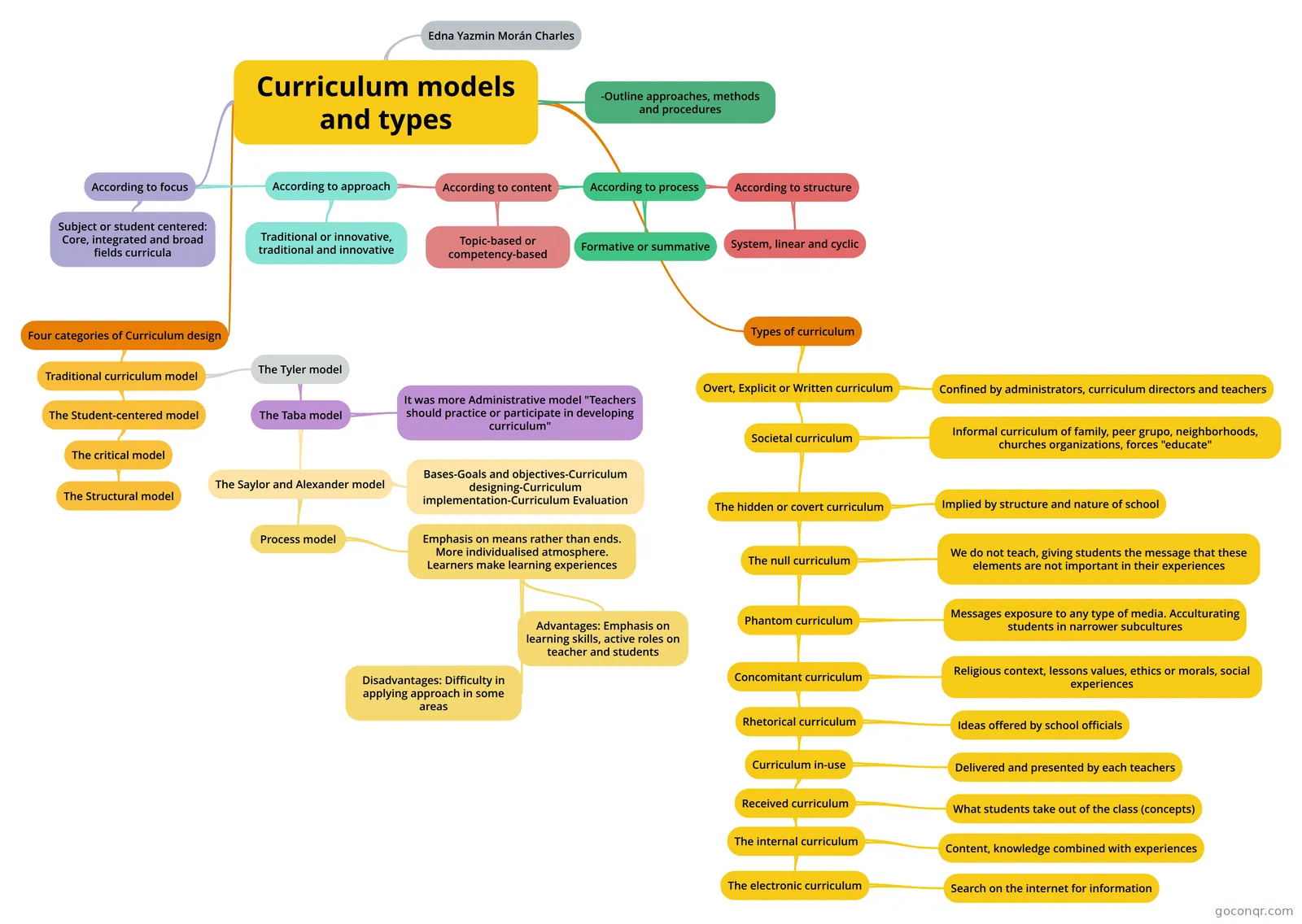
Mind map: Curriculum models and types
Contenido del mapa
Curriculum models and types
-Outline approaches, methods and procedures
According to focus
- Subject or student centered: Core, integrated and broad fields curricula
- According to approach
- Traditional or innovative, traditional and innovative
- According to content
- Topic-based or competency-based
- According to process
- Formative or summative
- According to structure
- System, linear and cyclic
Four categories of Curriculum design
- Traditional curriculum model
- The Student-centered model
- The critical model
- The Structural model
- The critical model
- The Tyler model
- The Taba model
- The Saylor and Alexander model
- Bases-Goals and objectives-Curriculum designing-Curriculum implementation-Curriculum Evaluation
- Process model
- Emphasis on means rather than ends. More individualised atmosphere. Learners make learning experiences
- Advantages: Emphasis on learning skills, active roles on teacher and students
- Disadvantages: Difficulty in applying approach in some areas
- Emphasis on means rather than ends. More individualised atmosphere. Learners make learning experiences
- It was more Administrative model "Teachers should practice or participate in developing curriculum"
- The Saylor and Alexander model
- The Taba model
- The Student-centered model
- Traditional curriculum model
Types of curriculum
- Overt, Explicit or Written curriculum
- Societal curriculum
- The hidden or covert curriculum
- The null curriculum
- Phantom curriculum
- Concomitant curriculum
- Rhetorical curriculum
- Curriculum in-use
- Received curriculum
- The internal curriculum
- The electronic curriculum
- Search on the internet for information
- Content, knowledge combined with experiences
- The electronic curriculum
- What students take out of the class (concepts)
- The internal curriculum
- Delivered and presented by each teachers
- Received curriculum
- Ideas offered by school officials
- Curriculum in-use
- Religious context, lessons values, ethics or morals, social experiences
- Rhetorical curriculum
- Messages exposure to any type of media. Acculturating students in narrower subcultures
- Concomitant curriculum
- We do not teach, giving students the message that these elements are not important in their experiences
- Phantom curriculum
- Implied by structure and nature of school
- The null curriculum
- Informal curriculum of family, peer grupo, neighborhoods, churches organizations, forces "educate"
- The hidden or covert curriculum
- Confined by administrators, curriculum directors and teachers
- Societal curriculum
- Overt, Explicit or Written curriculum
Edna Yazmin Morán Charles
Información
- Descripción
- Mind map about Curriculum designs
- Creado por
- Ed Charlie
- Visitas
- 375
- Etiquetas
- Valoración