
Mapa mental
Contract Practice - Performance security
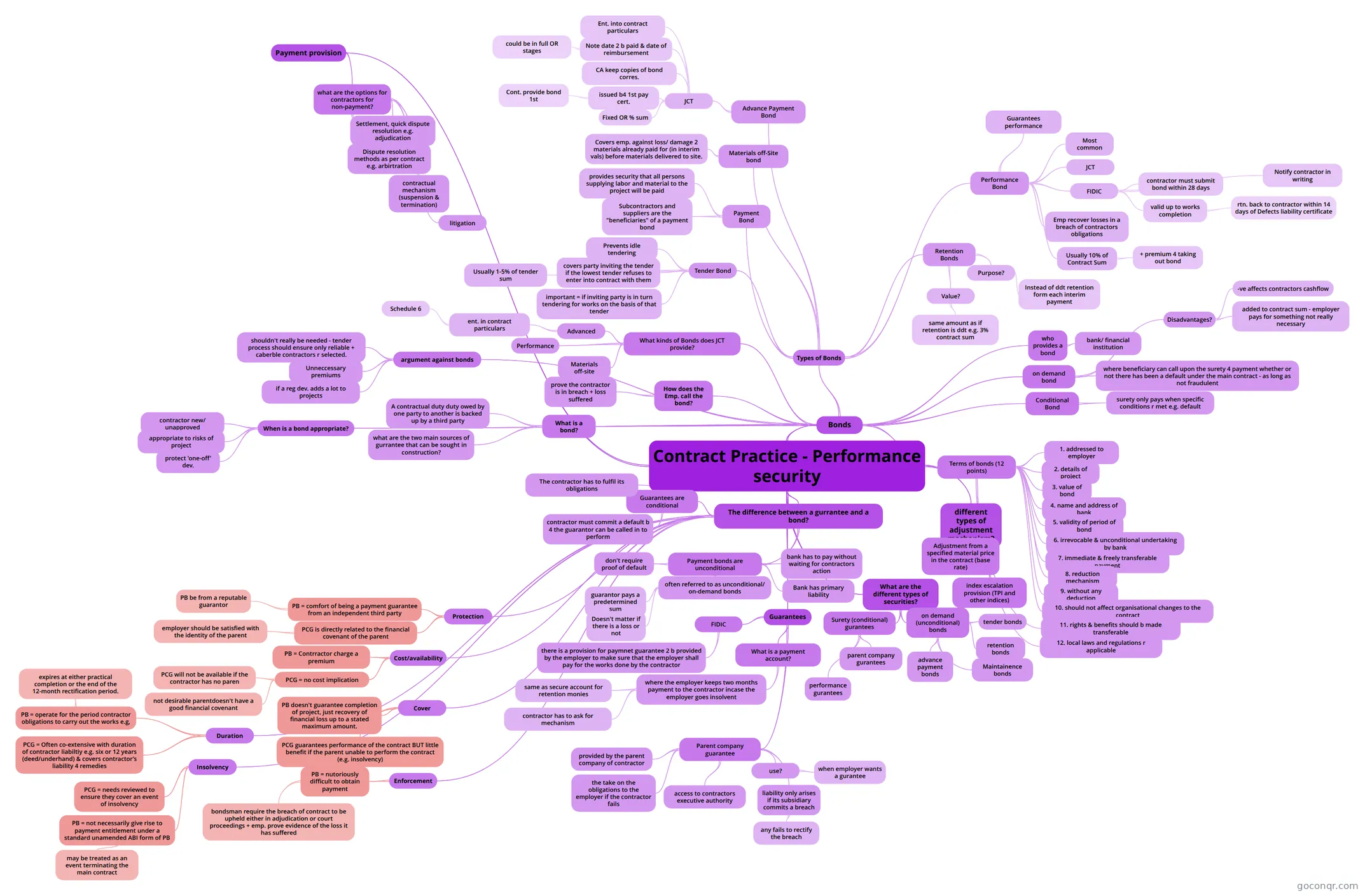
Mind map: Contract practice performance security
Contenido del mapa
Contract Practice - Performance security
Bonds
- What is a bond?
- A contractual duty duty owed by one party to another is backed up by a third party
- what are the two main sources of gurrantee that can be sought in construction?
- Terms of bonds (12 points)
- 1. addressed to employer
- 2. details of project
- 3. value of bond
- 4. name and address of bank
- 5. validity of period of bond
- 6. irrevocable & unconditional undertaking by bank
- 7. immediate & freely transferable payment
- 8. reduction mechanism
- 9. without any deduction
- 10. should not affect organisational changes to the contract
- 11. rights & benefits should b made transferable
- 12. local laws and regulations r applicable
- who provides a bond
- bank/ financial institution
- on demand bond
- where beneficiary can call upon the surety 4 payment whether or not there has been a default under the main contract - as long as not fraudulent
- Disadvantages?
- -ve affects contractors cashflow
- added to contract sum - employer pays for something not really necessary
- Conditional Bond
- surety only pays when specific conditions r met e.g. default
- Types of Bonds
- Retention Bonds
- Purpose?
- Instead of ddt retention form each interim payment
- Value?
- same amount as if retention is ddt e.g. 3% contract sum
- Purpose?
- Performance Bond
- Most common
- Emp recover losses in a breach of contractors obligations
- Usually 10% of Contract Sum
- + premium 4 taking out bond
- FIDIC
- contractor must submit bond within 28 days
- valid up to works completion
- rtn. back to contractor within 14 days of Defects liability certificate
- Notify contractor in writing
- JCT
- Guarantees performance
- Materials off-Site bond
- Covers emp. against loss/ damage 2 materials already paid for (in interim vals) before materials delivered to site.
- Advance Payment Bond
- JCT
- Ent. into contract particulars
- Fixed OR % sum
- Note date 2 b paid & date of reimbursement
- could be in full OR stages
- issued b4 1st pay cert.
- Cont. provide bond 1st
- CA keep copies of bond corres.
- JCT
- Tender Bond
- covers party inviting the tender if the lowest tender refuses to enter into contract with them
- important = if inviting party is in turn tendering for works on the basis of that tender
- Prevents idle tendering
- Usually 1-5% of tender sum
- Payment Bond
- provides security that all persons supplying labor and material to the project will be paid
- Subcontractors and suppliers are the "beneficiaries" of a payment bond
- Retention Bonds
- How does the Emp. call the bond?
- prove the contractor is in breach + loss suffered
- What kinds of Bonds does JCT provide?
- Advanced
- ent. in contract particulars
- Schedule 6
- ent. in contract particulars
- Materials off-site
- Performance
- Advanced
- argument against bonds
- shouldn't really be needed - tender process should ensure only reliable + caberble contractors r selected.
- Unneccessary premiums
- if a reg dev. adds a lot to projects
- When is a bond appropriate?
- contractor new/ unapproved
- protect 'one-off' dev.
- appropriate to risks of project
- What is a bond?
The difference between a gurrantee and a bond?
- Guarantees are conditional
- contractor must commit a default b 4 the guarantor can be called in to perform
- The contractor has to fulfil its obligations
- Payment bonds are unconditional
- don't require proof of default
- often referred to as unconditional/ on-demand bonds
- guarantor pays a predetermined sum
- Doesn't matter if there is a loss or not
- bank has to pay without waiting for contractors action
- Bank has primary liability
- Protection
- PB = comfort of being a payment guarantee from an independent third party
- PB be from a reputable guarantor
- PCG is directly related to the financial covenant of the parent
- employer should be satisfied with the identity of the parent
- PB = comfort of being a payment guarantee from an independent third party
- Cost/availability
- PB = Contrractor charge a premium
- PCG = no cost implication
- PCG will not be available if the contractor has no paren
- not desirable parentdoesn't have a good financial covenant
- Cover
- PB doesn't guarantee completion of project, just recovery of financial loss up to a stated maximum amount.
- PCG guarantees performance of the contract BUT little benefit if the parent unable to perform the contract (e.g. insolvency)
- Duration
- PCG = Often co-extensive with duration of contractor liabiltiy e.g. six or 12 years (deed/underhand) & covers contractor’s liability 4 remedies
- PB = operate for the period contractor obligations to carry out the works e.g,
- expires at either practical completion or the end of the 12-month rectification period.
- Insolvency
- PB = not necessarily give rise to payment entitlement under a standard unamended ABI form of PB
- may be treated as an event terminating the main contract
- PCG = needs reviewed to ensure they cover an event of insolvency
- PB = not necessarily give rise to payment entitlement under a standard unamended ABI form of PB
- Enforcement
- PB = nutoriously difficult to obtain payment
- bondsman require the breach of contract to be upheld either in adjudication or court proceedings + emp. prove evidence of the loss it has suffered
- PB = nutoriously difficult to obtain payment
- Guarantees are conditional
Guarantees
- FIDIC
- there is a provision for paymnet guarantee 2 b provided by the employer to make sure that the employer shall pay for the works done by the contractor
- What is a payment account?
- where the employer keeps two months payment to the contractor incase the employer goes insolvent
- same as secure account for retention monies
- contractor has to ask for mechanism
- where the employer keeps two months payment to the contractor incase the employer goes insolvent
- Parent company guarantee
- provided by the parent company of contractor
- the take on the obligations to the employer if the contractor fails
- access to contractors executive authority
- use?
- when employer wants a gurantee
- liability only arises if its subsidiary commits a breach
- any fails to rectify the breach
- FIDIC
Payment provision
- what are the options for contractors for non-payment?
- Settlement, quick dispute resolution e.g. adjudication
- contractual mechanism (suspension & termination)
- Dispute resolution methods as per contract e.g. arbirtration
- litigation
- what are the options for contractors for non-payment?
different types of adjustment mechanism?
- Adjustment from a specified material price in the contract (base rate)
- index escalation provision (TPI and other indices)
What are the different types of securities?
- Surety (conditional) gurantees
- performance gurantees
- parent company gurantees
- on demand (unconditional) bonds
- tender bonds
- advance payment bonds
- retention bonds
- Maintainence bonds
- Surety (conditional) gurantees
Información
- Descripción
- T017 & T016 Mapa Mental sobre Contract Practice - Performance security, creado por alison_patey0437 el 21/04/2013.
- Creado por
- alison_patey0437
- Visitas
- 170
- Etiquetas
- Valoración