
Mapa mental
B1 OCR
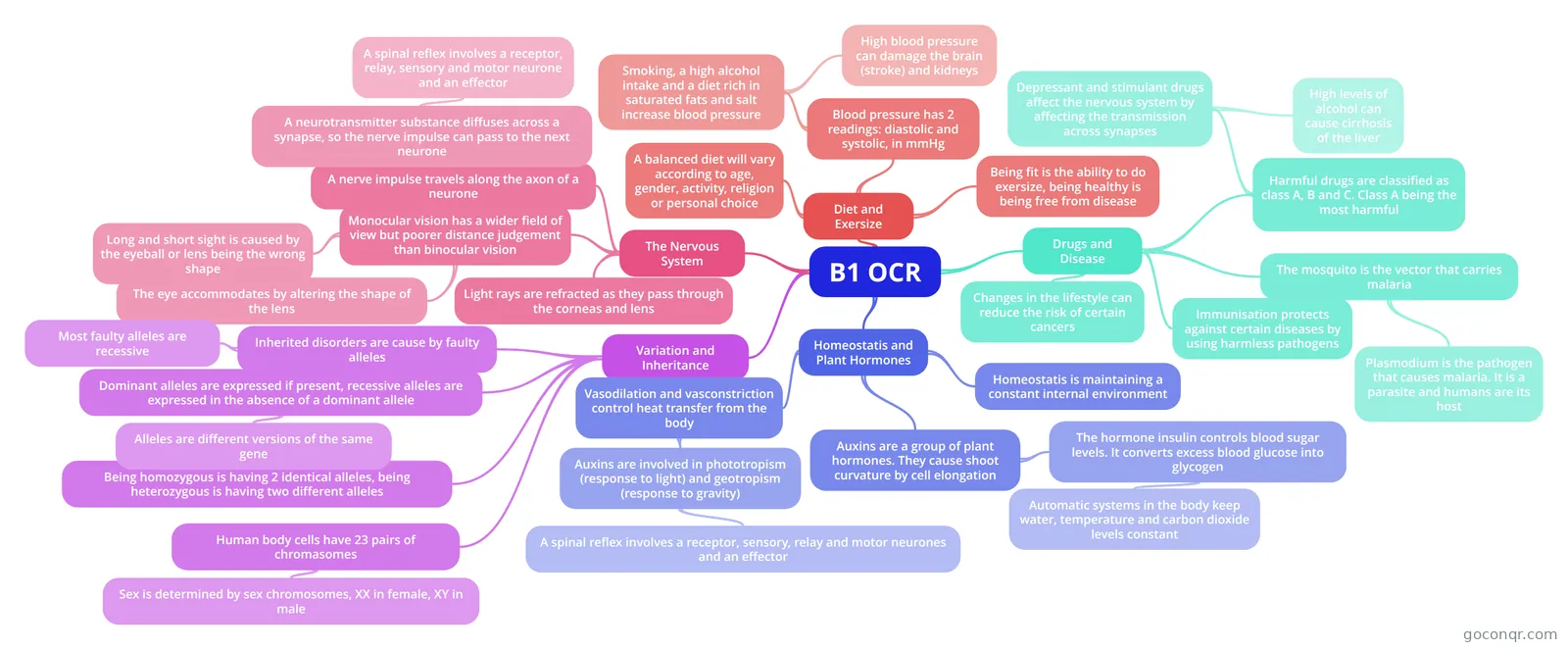
Mind map: B1 OCR biology
Contenido del mapa
B1 OCR
Diet and Exersize
- Blood pressure has 2 readings: diastolic and systolic, in mmHg
- Smoking, a high alcohol intake and a diet rich in saturated fats and salt increase blood pressure
- High blood pressure can damage the brain (stroke) and kidneys
- Smoking, a high alcohol intake and a diet rich in saturated fats and salt increase blood pressure
- Being fit is the ability to do exersize, being healthy is being free from disease
- A balanced diet will vary according to age, gender, activity, religion or personal choice
- Blood pressure has 2 readings: diastolic and systolic, in mmHg
Drugs and Disease
- Harmful drugs are classified as class A, B and C. Class A being the most harmful
- Depressant and stimulant drugs affect the nervous system by affecting the transmission across synapses
- High levels of alcohol can cause cirrhosis of the liver
- Depressant and stimulant drugs affect the nervous system by affecting the transmission across synapses
- Immunisation protects against certain diseases by using harmless pathogens
- Changes in the lifestyle can reduce the risk of certain cancers
- The mosquito is the vector that carries malaria
- Plasmodium is the pathogen that causes malaria. It is a parasite and humans are its host
- Harmful drugs are classified as class A, B and C. Class A being the most harmful
Homeostatis and Plant Hormones
- Homeostatis is maintaining a constant internal environment
- Vasodilation and vasconstriction control heat transfer from the body
- Auxins are involved in phototropism (response to light) and geotropism (response to gravity)
- A spinal reflex involves a receptor, sensory, relay and motor neurones and an effector
- Auxins are involved in phototropism (response to light) and geotropism (response to gravity)
- Auxins are a group of plant hormones. They cause shoot curvature by cell elongation
- The hormone insulin controls blood sugar levels. It converts excess blood glucose into glycogen
- Automatic systems in the body keep water, temperature and carbon dioxide levels constant
- The hormone insulin controls blood sugar levels. It converts excess blood glucose into glycogen
The Nervous System
- Light rays are refracted as they pass through the corneas and lens
- Monocular vision has a wider field of view but poorer distance judgement than binocular vision
- Long and short sight is caused by the eyeball or lens being the wrong shape
- The eye accommodates by altering the shape of the lens
- A nerve impulse travels along the axon of a neurone
- A neurotransmitter substance diffuses across a synapse, so the nerve impulse can pass to the next neurone
- A spinal reflex involves a receptor, relay, sensory and motor neurone and an effector
- A neurotransmitter substance diffuses across a synapse, so the nerve impulse can pass to the next neurone
Variation and Inheritance
- Inherited disorders are cause by faulty alleles
- Most faulty alleles are recessive
- Dominant alleles are expressed if present, recessive alleles are expressed in the absence of a dominant allele
- Alleles are different versions of the same gene
- Being homozygous is having 2 identical alleles, being heterozygous is having two different alleles
- Human body cells have 23 pairs of chromasomes
- Sex is determined by sex chromosomes, XX in female, XY in male
- Inherited disorders are cause by faulty alleles
Información
- Descripción
- GCSE Science Mapa Mental sobre B1 OCR, creado por Hannah Fowkes el 03/02/2014.
- Creado por
- Hannah Fowkes
- Visitas
- 95
- Etiquetas
- Valoración