
Mapa mental
METHODS AND APPROACHES
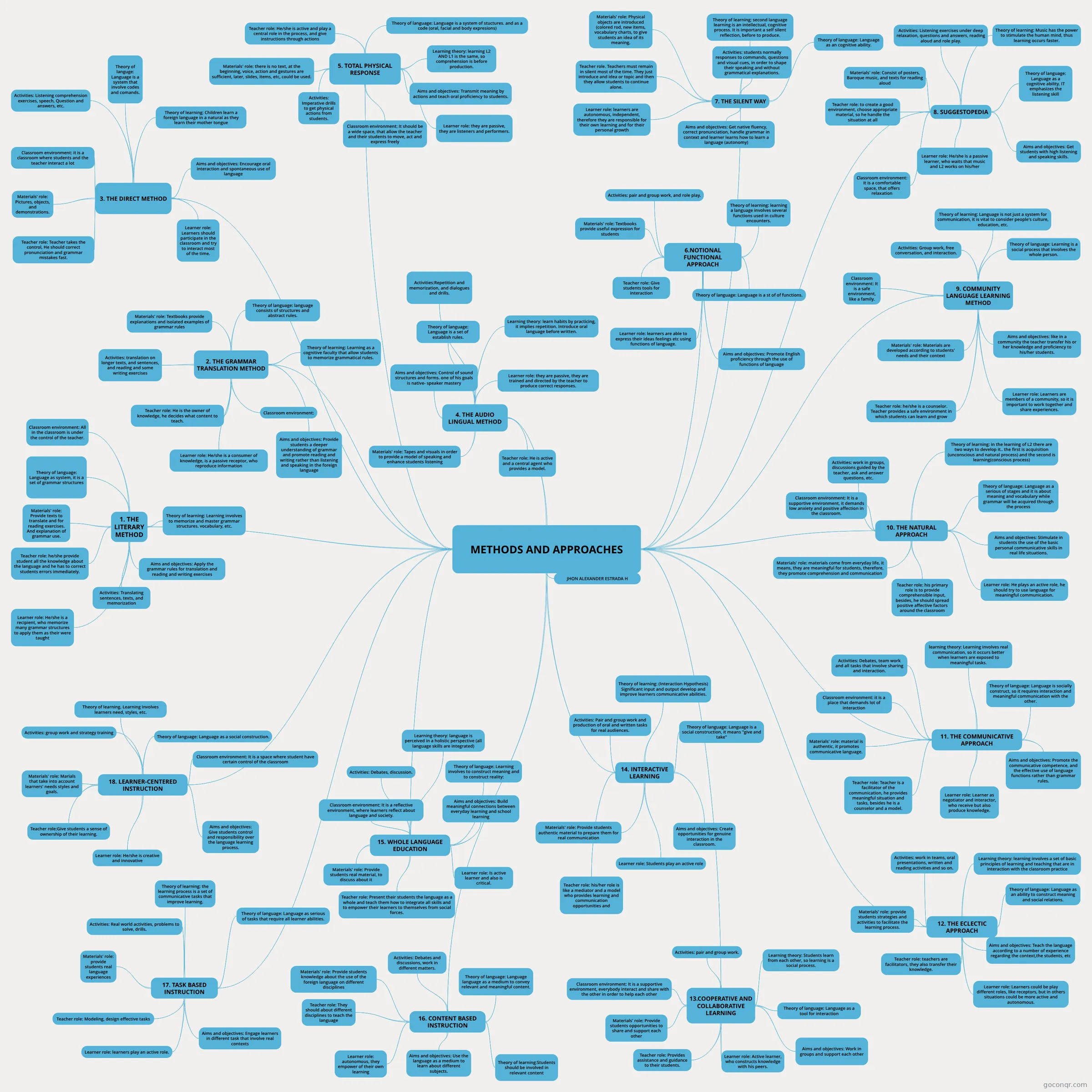
Mind map: methods and approaches in language teaching
Contenido del mapa
METHODS AND APPROACHES
16. CONTENT BASED INSTRUCTION
- Activities: Debates and discussions, work in different matters.
- Materials' role: Provide students knowledge about the use of the foreign language on different disciplines
- Learner role: autonomous, they empower of their own learning
- Aims and objectives: Use the language as a medium to learn about different subjects.
- Theory of learning:Students should be involved in relevant content
- Theory of language: Language language as a medium to convey relevant and meaningful content.
- Teacher role: They should about different disciplines to teach the language
9. COMMUNITY LANGUAGE LEARNING METHOD
- Teacher role: he/she is a counselor. Teacher provides a safe environment in which students can learn and grow
- Theory of learning: Language is not just a system for communication, it is vital to consider people's culture, education, etc.
- Activities: Group work, free conversation, and interaction.
- Aims and objectives: like in a community the teacher transfer his or her knowledge and proficiency to his/her students.
- Theory of language: Learning is a social process that involves the whole person.
- Materials' role: Materials are developed according to students' needs and their context
- Learner role: Learners are members of a community, so it is important to work together and share experiences.
- Classroom environment: It is a safe environment, like a family.
2. THE GRAMMAR TRANSLATION METHOD
- Aims and objectives: Provide students a deeper understanding of grammar and promote reading and writing rather than listening and speaking in the foreign language
- Learner role: He/she is a consumer of knowledge, is a passive receptor, who reproduce information
- Teacher role: He is the owner of knowledge, he decides what content to teach.
- Activities: translation on longer texts, and sentences, and reading and some writing exercises
- Materials' role: Textbooks provide explanations and isolated examples of grammar rules
- Theory of language: language consists of structures and abstract rules.
- Theory of learning: Learning as a cognitive faculty that allow students to memorize grammatical rules.
- Classroom environment:
3. THE DIRECT METHOD
- Theory of languge: Language is a system that involve codes and comands.
- Materials' role: Pictures, objects, and demonstrations.
- Teacher role: Teacher takes the control, He should correct pronunciation and grammar mistakes fast.
- Learner role: Learners should participate in the classroom and try to interact most of the time.
- Activities: Listening comprehension exercises, speech, Question and answers, etc.
- Aims and objectives: Encourage oral interaction and spontaneous use of language
- Theory of learning: Children learn a foreign language in a natural as they learn their mother tongue
- Classroom environment: it is a classroom where students and the teacher interact a lot
18. LEARNER-CENTERED INSTRUCTION
- Theory of language: Language as a social construction.
- Learner role: He/she is creative and innovative
- Materials' role: Marials that take into account learners' needs styles and goals.
- Theory of learning. Learning involves learners need, styles, etc.
- Activities: group work and strategy training
- Teacher role:Give students a sense of ownership of their learning.
- Aims and objectives: Give students control and responsibility over the language learning process.
- Classroom environment: It is a space where student have certain control of the classroom
8. SUGGESTOPEDIA
- Learner role: He/she is a passive learner, who waits that music and L2 works on his/her
- Activities: Listening exercises under deep relaxation, questions and answers, reading aloud and role play.
- Theory of language: Language as a cognitive ability. IT emphasizes the listening skill
- Aims and objectives: Get students with high listening and speaking skills.
- Teacher role: to create a good environment, choose appropriate material, so he handle the situation at all
- Theory of learning: Music has the power to stimulate the human mind, thus learning occurs faster.
- Materials' role: Consist of posters, Baroque music, and texts for reading aloud
- Classroom environment: It is a comfortable space, that offers relaxation
10. THE NATURAL APPROACH
- Aims and objectives: Stimulate in students the use of the basic personal communicative skills in real life situations.
- Learner role: He plays an active role, he should try to use language for meaningful communication.
- Activities: work in groups, discussions guided by the teacher, ask and answer questions, etc.
- Theory of learning: in the learning of L2 there are two ways to develop it.. the first is acquisition (unconscious and natural process) and the second is learning(conscious process)
- Theory of language: Language as a serious of stages and it is about meaning and vocabulary while grammar will be acquired through the process
- Materials' role: materials come from everyday life, it means, they are meaningful for students, therefore, they promote comprehension and communication
- Teacher role: his primary role is to provide comprehensible input, besides, he should spread positive affective factors around the classroom
- Classroom environment: It is a supportive environment, it demands low anxiety and positive affection in the classroom.
12. THE ECLECTIC APPROACH
- Activities: work in teams, oral presentations, written and reading activities and so on.
- Learning theory: learning involves a set of basic principles of learning and teaching that are in interaction with the classroom practice
- Theory of language: Language as an ability to construct meaning and social relations.
- Aims and objectives: Teach the language according to a number of experience regarding the context,the students, etc
- Learner role: Learners could be play different roles, like receptors, but in others situations could be more active and autonomous.
- Teacher role: teachers are facilitators, they also transfer their knowledge.
- Materials' role: provide students strategies and activities to facilitate the learning process.
5. TOTAL PHYSICAL RESPONSE
- Theory of language: Language is a system of stuctures. and as a code (oral, facial and body expresions)
- Learning theory: learning L2 AND L1 is the same, so comprehension is before production.
- Teacher role: He/she is active and play a central role in the process, and give instructions through actions
- Materials' role: there is no text, at the beginning, voice, action and gestures are sufficient, later, slides, items, etc, could be used.
- Aims and objectives: Transmit meaning by actions and teach oral proficiency to students.
- Learner role: they are passive, they are listeners and performers.
- Activities: Imperative drills to get physical actions from students.
- Classroom environment: It should be a wide space, that allow the teacher and their students to move, act and express freely
7. THE SILENT WAY
- Materials' role: Physical objects are introduced (colored rod, new items, vocabulary charts, to give students an idea of its meaning.
- Teacher role. Teachers must remain in silent most of the time. They just introduce and idea or topic and then they allow students to continue alone.
- Learner role: learners are autonomous, independent, therefore they are responsible for their own learning and for their personal growth
- Activities: students normally responses to commands, questions and visual cues, in order to shape their speaking and without grammatical explanations.
- Theory of learning: second language learning is an intellectual, cognitive process. It is important a self silent reflection, before to produce.
- Theory of language: Language as an cognitive ability.
- Aims and objectives: Get native fluency, correct pronunciation, handle grammar in context and learner learns how to learn a language (autonomy)
13.COOPERATIVE AND COLLABORATIVE LEARNING
- Teacher role: Provides assistance and guidance to their students.
- Learner role: Active learner, who constructs knowledge with his peers.
- Aims and objectives: Work in groups and support each other
- Materials' role: Provide students opportunities to share and support each other
- Activities: pair and group work.
- Learning theory: Students learn from each other, so learning is a social process.
- Theory of language: Language as a tool for interaction
- Classroom environment: It is a supportive environment, everybody interact and share with the other in order to help each other
17. TASK BASED INSTRUCTION
- Theory of language: Language as serious of tasks that require all learner abilities.
- Theory of learning: the learning process is a set of communicative tasks that improve learning.
- Activities: Real world activities, problems to solve, drills.
- Materials' role: provide students real language experiences
- Teacher role: Modeling, design effective tasks
- Aims and objectives: Engage learners in different task that involve real contexts
- Learner role: learners play an active role.
11. THE COMMUNICATIVE APPROACH
- Activities: Debates, team work and all tasks that involve sharing and interaction.
- learning theory: Learning involves real communication, so it occurs better when learners are exposed to meaningful tasks.
- Theory of language: Language is socially construct, so it requires interaction and meaningful communication with the other.
- Aims and objectives: Promote the communicative competence, and the effective use of language functions rather than grammar rules.
- Learner role: Learner as negotiator and interactor, who receive but also produce knowledge.
- Teacher role: Teacher is a facilitator of the communication, he provides meaningful situation and tasks, besides he is a counselor and a model.
- Materials' role: material is authentic, it promotes communicative language.
- Classroom environment: it is a place that demands lot of interaction
1. THE LITERARY METHOD
- Aims and objectives: Apply the grammar rules for translation and reading and writing exercises
- Activities: Translating sentences, texts, and memorization
- Learner role: He/she is a recipient, who memorize many grammar structures to apply them as their were taught
- Teacher role: he/she provide student all the knowledge about the language and he has to correct students errors immediately.
- Materials' role: Provide texts to translate and for reading exercises. And explanation of grammar use.
- Theory of language: Language as system, it is a set of grammar structures
- Theory of learning: Learning involves to memorize and master grammar structures. vocabulary, etc.
- Classroom environment: All in the classroom is under the control of the teacher.
15. WHOLE LANGUAGE EDUCATION
- Activities: Debates, discussion.
- Theory of language: Learning involves to construct meaning and to construct reality:
- Learning theory: language is perceived in a holistic perspective (all language skills are integrated)
- Materials' role: Provide students real material, to discuss about it
- Teacher role: Present their students the language as a whole and teach them how to integrate all skills and to empower their learners to themselves from social forces.
- Learner role: Is active learner and also is critical.
- Aims and objectives: Build meaningful connections between everyday learning and school learning
- Classroom environment: It is a reflective environment, where learners reflect about language and society.
14. INTERACTIVE LEARNING
- Theory of learning: (Interaction Hypothesis) Significant input and output develop and improve learners communicative abilities.
- Theory of language: Language is a social construction, it means "give and take"
- Aims and objectives: Create opportunities for genuine interaction in the classroom.
- Activities: Pair and group work and production of oral and written tasks for real audiences.
- Materials' role: Provide students authentic material to prepare them for real communication
- Teacher role: his/her role is like a mediator and a model who provides learning and communication opportunities and
- Learner role: Students play an active role
4. THE AUDIO LINGUAL METHOD
- Learning theory: learn habits by practicing, it implies repetition. Introduce oral language before written.
- Learner role: they are passive, they are trained and directed by the teacher to produce correct responses.
- Teacher role: He is active and a central agent who provides a model.
- Materials' role: Tapes and visuals in order to provide a model of speaking and enhance students listening
- Activities:Repetition and memorization, and dialogues and drills.
- Theory of language: Language is a set of establish rules.
- Aims and objectives: Control of sound structures and forms. one of his goals is native- speaker mastery
6.NOTIONAL FUNCTIONAL APPROACH
- Materials' role: Textbooks provide useful expression for students
- Activities: pair and group work, and role play.
- Theory of learning: learning a language involves several functions used in culture encounters.
- Theory of language: Language is a st of of functions.
- Teacher role: Give students tools for interaction
- Aims and objectives: Promote English proficiency through the use of functions of language
- Learner role: learners are able to express their ideas feelings etc using functions of language.
JHON ALEXANDER ESTRADA H
Información
- Descripción
- Interesting and useful for English learners
- Creado por
- alex estrada
- Visitas
- 66
- Etiquetas
- Valoración