
Mapa mental
8. Economic Problems: Inflation
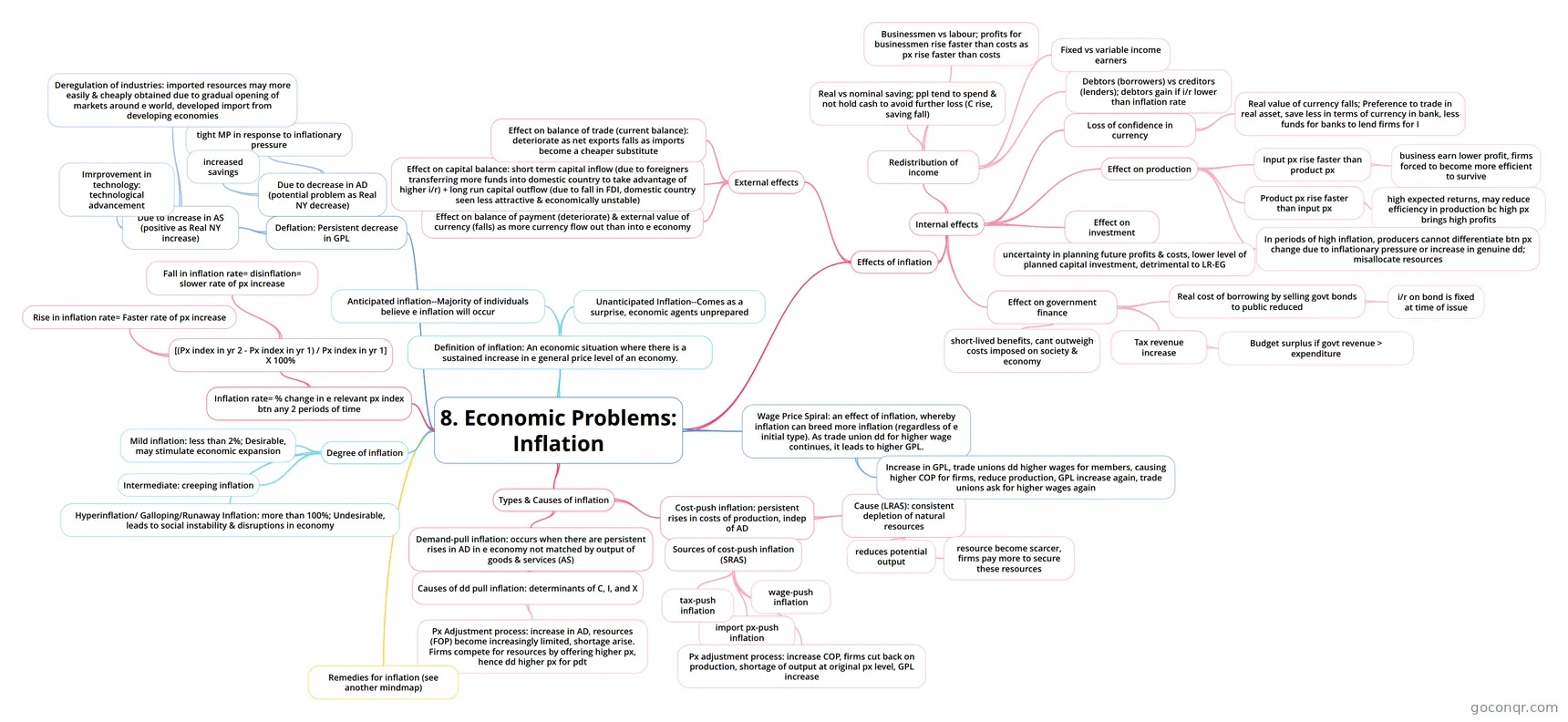
Mind map: Economic problems: inflation
Contenido del mapa
8. Economic Problems: Inflation
Definition of inflation: An economic situation where there is a sustained increase in e general price level of an economy.
- Anticipated inflation--Majority of individuals believe e inflation will occur
- Unanticipated Inflation--Comes as a surprise, economic agents unprepared
Inflation rate= % change in e relevant px index btn any 2 periods of time
- [(Px index in yr 2 - Px index in yr 1) / Px index in yr 1] X 100%
- Rise in inflation rate= Faster rate of px increase
- Fall in inflation rate= disinflation= slower rate of px increase
- [(Px index in yr 2 - Px index in yr 1) / Px index in yr 1] X 100%
Degree of inflation
- Mild inflation: less than 2%; Desirable, may stimulate economic expansion
- Intermediate: creeping inflation
- Hyperinflation/ Galloping/Runaway Inflation: more than 100%; Undesirable, leads to social instability & disruptions in economy
Types & Causes of inflation
- Demand-pull inflation: occurs when there are persistent rises in AD in e economy not matched by output of goods & services (AS)
- Causes of dd pull inflation: determinants of C, I, and X
- Px Adjustment process: increase in AD, resources (FOP) become increasingly limited, shortage arise. Firms compete for resources by offering higher px, hence dd higher px for pdt
- Causes of dd pull inflation: determinants of C, I, and X
- Cost-push inflation: persistent rises in costs of production, indep of AD
- Sources of cost-push inflation (SRAS)
- wage-push inflation
- import px-push inflation
- tax-push inflation
- Px adjustment process: increase COP, firms cut back on production, shortage of output at original px level, GPL increase
- Cause (LRAS): consistent depletion of natural resources
- reduces potential output
- resource become scarcer, firms pay more to secure these resources
- Sources of cost-push inflation (SRAS)
- Demand-pull inflation: occurs when there are persistent rises in AD in e economy not matched by output of goods & services (AS)
Wage Price Spiral: an effect of inflation, whereby inflation can breed more inflation (regardless of e initial type). As trade union dd for higher wage continues, it leads to higher GPL.
- Increase in GPL, trade unions dd higher wages for members, causing higher COP for firms, reduce production, GPL increase again, trade unions ask for higher wages again
Effects of inflation
- Internal effects
- Redistribution of income
- Debtors (borrowers) vs creditors (lenders); debtors gain if i/r lower than inflation rate
- Fixed vs variable income earners
- Businessmen vs labour; profits for businessmen rise faster than costs as px rise faster than costs
- Real vs nominal saving; ppl tend to spend & not hold cash to avoid further loss (C rise, saving fall)
- Loss of confidence in currency
- Real value of currency falls; Preference to trade in real asset, save less in terms of currency in bank, less funds for banks to lend firms for I
- Effect on investment
- uncertainty in planning future profits & costs, lower level of planned capital investment, detrimental to LR-EG
- Effect on government finance
- Real cost of borrowing by selling govt bonds to public reduced
- i/r on bond is fixed at time of issue
- Tax revenue increase
- Budget surplus if govt revenue > expenditure
- short-lived benefits, cant outweigh costs imposed on society & economy
- Real cost of borrowing by selling govt bonds to public reduced
- Effect on production
- Input px rise faster than product px
- business earn lower profit, firms forced to become more efficient to survive
- Product px rise faster than input px
- high expected returns, may reduce efficiency in production bc high px brings high profits
- In periods of high inflation, producers cannot differentiate btn px change due to inflationary pressure or increase in genuine dd; misallocate resources
- Input px rise faster than product px
- Redistribution of income
- External effects
- Effect on balance of payment (deteriorate) & external value of currency (falls) as more currency flow out than into e economy
- Effect on capital balance: short term capital inflow (due to foreigners transferring more funds into domestic country to take advantage of higher i/r) + long run capital outflow (due to fall in FDI, domestic country seen less attractive & economically unstable)
- Effect on balance of trade (current balance): deteriorate as net exports falls as imports become a cheaper substitute
- Internal effects
Remedies for inflation (see another mindmap)
Deflation: Persistent decrease in GPL
- Due to decrease in AD (potential problem as Real NY decrease)
- tight MP in response to inflationary pressure
- increased savings
- Due to increase in AS (positive as Real NY increase)
- Imrprovement in technology: technological advancement
- Deregulation of industries: imported resources may more easily & cheaply obtained due to gradual opening of markets around e world, developed import from developing economies
- Due to decrease in AD (potential problem as Real NY decrease)
Información
- Descripción
- Mapa Mental sobre 8. Economic Problems: Inflation, creado por Mavis Cyn el 09/09/2016.
- Creado por
- Mavis Cyn
- Visitas
- 1
- Valoración
Más sobre Inflation and deflation