
Mapa mental
Bach Cantata Background Research
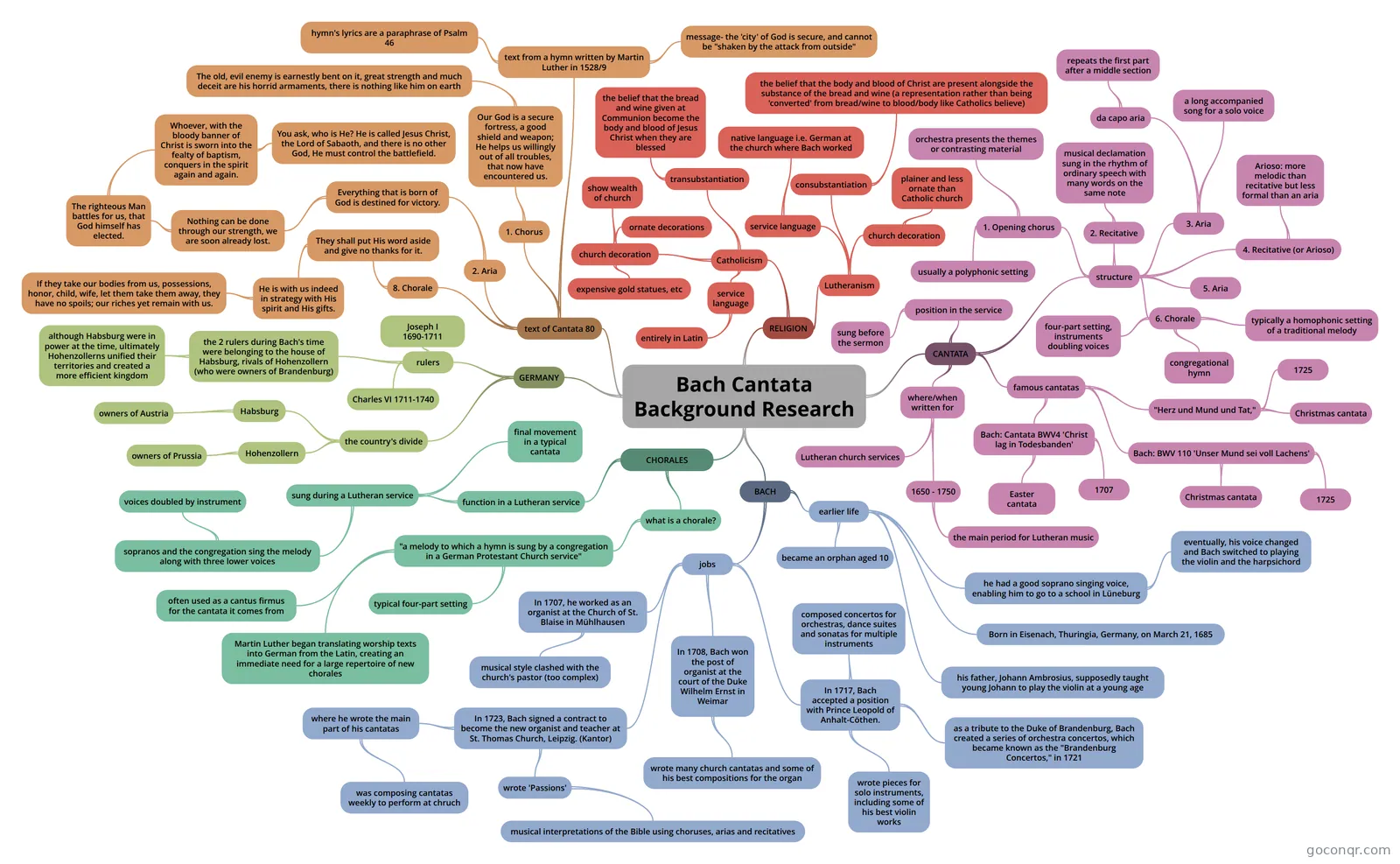
Mind map: Bach cantata background research
Contenido del mapa
Bach Cantata Background Research
CANTATA
- structure
- 1. Opening chorus
- usually a polyphonic setting
- orchestra presents the themes or contrasting material
- 2. Recitative
- musical declamation sung in the rhythm of ordinary speech with many words on the same note
- 3. Aria
- a long accompanied song for a solo voice
- da capo aria
- repeats the first part after a middle section
- 4. Recitative (or Arioso)
- Arioso: more melodic than recitative but less formal than an aria
- 5. Aria
- 6. Chorale
- typically a homophonic setting of a traditional melody
- four-part setting, instruments doubling voices
- congregational hymn
- 1. Opening chorus
- where/when written for
- Lutheran church services
- 1650 - 1750
- the main period for Lutheran music
- position in the service
- sung before the sermon
- famous cantatas
- Bach: Cantata BWV4 'Christ lag in Todesbanden'
- 1707
- Easter cantata
- "Herz und Mund und Tat,"
- 1725
- Christmas cantata
- Bach: BWV 110 'Unser Mund sei voll Lachens'
- 1725
- Christmas cantata
- Bach: Cantata BWV4 'Christ lag in Todesbanden'
- structure
CHORALES
- function in a Lutheran service
- sung during a Lutheran service
- sopranos and the congregation sing the melody along with three lower voices
- voices doubled by instrument
- final movement in a typical cantata
- sopranos and the congregation sing the melody along with three lower voices
- sung during a Lutheran service
- what is a chorale?
- "a melody to which a hymn is sung by a congregation in a German Protestant Church service"
- typical four-part setting
- often used as a cantus firmus for the cantata it comes from
- Martin Luther began translating worship texts into German from the Latin, creating an immediate need for a large repertoire of new chorales
- "a melody to which a hymn is sung by a congregation in a German Protestant Church service"
- function in a Lutheran service
BACH
- earlier life
- his father, Johann Ambrosius, supposedly taught young Johann to play the violin at a young age
- Born in Eisenach, Thuringia, Germany, on March 21, 1685
- became an orphan aged 10
- he had a good soprano singing voice, enabling him to go to a school in Lüneburg
- eventually, his voice changed and Bach switched to playing the violin and the harpsichord
- jobs
- In 1708, Bach won the post of organist at the court of the Duke Wilhelm Ernst in Weimar
- wrote many church cantatas and some of his best compositions for the organ
- In 1707, he worked as an organist at the Church of St. Blaise in Mühlhausen
- musical style clashed with the church's pastor (too complex)
- In 1717, Bach accepted a position with Prince Leopold of Anhalt-Cöthen.
- composed concertos for orchestras, dance suites and sonatas for multiple instruments
- wrote pieces for solo instruments, including some of his best violin works
- as a tribute to the Duke of Brandenburg, Bach created a series of orchestra concertos, which became known as the "Brandenburg Concertos," in 1721
- In 1723, Bach signed a contract to become the new organist and teacher at St. Thomas Church, Leipzig. (Kantor)
- where he wrote the main part of his cantatas
- was composing cantatas weekly to perform at chruch
- wrote 'Passions'
- musical interpretations of the Bible using choruses, arias and recitatives
- where he wrote the main part of his cantatas
- In 1708, Bach won the post of organist at the court of the Duke Wilhelm Ernst in Weimar
- earlier life
GERMANY
- the country's divide
- Habsburg
- owners of Austria
- Hohenzollern
- owners of Prussia
- Habsburg
- rulers
- Charles VI 1711-1740
- Joseph I 1690-1711
- the 2 rulers during Bach's time were belonging to the house of Habsburg, rivals of Hohenzollern (who were owners of Brandenburg)
- although Habsburg were in power at the time, ultimately Hohenzollerns unified their territories and created a more efficient kingdom
- the country's divide
text of Cantata 80
- 8. Chorale
- They shall put His word aside and give no thanks for it.
- He is with us indeed in strategy with His spirit and His gifts.
- If they take our bodies from us, possessions, honor, child, wife, let them take them away, they have no spoils; our riches yet remain with us.
- He is with us indeed in strategy with His spirit and His gifts.
- They shall put His word aside and give no thanks for it.
- 1. Chorus
- Our God is a secure fortress, a good shield and weapon; He helps us willingly out of all troubles, that now have encountered us.
- The old, evil enemy is earnestly bent on it, great strength and much deceit are his horrid armaments, there is nothing like him on earth
- Our God is a secure fortress, a good shield and weapon; He helps us willingly out of all troubles, that now have encountered us.
- 2. Aria
- Everything that is born of God is destined for victory.
- Nothing can be done through our strength, we are soon already lost.
- The righteous Man battles for us, that God himself has elected.
- Whoever, with the bloody banner of Christ is sworn into the fealty of baptism, conquers in the spirit again and again.
- You ask, who is He? He is called Jesus Christ, the Lord of Sabaoth, and there is no other God, He must control the battlefield.
- Whoever, with the bloody banner of Christ is sworn into the fealty of baptism, conquers in the spirit again and again.
- The righteous Man battles for us, that God himself has elected.
- Nothing can be done through our strength, we are soon already lost.
- Everything that is born of God is destined for victory.
- text from a hymn written by Martin Luther in 1528/9
- hymn's lyrics are a paraphrase of Psalm 46
- message- the 'city' of God is secure, and cannot be "shaken by the attack from outside"
- 8. Chorale
RELIGION
- Lutheranism
- service language
- native language i.e. German at the church where Bach worked
- church decoration
- plainer and less ornate than Catholic church
- consubstantiation
- the belief that the body and blood of Christ are present alongside the substance of the bread and wine (a representation rather than being 'converted' from bread/wine to blood/body like Catholics believe)
- service language
- Catholicism
- service language
- entirely in Latin
- church decoration
- ornate decorations
- expensive gold statues, etc
- show wealth of church
- transubstantiation
- the belief that the bread and wine given at Communion become the body and blood of Jesus Christ when they are blessed
- service language
- Lutheranism
Información
- Descripción
- A level Music 2017 Mapa Mental sobre Bach Cantata Background Research, creado por Alex C el 29/09/2016.
- Creado por
- Alex C
- Visitas
- 2
- Valoración