
Mapa mental
MULTIPLE ACCESS
Contenido del mapa
MULTIPLE ACCESS
Data Link Layer
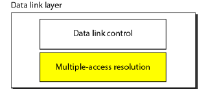
- Upper Sublayer --> data link control Lower Sublayer --> resolving access to the shared media
Random access protocols --> No station is superior to another station -->Possibility for access conflict (collision)
- MA (multiple access)
- CSMA (carrier sense multiple access)
- CSMA/CA (Collision Avoidance)
- to avoid collisions on wireless network
- strategies
- Interframe space
- station needs to wait time equal to the contention time
- contection window ->an amount of the divided into slots
- if channel busy, it stops the timer and restart it when the channel become idle
- Acknowledgement
- Interframe space
- strategies
- to avoid collisions on wireless network
- CSMA/CD (Collision Detection)
- medium send frame,if transformation successful station is finished.if there collision ,frame send again.
- Each station first listen before sending -->Reduce possibility of collision not eliminate it
- Persistence Strategy -->procedure for a station that sense a busy medium
- methods
- Nonpersistence
- sense the line , if the line idle station send immediately otherwise waits
- reduce the chance of collision
- 1 Persistence
- if the line idle station send immediately( with probability of 1)
- increase the chance of collision
- P-Persistence
- if the line idle 1.with probability p,the station sends its frame 2.with probability q=1-p, the station waits for the beginning of the next slot and checks the line again.
- Nonpersistence
- methods
- Persistence Strategy -->procedure for a station that sense a busy medium
- CSMA/CA (Collision Avoidance)
- -->ALOHA allows multiple access to shared the medium -->Potential of collision -->When a station sends data,another station may attempt to do so at the same time
- CSMA (carrier sense multiple access)
- MA (multiple access)
Controlled-access protocols
- -->The stations consult one another to find which stations has right to send. -->A station cannot send unless it has been authorized by other stations.
- methods
- Reservation
- A station needs to make reservation before sending data
- Polling
- one device designated as a primary station and other devices are secondary stations
- primary devices controls the link and secondary devices follow its instruction
- Select Mode -> used when the primary device has something to send
- Poll Mode -> used by the primary device to solicit transmission from the secondary device
- token passing
- station organized in a logical ring.Each station has a predecessor (station before the station in the ring) and successor (station after the station the ring)
- token-->a special packet -->circulate around the ring
- the station captures the token and sends one or more frames and finally releases the token to be used by the successor station
- Reservation
Channelization protocols
- a multiple-access method in which available bandwidth of the link is shared in time,frequency or code.
- protocols
- FDMA (Frequency-Division Multiple Access)
- -->available bandwidth is divided into frequency band -->Each station allocated a band to send its data --> used in cellular telephone and satellite -->used in data link layer
- TDMA (Time-Division Multiple Access)
- -->station share the bandwidth -->Each station allocated a time slot during send data -->Problem=achieving synchronization between different stations -->used in data link layer
- CDMA (Code-Division Multiple Access)
- -->no bandwidth sharing -->All station can send data simultaneously -->one channel carries all transmission simultaneously
- based on coding theory.Each station assigned a code/sequence(chips).Sequenced selected.
- Rules (send a 0 bit -> encodes -1) (send a bit 1 -> encodes +1)(idle ->no signal,interpreted as a 0)
- based on coding theory.Each station assigned a code/sequence(chips).Sequenced selected.
- -->no bandwidth sharing -->All station can send data simultaneously -->one channel carries all transmission simultaneously
- FDMA (Frequency-Division Multiple Access)
Imágenes y archivos del mapa
Información
- Descripción
- Mapa Mental sobre MULTIPLE ACCESS, creado por Annis Barakah el 06/12/2016.
- Creado por
- Annis Barakah
- Visitas
- 0
- Valoración