
Mapa mental
Variation & Evolution
Contenido del mapa
Variation & Evolution
Variation
- Due to:
- Different genotypes
- Epigenetic changes on same genotype
- Different environments
- The differences between organisms of the same species
- Heritable
- Change that can be inherited in genes
- Bought over by:
- Meiosis (Only in sexual reproduction)
- Mixing parental genotypes
- Random Assortment
- Crossing over
- Mutations (Asexual/sexual reproduction)
- Create long-lasting variation
- Occurence is rare
- Meiosis (Only in sexual reproduction)
- Bought over by:
- Change that can be inherited in genes
- Non-Heritable
- Change brought about by environment (no epigenetic change)
- Continuous variation
- Controlled by multiple genes (Polygenic)
- Can result in a range of characteristics
- Influenced by the environment
- Can result in a range of characteristics
- Controlled by multiple genes (Polygenic)
- Discontinuous variation
- Controlled by single genes (Monogenic)
- Code for discrete characteristics
- No intermediates
- Code for discrete characteristics
- Controlled by single genes (Monogenic)
- Due to:
Competition for breeding success & survival
- When no environmental resistance organisms over produce
- Finite resources bring about limited reproduction
- Types of competition
- Inter-specific
- Between organisms of different species
- Intra-specific
- Between organisms of the same species
- Inter-specific
- When no environmental resistance organisms over produce
Selective Pressure
- An environmental factor that can alter the frequency of alleles in a population
- Example of natural selection
- Factors = Selective agents
- Examples
- Availability of nesting sites
- Day lengths affect reproductive behaviour
- Overcrowding allows diseases to spread
- Predation & mimic species
- Temp/Human impact
- Examples
- Value of allele is dependant on environment
- Phenotypes more suited to the environment
- Are more likely to be passed on
- Thus becoming more abundant in the environment
- Are more likely to be passed on
- Phenotypes more suited to the environment
- An environmental factor that can alter the frequency of alleles in a population
Population genetics
- Gene pool
- All the alleles present in a population at a given time
- Allele frequency
- The % of alleles for a gene present in a gene pool
- Genetic Drift
- Random changes in allele frequencies in a population
- Particularly prevalent & an important evolutionary mechanism in small populations
- Not due to natural selection
- Particularly prevalent & an important evolutionary mechanism in small populations
- Random changes in allele frequencies in a population
- Hardy-Weinberg Principle
- In ideal conditions
- Allele & Genotype are constant generation to generation
- Ideal Conditions
- The organisms:
- Are diploid
- Allele frequencies are equal in both sexes
- Reproduce sexually and randomly
- Generations don't overlap
- The population
- Large population
- No migration, mutation, selection
- The organisms:
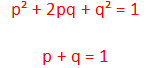
- Hardy-Weinberg equilibrium equation
- p = Frequency of dominant allele (AA)
- q = Frequency of recessive allele (aa)
- 2pq = Frequency of heterozygous genotype (Aa)
- In ideal conditions
- Gene pool
Evolution
- In general, ideal Hardy-Weinberg conditions don't exist
- Allele frequency/phenotypes change over time, Leading to evolution
- Evolution = Change in the average phenotype of a population
- If a big change in phenotype occurs, the organisms can't reproduce w/initial population
- Leading to Speciation: Formation of new species
- If a big change in phenotype occurs, the organisms can't reproduce w/initial population
- Changes brought by: Mutation, Genetic Drift, Gene Flow, Natural Selection
- Evolution = Change in the average phenotype of a population
- Allele frequency/phenotypes change over time, Leading to evolution
- Founder Effect
- Loss of genetic variation in a new population
- Established by a small No. of individuals
- That have become isolated from the rest of the population
- Established by a small No. of individuals
- Whilst the founder population stays small
- It may undergo genetic drift, making them even more different
- As many genes are subject to change
- Average phenotype can change quickly
- The smaller the population, the more significant the change
- Average phenotype can change quickly
- As many genes are subject to change
- It may undergo genetic drift, making them even more different
- Loss of genetic variation in a new population
- Natural selection
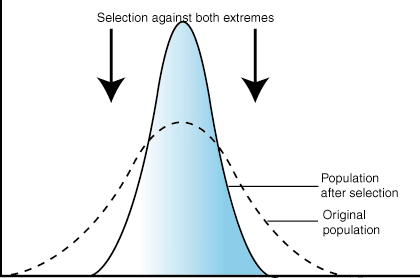
- Stabilising Selection
- Characteristic w/continuous variation has a range of values
- In a certain environment, average phenotype might be better than the extremes
- Meaning next gen will have smaller deviation & higher peak
- In a certain environment, average phenotype might be better than the extremes
- E.g Human birth weight
- Characteristic w/continuous variation has a range of values
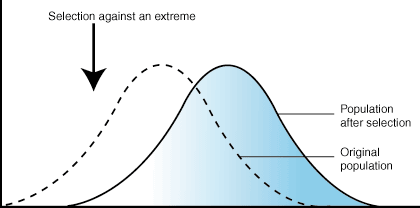
- Directional Selection
- Selection when an extreme phenotype proves more advantageous
- E.g Cichlid fish lake victoria, bigger fins to escape predators
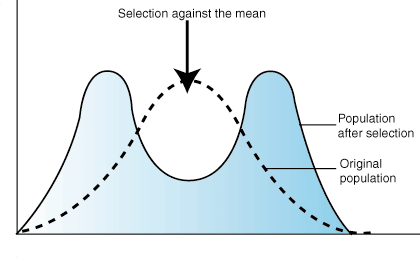
- Disruptive selection
- Average phenotypes have no advantage, extremes favoured
- Graph becomes bimodal (2 peaks)
- E.g Coho Salmon mating, small sneak, big fight, middle neither > fail
- Average phenotypes have no advantage, extremes favoured
- Stabilising Selection
- In general, ideal Hardy-Weinberg conditions don't exist
Isolation & Speciation
- Species = Groups of organisms that interbreed to make fertile offspring
- New species may arise from
- Abruptly, polyploidy = Chromosome No. doubles by endomitosis, but rare
- Gradually, by isolating groups of individuals
- Population = Inter-breeding group of 1 species
- Sub-groups in this population may breed more often w/each other than the rest of the population
- These are called demes
- If a deme gets isolated, it can't breed w/other demes
- So gene flow in/out of this deme is prevented
- This is an example of reproductive isolation
- Reproductive Isolation = Prevention of reproduction, and therefore the gene flow between the demes of a species
- If demes are isolated for many gens, mutations/changes in allele frequency occur
- Making them unable to inter-breed, hence speciation occurs
- If demes are isolated for many gens, mutations/changes in allele frequency occur
- Reproductive Isolation = Prevention of reproduction, and therefore the gene flow between the demes of a species
- This is an example of reproductive isolation
- So gene flow in/out of this deme is prevented
- If a deme gets isolated, it can't breed w/other demes
- These are called demes
- Sub-groups in this population may breed more often w/each other than the rest of the population
- New species may arise from
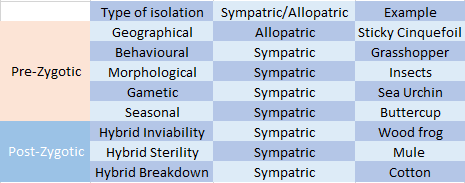
- Types of Reproduction Isolation
- Pre-Zygotic
- Geographical isolation
- Population split by physical barrier into separate demes
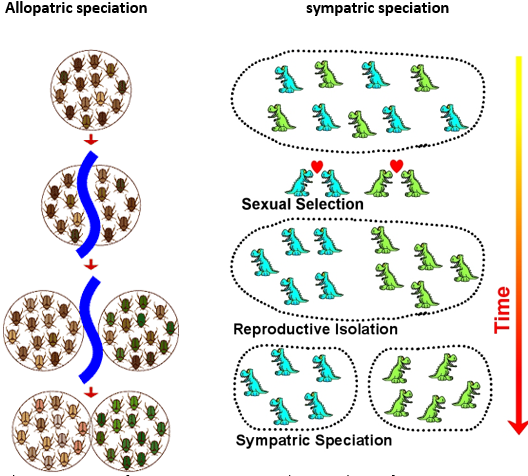
- When demes are in different areas, speciation is allopatric
- Allopatric Speciation: Evolution of new species from demes isolated in different geographical locations
- When demes are in different areas, speciation is allopatric
- Population split by physical barrier into separate demes
- Gametes are prevented from fusing, thus zygote never formed
- Behavioural Isolation
- Species have specific mating rituals & courtship displays
- But if Male A doesn't sings, Male B sings, Female B may mate w/Male A
- The 2 groups will diverge across generations that they become different species
- Called Sympatric Speciation = Evolution of new species from demes sharing a geographical location
- The 2 groups will diverge across generations that they become different species
- But if Male A doesn't sings, Male B sings, Female B may mate w/Male A
- Species have specific mating rituals & courtship displays
- Morphological Isolation
- Individuals of species have certain body shapes in order to reproduce (Mechanical isolation)/pollinate
- Gametic Isolation
- Gametes in open environments (water) meet gametes of other species
- Can often make viable offspring (Coral reefs)
- Barriers prevent fusion of gametes of different species
- Leading to isolated populations
- Gamete membrane has molecules that prevent inter-species fusion
- Female secretes chemo-attractants that are only recognised by males of same species
- Gametic isolation lead to sympatric isolation
- Leading to isolated populations
- Barriers prevent fusion of gametes of different species
- Can often make viable offspring (Coral reefs)
- Gametes in open environments (water) meet gametes of other species
- Seasonal (Temporal) Isolation
- Reproductive organs of different demes mature at different times of year
- Thus unable to hybridise & are genetically isolated
- Grow in the same area, so this leads to sympatric isolation
- Thus unable to hybridise & are genetically isolated
- Reproductive organs of different demes mature at different times of year
- Geographical isolation
- Post-Zygotic
- Gametes fuse, zygote forms, organism is infertile so genes are separate & species don't merge
- Hybrid inviability
- Fertilisation occurs,
- Incompatibility means embryo fails to develop
- Leading to hybrid = Offspring of a cross between members of different species
- Incompatibility means embryo fails to develop
- Fertilisation occurs,
- Hybrid Sterility
- Some cases an embryo develops
- But if chromosomes aren't similar enough, the don't pair at prophase 1
- Meaning no gametes = Hybrid is sterile
- Sterility prevents gene flow between the parental species
- Meaning the species remains distinct
- Sterility prevents gene flow between the parental species
- Meaning no gametes = Hybrid is sterile
- But if chromosomes aren't similar enough, the don't pair at prophase 1
- Plants only
- If infertile F1 offspring undergoes endomitosis
- & Doesn't undergo cytokinesis
- Chromosome No. doubles >
- 2 copies of each chromosome are present
- Pairing occurs > Offspring fertile
- 2 copies of each chromosome are present
- Chromosome No. doubles >
- & Doesn't undergo cytokinesis
- If infertile F1 offspring undergoes endomitosis
- Some cases an embryo develops
- Hybrid Breakdown
- Some F1 are fertile, Some F2 infertile
- More common in plants (Cotton, Rice)
- Due to Incompatibility between nuclear genes & mitochondria/chloroplast genes
- More common in plants (Cotton, Rice)
- Some F1 are fertile, Some F2 infertile
- Pre-Zygotic
- Speciation occurs as a result of the founder effect, genetic drift & natural selection
- It is enhanced by Reproductive isolation
- Species = Groups of organisms that interbreed to make fertile offspring
Darwinian Evolution
- Darwin went to galapagos islands
- Found 14 species of finch, found nowhere else on earth
- Sub-species had adapted to environmental conditions of their habitat
- Filling vacant niches free from competition from other flinches that failed to reach the island
- Sub species differed (beak shape & size) reflecting habitat
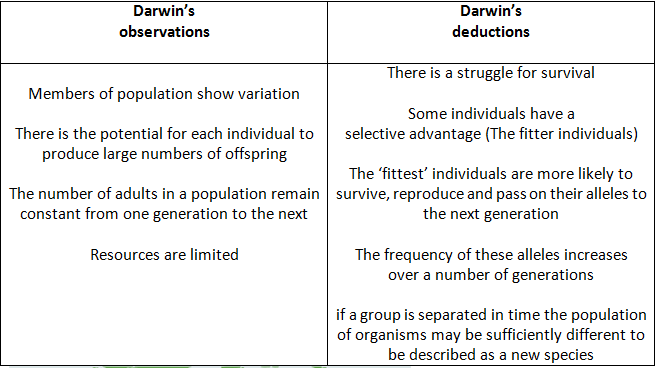
- Darwins observations & deductions, in modern terms
- 1) Competition for limited resources
- 2) Individuals w/alleles making better-adapted phenotypes reproduce more successfully
- 3) Passing alleles of phenotype to offspring, continues over generations
- 4) Those alleles start to appear more frequently in the gene pool of a population
- 5) Causing the average phenotype to change (This change = Evolution)
- 6) If changes are significant enough, individual can't interbreed w/member of original population
- 7) Forming a new species
- 8) Natural selection maintains phenotypes in stable environment, Changes them in a changing environment
- 7) Forming a new species
- 6) If changes are significant enough, individual can't interbreed w/member of original population
- 5) Causing the average phenotype to change (This change = Evolution)
- 4) Those alleles start to appear more frequently in the gene pool of a population
- 3) Passing alleles of phenotype to offspring, continues over generations
- 2) Individuals w/alleles making better-adapted phenotypes reproduce more successfully
- 1) Competition for limited resources
- Darwins observations & deductions, in modern terms
- Sub species differed (beak shape & size) reflecting habitat
- Filling vacant niches free from competition from other flinches that failed to reach the island
- Sub-species had adapted to environmental conditions of their habitat
- Found 14 species of finch, found nowhere else on earth
- 2 types of evolutionary product
- Adaptations are features used in original form
- Exaptations are structures that appear to have their original use modified
- Natural Selection, founder effect, genetic drift, only modify phenotype by acting on alleles already present
- Therefore evolution only changes what is already there
- & only does so in response to environmental changes
- Evolution isn't always direct or follows a linear path
- Some structures don't appear ideally suited to their function
- Evolution isn't always direct or follows a linear path
- & only does so in response to environmental changes
- Therefore evolution only changes what is already there
- Darwin went to galapagos islands
Niche: Particular area in a population
Imágenes y archivos del mapa
Información
- Descripción
- Mapa Mental sobre Variation & Evolution, creado por Shehzeb B el 14/12/2016.
- Creado por
- Shehzeb B
- Visitas
- 7
- Valoración