
Mapa mental
week 4: the implementation
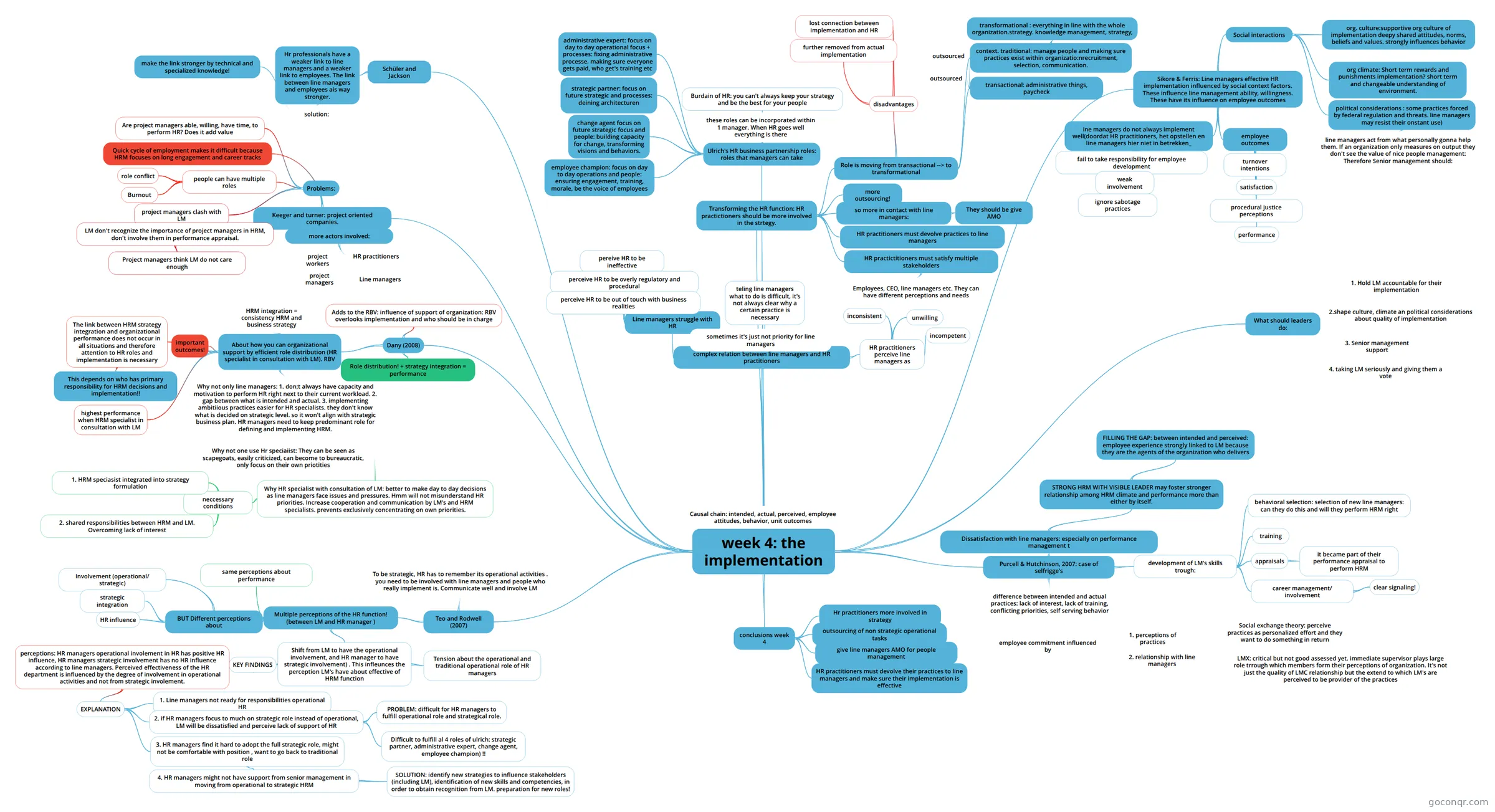
Mind map: week 4 the implementation HR
Contenido del mapa
week 4: the implementation
Causal chain: intended, actual, perceived, employee attitudes, behavior, unit outcomes
Transforming the HR function: HR practictioners should be more involved in the strtegy.
- Role is moving from transactional --> to transformational
- disadvantages
- further removed from actual implementation
- lost connection between implementation and HR
- transactional: administrative things, paycheck
- outsourced
- outsourced
- context. traditional: manage people and making sure practices exist within organizatio:nrecruitment, selection, communication.
- transformational : everything in line with the whole organization.strategy. knowledge management, strategy,
- disadvantages
- more outsourcing!
- HR practitioners must devolve practices to line managers
- HR practictitioners must satisfy multiple stakeholders
- Employees, CEO, line managers etc. They can have different perceptions and needs
- so more in contact with line managers:
- They should be give AMO
- Role is moving from transactional --> to transformational
Ulrich's HR business partnership roles: roles that managers can take
- strategic partner: focus on future strategic and processes: deining architecturen
- administrative expert: focus on day to day operational focus + processes: fixing administrative processe. making sure everyone gets paid, who get's training etc
- change agent focus on future strategic focus and people: building capacity for change, transforming visions and behaviors.
- employee champion: focus on day to day operations and people: ensuring engagement, training, morale, be the voice of employees
- these roles can be incorporated within 1 manager. When HR goes well everything is there
- Burdain of HR: you can't always keep your strategy and be the best for your people
Sikore & Ferris: Line managers effective HR implementation influenced by social context factors. These influence line management ability, willingness. These have its influence on employee outcomes
- Social interactions
- political considerations : some practices forced by federal regulation and threats. line managers may resist their onstant use)
- line managers act from what personally gonna help them. If an organization only measures on output they don't see the value of nice people management: Therefore Senior management should:
- 1. Hold LM accountable for their implementation
- 2.shape culture, climate an political considerations about quality of implementation
- 3. Senior management support
- 4. taking LM seriously and giving them a vote
- 3. Senior management support
- 2.shape culture, climate an political considerations about quality of implementation
- 1. Hold LM accountable for their implementation
- line managers act from what personally gonna help them. If an organization only measures on output they don't see the value of nice people management: Therefore Senior management should:
- org. culture:supportive org culture of implementation deepy shared attitudes, norms, beliefs and values. strongly influences behavior
- org climate: Short term rewards and punishments implementation? short term and changeable understanding of environment.
- political considerations : some practices forced by federal regulation and threats. line managers may resist their onstant use)
- employee outcomes
- turnover intentions
- satisfaction
- procedural justice perceptions
- performance
- ine managers do not always implement well(doordat HR practitioners, het opstellen en line managers hier niet in betrekken_
- fail to take responsibility for employee development
- weak involvement
- ignore sabotage practices
- weak involvement
- fail to take responsibility for employee development
- Social interactions
complex relation between line managers and HR practitioners
- Line managers struggle with HR
- pereive HR to be ineffective
- perceive HR to be overly regulatory and procedural
- perceive HR to be out of touch with business realities
- teling line managers what to do is difficult, it's not always clear why a certain practice is necessary
- HR practitioners perceive line managers as
- inconsistent
- unwilling
- incompetent
- sometimes it's just not priority for line managers
- Line managers struggle with HR
Schüler and Jackson
- Hr professionals have a weaker link to line managers and a weaker link to employees. The link between line managers and employees ais way stronger.
- solution:
- make the link stronger by technical and specialized knowledge!
- solution:
- Hr professionals have a weaker link to line managers and a weaker link to employees. The link between line managers and employees ais way stronger.
What should leaders do:
Keeger and turner: project oriented companies.
- Quick cycle of employment makes it difficult because HRM focuses on long engagement and career tracks
- more actors involved:
- HR practitioners
- Line managers
- project managers
- project workers
- project managers
- Line managers
- HR practitioners
- Problems:
- people can have multiple roles
- role conflict
- Burnout
- project managers clash with LM
- LM don't recognize the importance of project managers in HRM, don't involve them in performance appraisal.
- Project managers think LM do not care enough
- LM don't recognize the importance of project managers in HRM, don't involve them in performance appraisal.
- Are project managers able, willing, have time, to perform HR? Does it add value
- people can have multiple roles
Dany (2008)
- About how you can organizational support by efficient role distribution (HR specialist in consultation with LM). RBV
- highest performance when HRM specialist in consultation with LM
- The link between HRM strategy integration and organizational performance does not occur in all situations and therefore attention to HR roles and implementation is necessary
- This depends on who has primary responsibility for HRM decisions and implementation!!
- HRM integration = consistency HRM and business strategy
- Why not only line managers: 1. don;t always have capacity and motivation to perform HR right next to their current workload. 2. gap between what is intended and actual. 3. implementing ambitiious practices easier for HR specialists. they don't know what is decided on strategic level. so it won't align with strategic business plan. HR managers need to keep predominant role for defining and implementing HRM.
- Why not one use Hr speciaiist: They can be seen as scapegoats, easily criticized, can become to bureaucratic, only focus on their own priotities
- Why HR specialist with consultation of LM: better to make day to day decisions as line managers face issues and pressures. Hmm will not misunderstand HR priorities. Increase cooperation and communication by LM's and HRM specialists. prevents exclusively concentrating on own priorities.
- neccessary conditions
- 1. HRM speciasist integrated into strategy formulation
- 2. shared responsibilities between HRM and LM. Overcoming lack of interest
- neccessary conditions
- Why HR specialist with consultation of LM: better to make day to day decisions as line managers face issues and pressures. Hmm will not misunderstand HR priorities. Increase cooperation and communication by LM's and HRM specialists. prevents exclusively concentrating on own priorities.
- Why not one use Hr speciaiist: They can be seen as scapegoats, easily criticized, can become to bureaucratic, only focus on their own priotities
- important outcomes!
- Adds to the RBV: influence of support of organization: RBV overlooks implementation and who should be in charge
- Role distribution! + strategy integration = performance
- About how you can organizational support by efficient role distribution (HR specialist in consultation with LM). RBV
Teo and Rodwell (2007)
- To be strategic, HR has to remember its operational activities . you need to be involved with line managers and people who really implement is. Communicate well and involve LM
- Multiple perceptions of the HR function! (between LM and HR manager )
- same perceptions about performance
- BUT Different perceptions about
- Involvement (operational/ strategic)
- strategic integration
- HR influence
- Shift from LM to have the operational involvement, and HR manager to have strategic involvement) . This infleunces the perception LM's have about effective of HRM function
- KEY FINDINGS
- perceptions: HR managers operational involement in HR has positive HR influence, HR managers strategic involvement has no HR influence according to line managers. Perceived effectiveness of the HR department is influenced by the degree of involvement in operational activities and not from strategic involement.
- EXPLANATION
- 1. Line managers not ready for responsibilities operational HR
- 2. if HR managers focus to much on strategic role instead of operational, LM will be dissatisfied and perceive lack of support of HR
- PROBLEM: difficult for HR managers to fulfill operational role and strategical role.
- Difficult to fulfill al 4 roles of ulrich: strategic partner, administrative expert, change agent, employee champion) !!
- 3. HR managers find it hard to adopt the full strategic role, might not be comfortable with position , want to go back to traditional role
- 4. HR managers might not have support from senior management in moving from operational to strategic HRM
- SOLUTION: identify new strategies to influence stakeholders (including LM), identification of new skills and competencies, in order to obtain recognition from LM. preparation for new roles!
- 4. HR managers might not have support from senior management in moving from operational to strategic HRM
- EXPLANATION
- perceptions: HR managers operational involement in HR has positive HR influence, HR managers strategic involvement has no HR influence according to line managers. Perceived effectiveness of the HR department is influenced by the degree of involvement in operational activities and not from strategic involement.
- Tension about the operational and traditional operational role of HR managers
- KEY FINDINGS
Purcell & Hutchinson, 2007: case of selfrigge's
- Dissatisfaction with line managers: especially on performance management t
- STRONG HRM WITH VISIBLE LEADER may foster stronger relationship among HRM climate and performance more than either by itself.
- FILLING THE GAP: between intended and perceived: employee experience strongly linked to LM because they are the agents of the organization who delivers
- STRONG HRM WITH VISIBLE LEADER may foster stronger relationship among HRM climate and performance more than either by itself.
- development of LM's skills trough:
- behavioral selection: selection of new line managers: can they do this and will they perform HRM right
- training
- appraisals
- it became part of their performance appraisal to perform HRM
- career management/ involvement
- clear signaling!
- difference between intended and actual practices: lack of interest, lack of training, conflicting priorities, self serving behavior
- employee commitment influenced by
- 1. perceptions of practices
- Social exchange theory: perceive practices as personalized effort and they want to do something in return
- 2. relationship with line managers
- LMX: critical but not good assessed yet. immediate supervisor plays large role trrough which members form their perceptions of organization. It's not just the quality of LMC relationship but the extend to which LM's are perceived to be provider of the practices
- 1. perceptions of practices
- employee commitment influenced by
- Dissatisfaction with line managers: especially on performance management t
conclusions week 4
- Hr practitioners more involved in strategy
- outsourcing of non strategic operational tasks
- give line managers AMO for people management
- HR practitioners must devolve their practices to line managers and make sure their implementation is effective
Información
- Descripción
- Managing people strategically Mapa Mental sobre week 4: the implementation, creado por Ella Hustinx el 20/12/2016.
- Creado por
- Ella Hustinx
- Visitas
- 0
- Valoración