
Mapa mental
The Winter's Tale
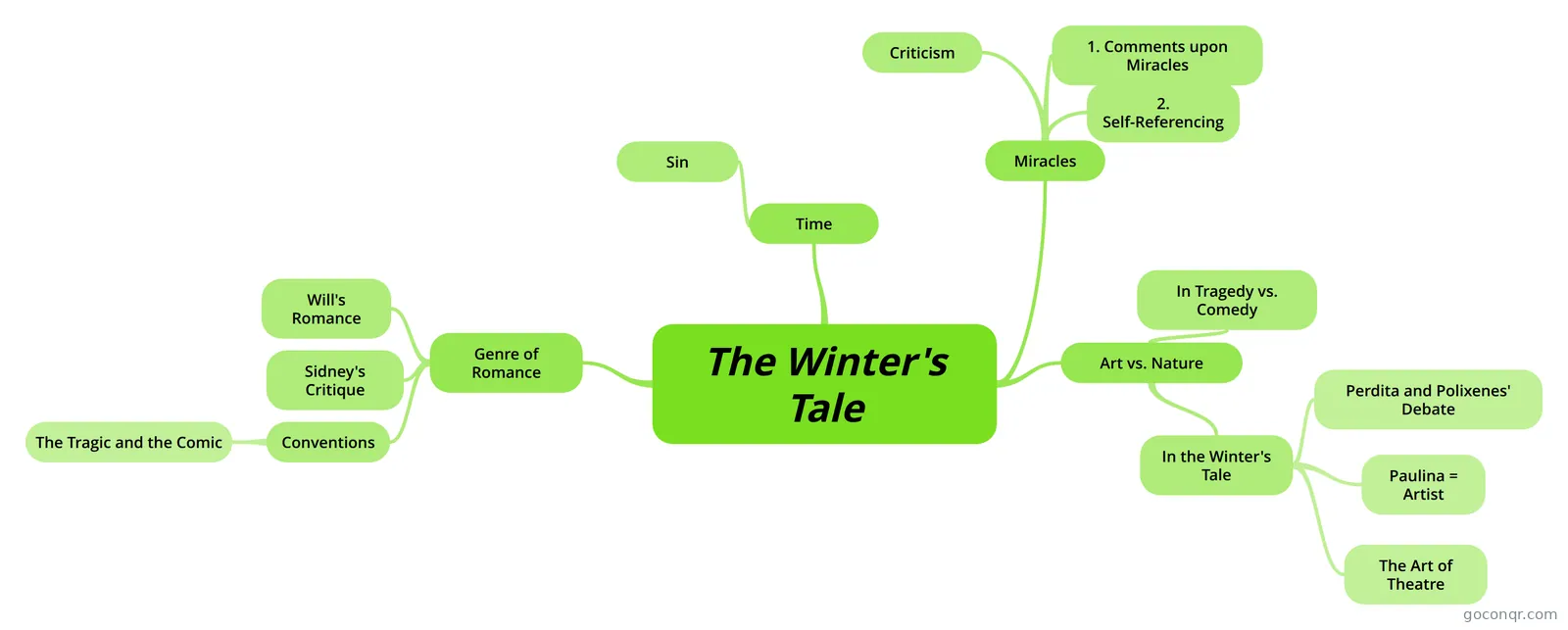
Mind map: The Winter's Tale
Contenido del mapa
The Winter's Tale
- 1610, 1611
Genre of Romance
- Will's shift to Romance is also a return, to a style considered old-fashioned by the early 17th century. It was popular in the late 1570s and 80s, but its popularity had waned as theatre groups became more sophisticated.
- Conventions
- Romance is marked by a very liberal use of time and space, its mixture of high and low born character, and its reliance upon the fantastical, magical, or miraculous. It is not quite the same as tragicomedy (not all tragicomedies are romances) but it uses the tragicomical structure. Both move from order --> disorder --> order.
- The Tragic and the Comic
- Recall that the opening scenario of Midsummer Night's Dream and Romeo and Juliet are very similar. One develops comically, the other tragically, yet each is haunted by the opposite genre. In The Winter's Tale, tragedy's potential is actually developed and becomes the precondition of the comedy to follow. This is a structural precondition, and an emotional one; our feelings of joy, love and wonder depend upon the strength of tragic emotions.
- Sidney's Critique
- Sidney criticies Romance because of its use of time and space. Sidney subscribes to the Aristotelian unities of time, space, and action. (1) The duration of fictional time must not exceed 1 day, ideally the same amount of time as the performance. (2) All of the action should occur in one fictional location. (3) The drama must imitate the causal action in the real world, ruling out the miraculous. Because of these things, for Sidney, Romance is bad drama. The unities imply an imitative relationship between art and nature; art must be the mirror of nature.
- Will's Romance
- Unlike Sidney (or Jonson), Will certainly wouldn't consider The Winter's Tale a failure. He is highly aware of neoclassical theory. Rather, this play is experimental: the relationship between nature and art is more complex than Sidney's, Ben's, or Hamlet's.
Time
- In tragedy, time devours. In Romance, time is a productive and providential force. In addition, The Winter's Tale has time as a character. Time is an active moral force that unfolds error to reveal the truth: the oracle, for example, is ultimately fulfilled (over time).
- Sin
- Time also allows the redemption of sin; forgiveness is achieved not through works, but through grace. The King's sin is his lack of faith. Nothing he can do can make up for that sin, but time heals the wound for him. This gives Perdita, and especially Hermione, the redemptive powers of a Christ-figure.
Art vs. Nature
- theatre/art vs. reality/nature.
- In Tragedy vs. Comedy
- In Comedy, art and nature are frequently equated (i.e. "all the world's a stage"). This emphasizes, at least from Jacques' perspective, the vanity of life. In tragedy, characters tend to emphasize the emptiness or unreality of both theatre and of life. In Henry V, the power of theatre is completely inadequate; history cannot be staged. In Hamlet, the Mousetrap appears more like theatre so that Hamlet's story appears more realistic. In other words, theatre has to denounce itself.
- In the Winter's Tale
- This play problematizes its own status as theatre; it makes theatre a self-referential theme. Maybe, reality imitates art?
- Perdita and Polixenes' Debate
- In 4.4, Perdita reveals that she dislikes Gillyflowers, "nature's bastards," because they are the result of humans tampering with nature. Polixenes counters by saying that art both supplements and is the product of nature. Grafting, a process conducted by man, is nature. They aren't just talking about flowers, but of the "unnatural" mixing of commoners and aristocrats. Ironically, with regard to the marriage, they argue the opposite side. [In Romance, opposites are reconciled by making the oppositions disappear].
- Paulina = Artist
- Paulina is the play's artist figure; moving beyond imitation, she has the ability to transform art into life. It is important that the second Gentleman convinces us that the statue is, in fact, a statue. Paulina's magic, consequently, becomes transformative and life-giving.
- The Art of Theatre
- The play gives us opportunities to believe that Hermione did not, in fact die. Hence, the "miracle" of her resurrection becomes, not a miracle of magic, but of theatre. Leontes has suffered as if his wife had died; he played the role of mourning, guilty husband, even if he didn' know it was a role. Paulina has been drawing him in to a piece of theatre, feeding his lines to him. But she also threatens to end the performance (i.e. by drawing the curtains, remember that the paint is not dry), heightening the drama of the performance.
Miracles
- Miracles and/or magic are strictly against the three neoclassical unities, but they are the qualities of the Romance genre.
- Criticism
- Perdita, in the debate of the flowers, has the perspective of a critic of Romance. But since Will was returning to a somewhat antiquated genre, he may have toned down the criticism. Instead, he ups the Romance in two ways.
- 1. Comments upon Miracles
- Characters often comment upon "wonders" and their lack of words to express them. They view miracles as things more than art can express. Even ballad makers, who specialize in writing songs for the masses, cannot comment upon the play's miracle - who can?
- 2. Self-Referencing
- Characters describe the events they witness by comparing them, ironically, to the genre of Romance. Phrases like "so like an old tale" suggest that, perhaps, Romance does imitate life… Perhaps, conversely, the play indicates that life imitates Romance. By calling something a "tale," reality participates in the quality of fiction. These examples also pre-empt the audiences' disbelief (i.e. you aren't going to believe this!) and paradoxically reminds us that this entire thing is a tale.
Información
- Descripción
- Mapa Mental sobre The Winter's Tale, creado por emilyvanharen el 14/04/2014.
- Creado por
- emilyvanharen
- Visitas
- 53
- Valoración