
Mapa mental
Arbitration
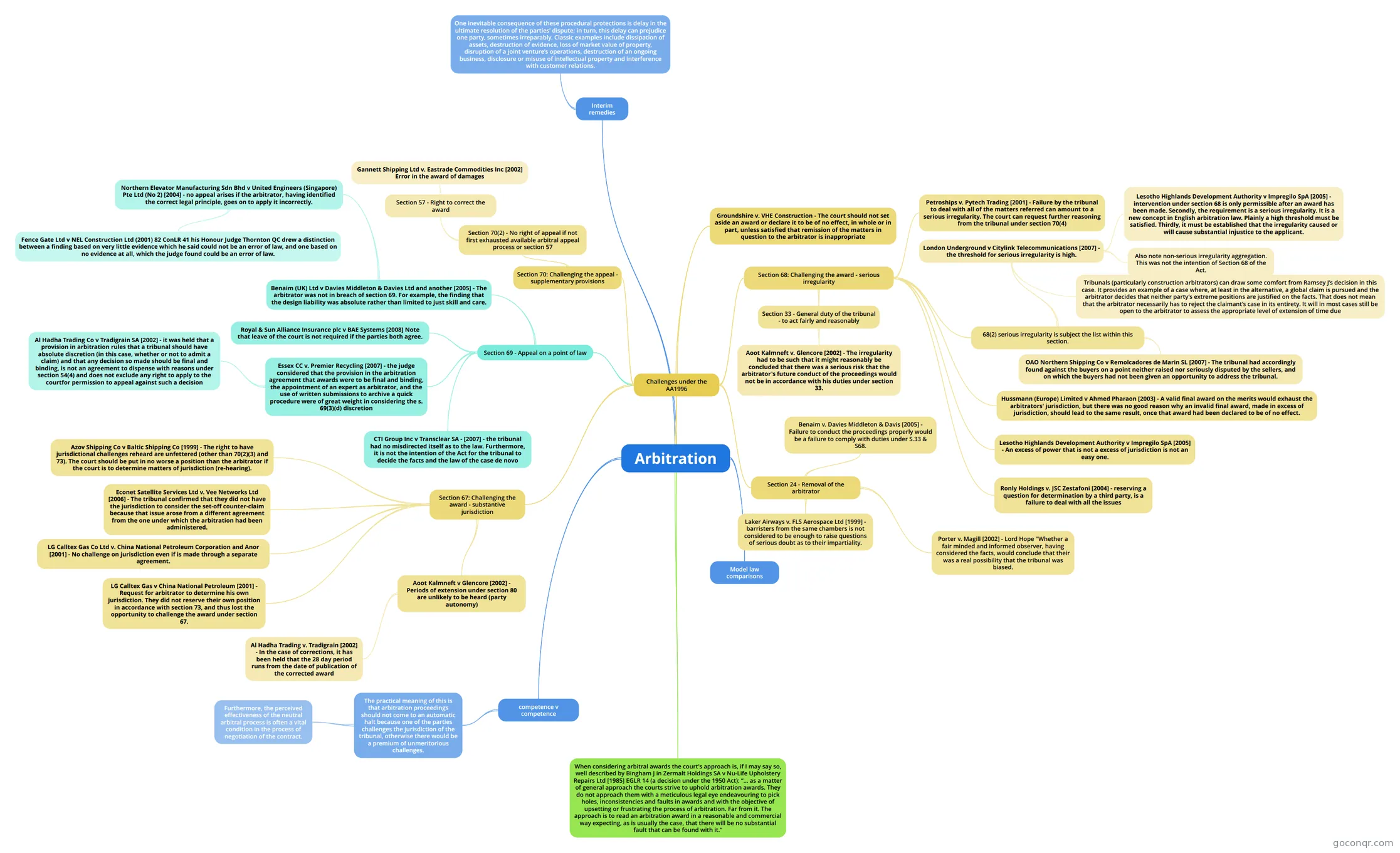
Mind map: Arbitration
Contenido del mapa
Arbitration
Challenges under the AA1996
- Section 70: Challenging the appeal - supplementary provisions
- Section 70(2) - No right of appeal if not first exhausted available arbitral appeal process or section 57
- Section 57 - Right to correct the award
- Gannett Shipping Ltd v. Eastrade Commodities Inc [2002] Error in the award of damages
- Section 57 - Right to correct the award
- Section 70(2) - No right of appeal if not first exhausted available arbitral appeal process or section 57
- Section 67: Challenging the award - substantive jurisdiction
- LG Calltex Gas Co Ltd v. China National Petroleum Corporation and Anor [2001] - No challenge on jurisdiction even if is made through a separate agreement.
- Aoot Kalmneft v Glencore [2002] - Periods of extension under section 80 are unlikely to be heard (party autonomy)
- Al Hadha Trading v. Tradigrain [2002] - In the case of corrections, it has been held that the 28 day period runs from the date of publication of the corrected award
- Azov Shipping Co v Baltic Shipping Co [1999] - The right to have jurisdictional challenges reheard are unfettered (other than 70(2)(3) and 73). The court should be put in no worse a position than the arbitrator if the court is to determine matters of jurisdiction (re-hearing).
- LG Calltex Gas v China National Petroleum [2001] - Request for arbitrator to determine his own jurisdiction. They did not reserve their own position in accordance with section 73, and thus lost the opportunity to challenge the award under section 67.
- Econet Satellite Services Ltd v. Vee Networks Ltd [2006] - The tribunal confirmed that they did not have the jurisdiction to consider the set-off counter-claim because that issue arose from a different agreement from the one under which the arbitration had been administered.
- Section 68: Challenging the award - serious irregularity
- Hussmann (Europe) Limited v Ahmed Pharaon [2003] - A valid final award on the merits would exhaust the arbitrators' jurisdiction, but there was no good reason why an invalid final award, made in excess of jurisdiction, should lead to the same result, once that award had been declared to be of no effect.
- 68(2) serious irregularity is subject the list within this section.
- London Underground v Citylink Telecommunications [2007] - the threshold for serious irregularity is high.
- Also note non-serious irregularity aggregation. This was not the intention of Section 68 of the Act.
- Tribunals (particularly construction arbitrators) can draw some comfort from Ramsey J’s decision in this case. It provides an example of a case where, at least in the alternative, a global claim is pursued and the arbitrator decides that neither party’s extreme positions are justified on the facts. That does not mean that the arbitrator necessarily has to reject the claimant’s case in its entirety. It will in most cases still be open to the arbitrator to assess the appropriate level of extension of time due
- Lesotho Highlands Development Authority v Impregilo SpA [2005] - intervention under section 68 is only permissible after an award has been made. Secondly, the requirement is a serious irregularity. It is a new concept in English arbitration law. Plainly a high threshold must be satisfied. Thirdly, it must be established that the irregularity caused or will cause substantial injustice to the applicant.
- OAO Northern Shipping Co v Remolcadores de Marin SL [2007] - The tribunal had accordingly found against the buyers on a point neither raised nor seriously disputed by the sellers, and on which the buyers had not been given an opportunity to address the tribunal.
- London Underground v Citylink Telecommunications [2007] - the threshold for serious irregularity is high.
- Section 33 - General duty of the tribunal - to act fairly and reasonably
- Aoot Kalmneft v. Glencore [2002] - The irregularity had to be such that it might reasonably be concluded that there was a serious risk that the arbitrator's future conduct of the proceedings would not be in accordance with his duties under section 33.
- Lesotho Highlands Development Authority v Impregilo SpA [2005] - An excess of power that is not a excess of jurisdiction is not an easy one.
- Petroships v. Pytech Trading [2001] - Failure by the tribunal to deal with all of the matters referred can amount to a serious irregularity. The court can request further reasoning from the tribunal under section 70(4)
- Ronly Holdings v. JSC Zestafoni [2004] - reserving a question for determination by a third party, is a failure to deal with all the issues
- Section 69 - Appeal on a point of law
- Benaim (UK) Ltd v Davies Middleton & Davies Ltd and another [2005] - The arbitrator was not in breach of section 69. For example, the finding that the design liability was absolute rather than limited to just skill and care.
- Northern Elevator Manufacturing Sdn Bhd v United Engineers (Singapore) Pte Ltd (No 2) [2004] - no appeal arises if the arbitrator, having identified the correct legal principle, goes on to apply it incorrectly.
- Fence Gate Ltd v NEL Construction Ltd (2001) 82 ConLR 41 his Honour Judge Thornton QC drew a distinction between a finding based on very little evidence which he said could not be an error of law, and one based on no evidence at all, which the judge found could be an error of law.
- Northern Elevator Manufacturing Sdn Bhd v United Engineers (Singapore) Pte Ltd (No 2) [2004] - no appeal arises if the arbitrator, having identified the correct legal principle, goes on to apply it incorrectly.
- Royal & Sun Alliance Insurance plc v BAE Systems [2008] Note that leave of the court is not required if the parties both agree.
- Essex CC v. Premier Recycling [2007] - the judge considered that the provision in the arbitration agreement that awards were to be final and binding, the appointment of an expert as arbitrator, and the use of written submissions to archive a quick procedure were of great weight in considering the s. 69(3)(d) discretion
- Al Hadha Trading Co v Tradigrain SA [2002] - it was held that a provision in arbitration rules that a tribunal should have absolute discretion (in this case, whether or not to admit a claim) and that any decision so made should be final and binding, is not an agreement to dispense with reasons under section 54(4) and does not exclude any right to apply to the courtfor permission to appeal against such a decision
- CTI Group Inc v Transclear SA - [2007] - the tribunal had no misdirected itself as to the law. Furthermore, it is not the intention of the Act for the tribunal to decide the facts and the law of the case de novo
- Benaim (UK) Ltd v Davies Middleton & Davies Ltd and another [2005] - The arbitrator was not in breach of section 69. For example, the finding that the design liability was absolute rather than limited to just skill and care.
- Groundshire v. VHE Construction - The court should not set aside an award or declare it to be of no effect, in whole or in part, unless satisfied that remission of the matters in question to the arbitrator is inappropriate
- Section 24 - Removal of the arbitrator
- Laker Airways v. FLS Aerospace Ltd [1999] - barristers from the same chambers is not considered to be enough to raise questions of serious doubt as to their impartiality.
- Porter v. Magill [2002] - Lord Hope "Whether a fair minded and informed observer, having considered the facts, would conclude that their was a real possibility that the tribunal was biased.
- Benaim v. Davies Middleton & Davis [2005] - Failure to conduct the proceedings properly would be a failure to comply with duties under S.33 & S68.
- Section 70: Challenging the appeal - supplementary provisions
When considering arbitral awards the court's approach is, if I may say so, well described by Bingham J in Zermalt Holdings SA v Nu-Life Upholstery Repairs Ltd [1985] EGLR 14 (a decision under the 1950 Act): “... as a matter of general approach the courts strive to uphold arbitration awards. They do not approach them with a meticulous legal eye endeavouring to pick holes, inconsistencies and faults in awards and with the objective of upsetting or frustrating the process of arbitration. Far from it. The approach is to read an arbitration award in a reasonable and commercial way expecting, as is usually the case, that there will be no substantial fault that can be found with it.”
competence v competence
- The practical meaning of this is that arbitration proceedings should not come to an automatic halt because one of the parties challenges the jurisdiction of the tribunal, otherwise there would be a premium of unmeritorious challenges.
- Furthermore, the perceived effectiveness of the neutral arbitral process is often a vital condition in the process of negotiation of the contract.
- The practical meaning of this is that arbitration proceedings should not come to an automatic halt because one of the parties challenges the jurisdiction of the tribunal, otherwise there would be a premium of unmeritorious challenges.
Interim remedies
- One inevitable consequence of these procedural protections is delay in the ultimate resolution of the parties’ dispute; in turn, this delay can prejudice one party, sometimes irreparably. Classic examples include dissipation of assets, destruction of evidence, loss of market value of property, disruption of a joint venture’s operations, destruction of an ongoing business, disclosure or misuse of intellectual property and interference with customer relations.
Model law comparisons
Información
- Descripción
- Mapa Mental sobre Arbitration, creado por petersolomon3 el 14/04/2014.
- Creado por
- petersolomon3
- Visitas
- 51
- Valoración