
Mapa mental
Chapter 1- Energy
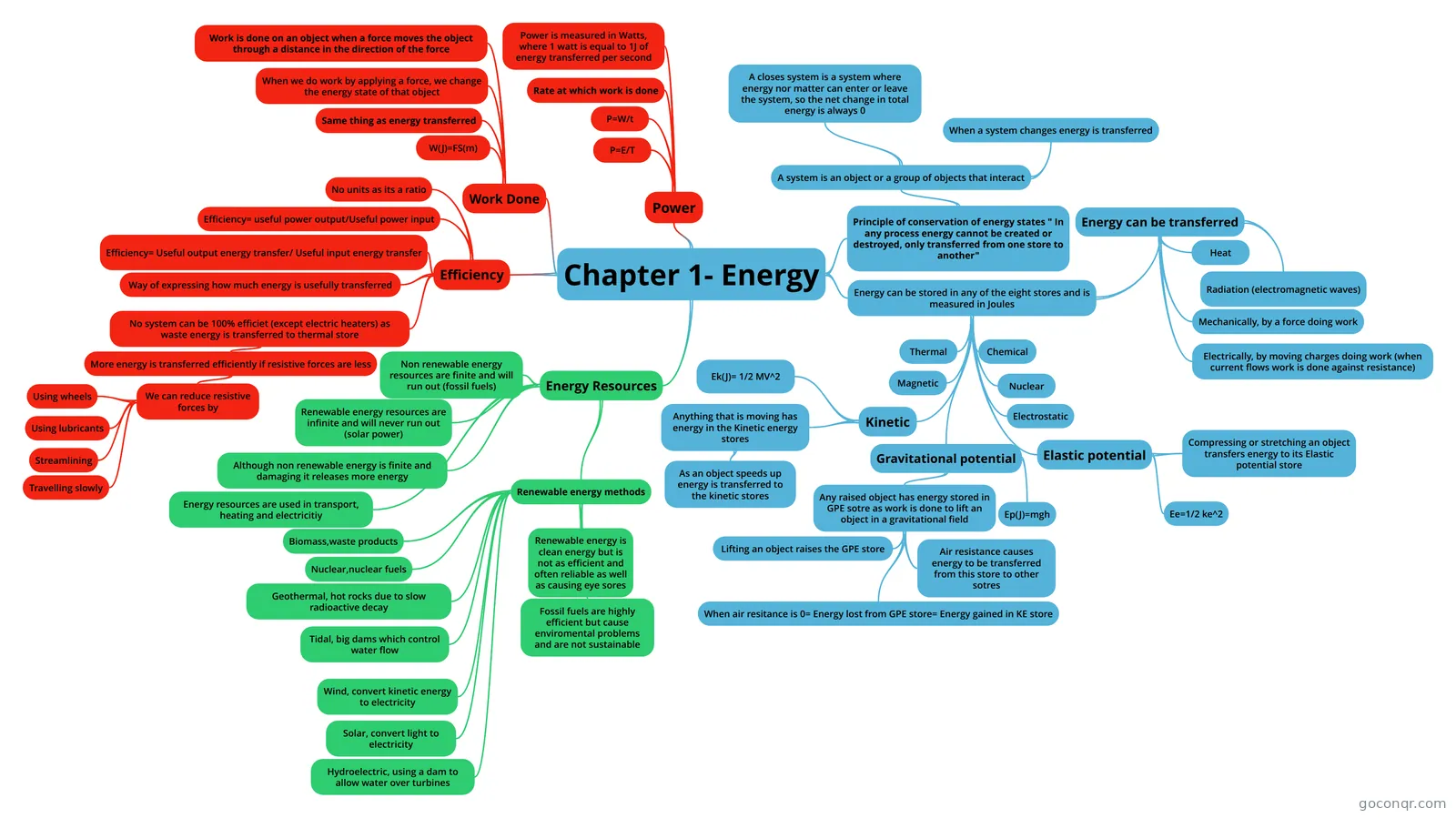
Mind map: Chapter 1 energy
Contenido del mapa
Chapter 1- Energy
Principle of conservation of energy states " In any process energy cannot be created or destroyed, only transferred from one store to another"
- A system is an object or a group of objects that interact
- When a system changes energy is transferred
- A closes system is a system where energy nor matter can enter or leave the system, so the net change in total energy is always 0
- A system is an object or a group of objects that interact
Energy can be stored in any of the eight stores and is measured in Joules
- Thermal
- Kinetic
- Anything that is moving has energy in the Kinetic energy stores
- As an object speeds up energy is transferred to the kinetic stores
- Ek(J)= 1/2 MV^2
- Anything that is moving has energy in the Kinetic energy stores
- Gravitational potential
- Any raised object has energy stored in GPE sotre as work is done to lift an object in a gravitational field
- Lifting an object raises the GPE store
- Air resistance causes energy to be transferred from this store to other sotres
- When air resitance is 0= Energy lost from GPE store= Energy gained in KE store
- Ep(J)=mgh
- Any raised object has energy stored in GPE sotre as work is done to lift an object in a gravitational field
- Elastic potential
- Compressing or stretching an object transfers energy to its Elastic potential store
- Ee=1/2 ke^2
- Magnetic
- Chemical
- Electrostatic
- Nuclear
- Energy can be transferred
- Mechanically, by a force doing work
- Electrically, by moving charges doing work (when current flows work is done against resistance)
- Heat
- Radiation (electromagnetic waves)
Work Done
- Work is done on an object when a force moves the object through a distance in the direction of the force
- W(J)=FS(m)
- When we do work by applying a force, we change the energy state of that object
- Same thing as energy transferred
Power
- Rate at which work is done
- P=E/T
- P=W/t
- Power is measured in Watts, where 1 watt is equal to 1J of energy transferred per second
Efficiency
- Way of expressing how much energy is usefully transferred
- Efficiency= useful power output/Useful power input
- Efficiency= Useful output energy transfer/ Useful input energy transfer
- No units as its a ratio
- No system can be 100% efficiet (except electric heaters) as waste energy is transferred to thermal store
- More energy is transferred efficiently if resistive forces are less
- We can reduce resistive forces by
- Using wheels
- Using lubricants
- Travelling slowly
- Streamlining
- We can reduce resistive forces by
- More energy is transferred efficiently if resistive forces are less
Energy Resources
- Non renewable energy resources are finite and will run out (fossil fuels)
- Renewable energy resources are infinite and will never run out (solar power)
- Although non renewable energy is finite and damaging it releases more energy
- Energy resources are used in transport, heating and electricitiy
- Renewable energy methods
- Nuclear,nuclear fuels
- Wind, convert kinetic energy to electricity
- Biomass,waste products
- Solar, convert light to electricity
- Tidal, big dams which control water flow
- Geothermal, hot rocks due to slow radioactive decay
- Hydroelectric, using a dam to allow water over turbines
- Fossil fuels are highly efficient but cause enviromental problems and are not sustainable
- Renewable energy is clean energy but is not as efficient and often reliable as well as causing eye sores