
Mapa mental
Globalisation and Technology
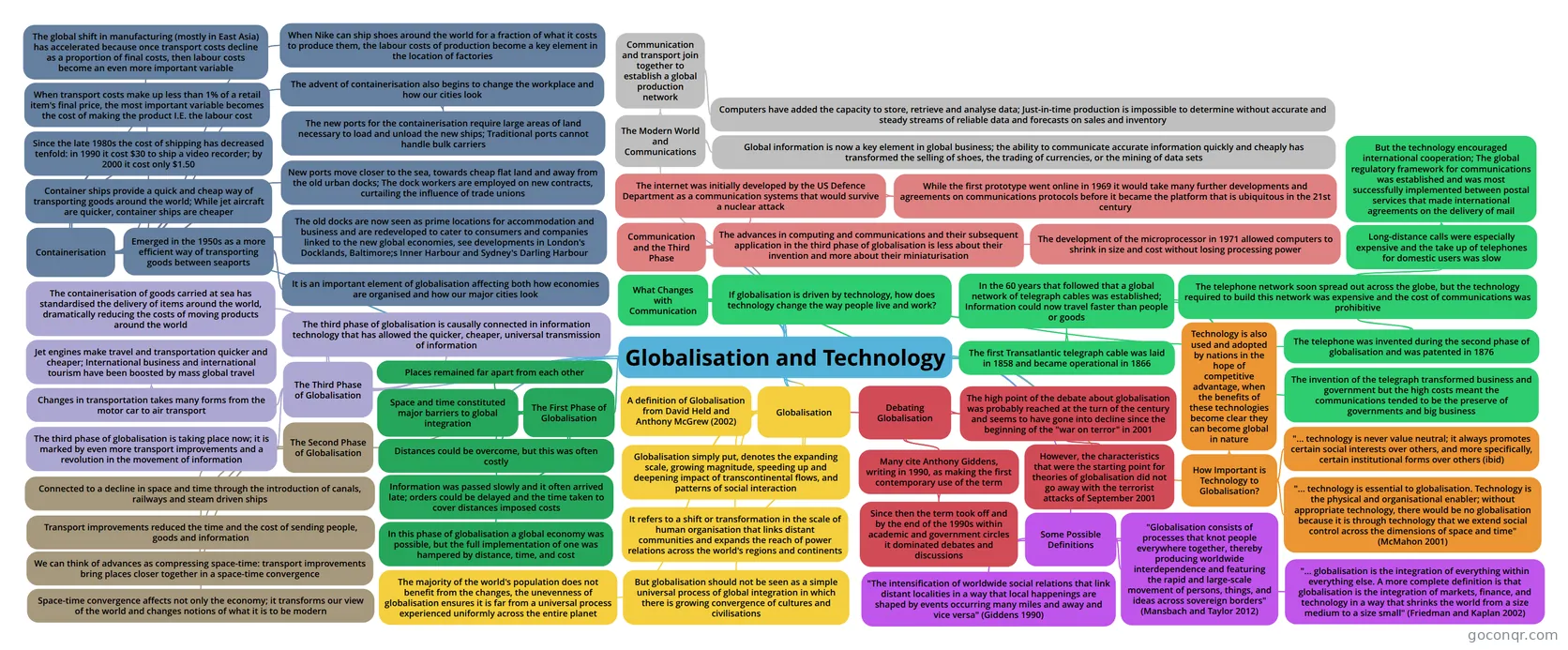
Mind map: Globalisation and Technology
Contenido del mapa
Globalisation and Technology
Debating Globalisation
- Many cite Anthony Giddens, writing in 1990, as making the first contemporary use of the term
- Since then the term took off and by the end of the 1990s within academic and government circles it dominated debates and discussions
- The high point of the debate about globalisation was probably reached at the turn of the century and seems to have gone into decline since the beginning of the "war on terror" in 2001
- However, the characteristics that were the starting point for theories of globalisation did not go away with the terrorist attacks of September 2001
- Many cite Anthony Giddens, writing in 1990, as making the first contemporary use of the term
Some Possible Definitions
- "The intensification of worldwide social relations that link distant localities in a way that local happenings are shaped by events occurring many miles and away and vice versa" (Giddens 1990)
- "Globalisation consists of processes that knot people everywhere together, thereby producing worldwide interdependence and featuring the rapid and large-scale movement of persons, things, and ideas across sovereign borders" (Mansbach and Taylor 2012)
- "... globalisation is the integration of everything within everything else. A more complete definition is that globalisation is the integration of markets, finance, and technology in a way that shrinks the world from a size medium to a size small" (Friedman and Kaplan 2002)
How Important is Technology to Globalisation?
- "... technology is essential to globalisation. Technology is the physical and organisational enabler; without appropriate technology, there would be no globalisation because it is through technology that we extend social control across the dimensions of space and time" (McMahon 2001)
- "... technology is never value neutral; it always promotes certain social interests over others, and more specifically, certain institutional forms over others (ibid)
- Technology is also used and adopted by nations in the hope of competitive advantage, when the benefits of these technologies become clear they can become global in nature
Globalisation
- A definition of Globalisation from David Held and Anthony McGrew (2002)
- Globalisation simply put, denotes the expanding scale, growing magnitude, speeding up and deepening impact of transcontinental flows, and patterns of social interaction
- It refers to a shift or transformation in the scale of human organisation that links distant communities and expands the reach of power relations across the world's regions and continents
- But globalisation should not be seen as a simple universal process of global integration in which there is growing convergence of cultures and civilisations
- The majority of the world's population does not benefit from the changes, the unevenness of globalisation ensures it is far from a universal process experienced uniformly across the entire planet
The First Phase of Globalisation
- Space and time constituted major barriers to global integration
- Distances could be overcome, but this was often costly
- Information was passed slowly and it often arrived late; orders could be delayed and the time taken to cover distances imposed costs
- In this phase of globalisation a global economy was possible, but the full implementation of one was hampered by distance, time, and cost
- Places remained far apart from each other
The Second Phase of Globalisation
- Connected to a decline in space and time through the introduction of canals, railways and steam driven ships
- Transport improvements reduced the time and the cost of sending people, goods and information
- We can think of advances as compressing space-time: transport improvements bring places closer together in a space-time convergence
- Space-time convergence affects not only the economy; it transforms our view of the world and changes notions of what it is to be modern
The Third Phase of Globalisation
- The third phase of globalisation is taking place now; it is marked by even more transport improvements and a revolution in the movement of information
- Changes in transportation takes many forms from the motor car to air transport
- Jet engines make travel and transportation quicker and cheaper; International business and international tourism have been boosted by mass global travel
- The containerisation of goods carried at sea has standardised the delivery of items around the world, dramatically reducing the costs of moving products around the world
- The third phase of globalisation is causally connected in information technology that has allowed the quicker, cheaper, universal transmission of information
Containerisation
- Emerged in the 1950s as a more efficient way of transporting goods between seaports
- It is an important element of globalisation affecting both how economies are organised and how our major cities look
- Container ships provide a quick and cheap way of transporting goods around the world; While jet aircraft are quicker, container ships are cheaper
- Since the late 1980s the cost of shipping has decreased tenfold: in 1990 it cost $30 to ship a video recorder; by 2000 it cost only $1.50
- When transport costs make up less than 1% of a retail item's final price, the most important variable becomes the cost of making the product I.E. the labour cost
- The global shift in manufacturing (mostly in East Asia) has accelerated because once transport costs decline as a proportion of final costs, then labour costs become an even more important variable
- When Nike can ship shoes around the world for a fraction of what it costs to produce them, the labour costs of production become a key element in the location of factories
- The advent of containerisation also begins to change the workplace and how our cities look
- The new ports for the containerisation require large areas of land necessary to load and unload the new ships; Traditional ports cannot handle bulk carriers
- New ports move closer to the sea, towards cheap flat land and away from the old urban docks; The dock workers are employed on new contracts, curtailing the influence of trade unions
- The old docks are now seen as prime locations for accommodation and business and are redeveloped to cater to consumers and companies linked to the new global economies, see developments in London's Docklands, Baltimore;s Inner Harbour and Sydney's Darling Harbour
- Emerged in the 1950s as a more efficient way of transporting goods between seaports
What Changes with Communication
- If globalisation is driven by technology, how does technology change the way people live and work?
- The first Transatlantic telegraph cable was laid in 1858 and became operational in 1866
- In the 60 years that followed that a global network of telegraph cables was established; Information could now travel faster than people or goods
- The invention of the telegraph transformed business and government but the high costs meant the communications tended to be the preserve of governments and big business
- In the 60 years that followed that a global network of telegraph cables was established; Information could now travel faster than people or goods
- The telephone was invented during the second phase of globalisation and was patented in 1876
- The telephone network soon spread out across the globe, but the technology required to build this network was expensive and the cost of communications was prohibitive
- Long-distance calls were especially expensive and the take up of telephones for domestic users was slow
- But the technology encouraged international cooperation; The global regulatory framework for communications was established and was most successfully implemented between postal services that made international agreements on the delivery of mail
- Long-distance calls were especially expensive and the take up of telephones for domestic users was slow
- The telephone network soon spread out across the globe, but the technology required to build this network was expensive and the cost of communications was prohibitive
Communication and the Third Phase
- The advances in computing and communications and their subsequent application in the third phase of globalisation is less about their invention and more about their miniaturisation
- The development of the microprocessor in 1971 allowed computers to shrink in size and cost without losing processing power
- The internet was initially developed by the US Defence Department as a communication systems that would survive a nuclear attack
- While the first prototype went online in 1969 it would take many further developments and agreements on communications protocols before it became the platform that is ubiquitous in the 21st century
The Modern World and Communications
- Global information is now a key element in global business; the ability to communicate accurate information quickly and cheaply has transformed the selling of shoes, the trading of currencies, or the mining of data sets
- Communication and transport join together to establish a global production network
- Computers have added the capacity to store, retrieve and analyse data; Just-in-time production is impossible to determine without accurate and steady streams of reliable data and forecasts on sales and inventory
Información
- Descripción
- Mapa Mental sobre Globalisation and Technology, creado por Luigi Botrugno el 02/03/2017.
- Creado por
- Luigi Botrugno
- Visitas
- 0
- Valoración