
Mapa mental
PERSONALITY & INDIV. DIFFS
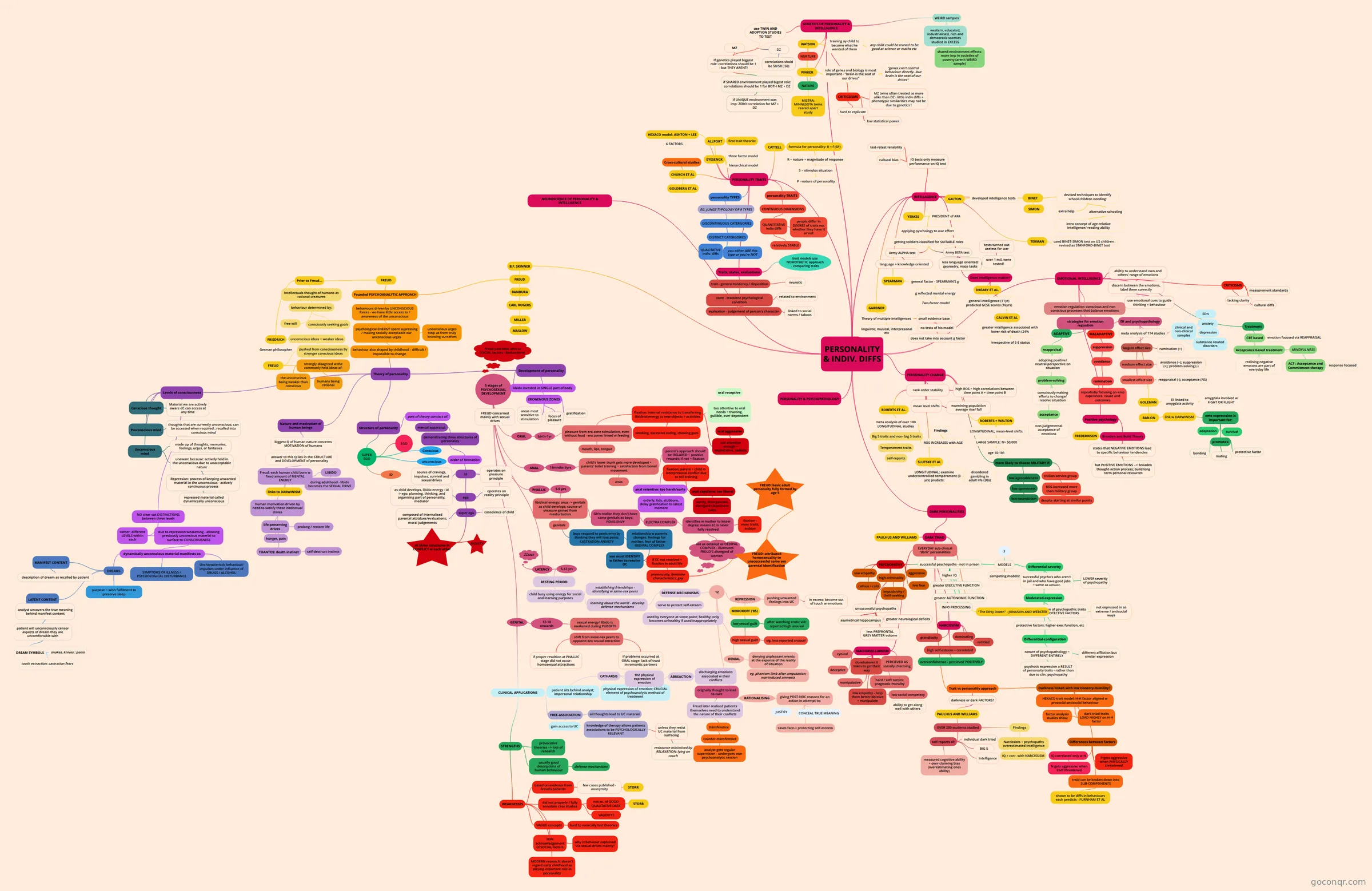
Mind map: personality and individual differences
Contenido del mapa
PERSONALITY & INDIV. DIFFS
PERSONALITY TRAITS
- personality TYPES
- EG. JUNGS TYPOLOGY OF 8 TYPES
- DISCONTINUOUS CATERGORIES
- DISTINCT CATERGORIES
- QUALITATIVE indiv. diffs
- you either ARE this type or you're NOT
- QUALITATIVE indiv. diffs
- DISTINCT CATERGORIES
- DISCONTINUOUS CATERGORIES
- EG. JUNGS TYPOLOGY OF 8 TYPES
- personality TRAITS
- CONTNUOUS DIMENSIONS
- QUANTITATIVE indiv diffs
- people differ in DEGREE of traits not whether they have it or not
- relatively STABLE
- QUANTITATIVE indiv diffs
- CONTNUOUS DIMENSIONS
- Traits, states, evaluations
- trait - general tendency / disposition
- state - transient psychological condition
- evaluation - judgement of person's character
- linked to social norms / taboos
- related to environment
- evaluation - judgement of person's character
- neurotic
- state - transient psychological condition
- trait models use NOMOTHETIC approach - comparing traits
- trait - general tendency / disposition
- ALLPORT
- first trait theorist
- CATTELL
- formula for personality: R = f (SP)
- R = nature + magnitude of response
- S = stimulus situation
- P =nature of personality
- S = stimulus situation
- R = nature + magnitude of response
- formula for personality: R = f (SP)
- CHURCH ET AL
- GOLDBERG ET AL
- Cross-cultural studies
- EYESENCK
- three factor model
- hierarchical model
- HEXACO model: ASHTON + LEE
- 6 FACTORS
- personality TYPES
PERSONALITY CHANGE
- rank order stability
- high ROS = high correlations between time point A + time point B
- ROBERTS ET AL.
- meta analysis of over 100 LONGITUDINAL studies
- Big 5 traits and non- big 5 traits
- Temperament traits
- self-reports
- Temperament traits
- ROS INCREASES with AGE
- Findings
- Big 5 traits and non- big 5 traits
- meta analysis of over 100 LONGITUDINAL studies
- mean level shifts
- examining population average rise/ fall
- SLUTSKE ET AL
- LONGITUDINAL; examine undercontrollled temperament (3 yrs) predicts:
- disordered gambling in adult life (30s)
- LONGITUDINAL; examine undercontrollled temperament (3 yrs) predicts:
- ROBERTS + WALTON
- LONGITUDINAL; mean-level shifts
- LARGE SAMPLE: N> 50,000
- age 10-101
- more likely to choose MILITARY if:
- low agreeableness
- low opennness
- low neuroticism
- low opennness
- civilian service group
- ROS increased more than military group
- despite starting at similar points
- ROS increased more than military group
- low agreeableness
- rank order stability
PERSONALITY & PSYCHOPATHOLOGY
DARK PERSONALITIES
- DARK TRIAD
- EVERYDAY sub-clinical "dark" personalities
- PSYCHOPATHY
- callous / cold
- aggressive
- low empathy
- high criminality
- impuslsivity / thrill-seeking
- low fear
- successful psychopaths - not in prison
- higher IQ
- greater EXECUTIVE FUNCTION
- greater AUTONOMIC FUNCTION
- INFO PROCESSING
- MODELS
- 3
- Differential-severity
- Moderated-expression
- Differential-configuration
- nature of psychopathology = DIFFERENT ENTIRELY
- different affliction but similar expression
- psychotic expression a RESULT of personaity traits - rather than due to clin. psychopathy
- nature of psychopathology = DIFFERENT ENTIRELY
- successful: the expression of psychopathic traits is MODERATED by PROTECTIVE FACTORS
- protective factors: higher exec function, etc
- not expressed in as extreme / antisocial ways
- Differential-configuration
- successful psycho's who aren't in jail and who have good jobs = same as unsucc.
- LOWER severity of psychopathy
- Moderated-expression
- competing models!
- unsuccessful psychopaths
- asymetrical hippocampus
- greater neurological deficits
- less PREFRONTAL GREY MATTER volume
- MACHIAVELLIANISM
- cynical
- do whatever it takes to get their way
- manipulative
- deceptive
- hard / soft tactics: pragmatic morality
- PERCIEVED AS socially charming
- low empathy - help them better deceive + manipulate
- low social competecy
- ability to get along well with others
- PSYCHOPATHY
- PAULHUS AND WILLIAMS
- NARCISSISM
- grandiosity
- dominating
- high self-esteem + correlated
- overconfidnence - percieved POSITIVELY
- entitled
- "The Dirty Dozen" - JONASON AND WEBSTER
- Trait vs personality approach
- darkness or dark FACTORS?
- PAULHUS AND WILLIAMS
- OVER 200 students studied
- self-reports of:
- individual dark triad
- BIG 5
- Intelligence
- measured cognitive ability + over-claiming bias (overestimating ones ability)
- Findings
- IQ + corr. with NARCISSISM
- Narcissists + psychopaths overestimated intelligence
- IQ + corr. with NARCISSISM
- self-reports of:
- OVER 200 students studied
- PAULHUS AND WILLIAMS
- Darkness linked with low Honesty-Humility?
- HEXACO trait model: H-H factor aligned w prosocial-antisocial behaviour
- dark triad traits LOAD HIGHLY on H-H factor
- factor analysis studies show:
- dark triad traits LOAD HIGHLY on H-H factor
- Differences between factors
- IQ correlated only w N
- N gets aggressive when EGO threatened
- P gets aggressive when PHYSICALLY threatened
- traid can be broken down into SUB-COMPONENTS
- shown to be diffs in behaviours each predicts - FURNHAM ET AL
- IQ correlated only w N
- HEXACO trait model: H-H factor aligned w prosocial-antisocial behaviour
- darkness or dark FACTORS?
- EVERYDAY sub-clinical "dark" personalities
- DARK TRIAD
INTELLIGENCE
- GALTON
- developed intelligence tests
- BINET
- devised techniques to identify school children needing:
- alternative schooling
- intro concept of age-relative intelligence/ reading ability
- extra help
- alternative schooling
- SIMON
- devised techniques to identify school children needing:
- TERMAN
- used BINET-SIMON test on US children : revised as STANFORD-BINET test
- YERKES
- PRESIDENT of APA
- applying pyschology to war effort
- getting soldiers classified for SUITABLE roles
- Army ALPHA test
- language + knowledge oriented
- Army BETA test
- less language oriented: geometry, maze tasks
- tests turned out useless for war
- over 1 mil. were tested!
- less language oriented: geometry, maze tasks
- Army ALPHA test
- getting soldiers classified for SUITABLE roles
- applying pyschology to war effort
- PRESIDENT of APA
- SPEARMAN
- general factor - SPEARMAN'S g
- g reflected mental energy
- Two-factor model
- g reflected mental energy
- general factor - SPEARMAN'S g
- GARDNER
- Theory of multiple intelligences
- linguistic, musical, interpresonal etc
- small evidence base
- no tests of his model
- does not take into account g factor
- no tests of his model
- Theory of multiple intelligences
- Does intelligence matter?
- DREARY ET AL.
- general intelligence (11yr) predicted GCSE scores (16yrs)
- CALVIN ET AL
- greater intelligence associated with lower risk of death (24%
- irrespective of S-E status
- greater intelligence associated with lower risk of death (24%
- DREARY ET AL.
- IO tests only measure performance on IQ test
- cultural bias
- test-retest reliability
- GALTON
EMOTIONAL INTELLIGENCE
- emotion regulation: conscious and non conscious processes that balance emotions
- strategies for emotion reguation
- ADAPTIVE
- reappraisal
- adopting positive/ neutral perspective on situation
- problem-solving
- consciously making efforts to change/ resolve situation
- acceptance
- non-judgemental acceptance of emotions
- reappraisal
- MALADAPTIVE
- suppression
- avoidance
- rumination
- repeatedly focusing on emo experience, cause and outcomes
- rumination
- avoidance
- suppression
- ER and psychopathology
- meta analysis of 114 studies
- clinical and non-clinical samples
- anxiety
- depression
- substance related disorders
- ED's
- largest effect size
- medium effect size
- smallest effect size
- reappraisal (-); acceptance (NS)
- avoidance (+); suppression (+); problem-solving (-)
- smallest effect size
- rumination (+)
- medium effect size
- clinical and non-clinical samples
- GOLEMAN
- EI linked to amygdala activity
- amygdala involved w FIGHT OR FLIGHT
- BAR-ON
- link w DARWINISM
- emo expresssion is important for:
- adaptation
- survival
- promotes:
- bonding
- mating
- protective factor
- emo expresssion is important for:
- link w DARWINISM
- EI linked to amygdala activity
- meta analysis of 114 studies
- ADAPTIVE
- strategies for emotion reguation
- Positive psychology
- Broaden and Build Theory
- FREDERIKSON
- states that NEGATIVE EMOTIONS lead to specific behaviour tendencies
- but POSITIVE EMOTIONS --> broaden thought-action process; build long term personal resources
- Broaden and Build Theory
- abiltiy to understand own and others' range of emotions
- discern between the emotions, label them correctly
- use emotional cues to guide thinking + behaviour
- discern between the emotions, label them correctly
- CRITICISMS
- lacking clarity
- measurement standards
- cultural diffs
- Treatment
- CBT based
- realising negative emotons are part of everyday life
- Acceptance based treatment
- MINDFULNESS
- ACT : Acceptance and Commitment therapy
- response focused
- ACT : Acceptance and Commitment therapy
- MINDFULNESS
- Acceptance based treatment
- emotion focused via REAPPRAISAL
- realising negative emotons are part of everyday life
- CBT based
- emotion regulation: conscious and non conscious processes that balance emotions
GENETICS OF PERSONALITY & INTELLIGENCE
- WATSON
- training ay child to become what he wanted of them
- any child could be traned to be good at science or maths etc
- NURTURE
- PINKER
- NATURE
- role of genes and biology is most important - "brain is the seat of our drives"
- "genes can't control behaviour directly...but brain is the seat of our drives"
- training ay child to become what he wanted of them
- use TWIN AND ADOPTION STUDIES TO TEST
- If genetics played biggest role: correlations should be 1 - but THEY ARENT!
- MZ
- if SHARED envrironment played bigest role: correlations should be 1 for BOTH MZ + DZ
- if UNIQUE environment was imp: ZERO correlation for MZ + DZ
- DZ
- correlations shold be 50/50 (.50)
- If genetics played biggest role: correlations should be 1 - but THEY ARENT!
- WEIRD samples
- western, educated, industrialised, rich and democratic soceties studied in EXCESS
- shared-environment effects: more imp in societies of poverty (aren't WEIRD sample)
- CRITICSISMS
- MZ twins often treated as more alike than DZ - little indiv diffs + phenotypic similarities may not be due to genetics !
- hard to replicate
- low statistical power
- MISTRA: MINNESOTA twins reared apart study
- WATSON
NEUROSCIENCE OF PERSONALITY & INTELLIGENCE
B.F. SKINNER
- FREUD
- BANDURA
- CARL ROGERS
- MILLER
- MASLOW
- MILLER
- CARL ROGERS
- Founded PSYCHOANALYTIC APPROACH
- FREUD
- Prior to Freud...
- Intellectuals thought of humans as rational creatures
- behaviour determined by:
- free will
- consciously seeking goals
- behaviour determined by:
- FRIEDRICH
- unconscious ideas = weaker ideas
- pushed from consciousness by stronger conscious ideas
- FREUD
- strongly disagreed w the commonly held ideas of:
- the unconscious being weaker than conscious
- humans being rational
- strongly disagreed w the commonly held ideas of:
- FREUD
- pushed from consciousness by stronger conscious ideas
- German philosopher
- unconscious ideas = weaker ideas
- Intellectuals thought of humans as rational creatures
- Prior to Freud...
- behaviours driven by UNCONSCIOUS forces - we have little access to / awareness of the unconscious
- psychological ENERGY spent supressing / making socially acceptable our unconscious urges
- behaviour also shaped by childhood - difficult / impossible to change
- Theory of personality
- Levels of consciousness
- Conscious thought
- Material we are actively aware of; can access at any time
- example: as I write this I am actively aware of trying to think of an example of conscious thought, and 'what to write next' is my conscious thought at this moment.
- Material we are actively aware of; can access at any time
- Preconscious mind
- thoughts that are currently unconscious; can be accessed when required ; recalled into conscious mind
- example: what you ate for breakfast yesterday
- thoughts that are currently unconscious; can be accessed when required ; recalled into conscious mind
- Unconscious mind
- unaware because: actively held in the unconscious due to unacceptable nature
- example: sexual urges or fantasies that are not sociallly acceptable
- Repression: process of keeping unwanted material in the unconscious - actively continuous process
- repressed material called dynamiccally unconscious
- made up of thoughts, memories, feelings, urges, or fantasies
- unaware because: actively held in the unconscious due to unacceptable nature
- NO clear cut DISTINCTIONS between three levels
- rather, different LEVELS within each
- due to repression weakening - allowing previously unconsious material to surface to CONSCIOUSNESS
- dynamically unconscious material manifests as:
- DREAMS
- purpose = wish fulfilment to preserve sleep
- MANIFEST CONTENT
- description of dream as recalled by patient
- LATENT CONTENT
- analyst uncovers the true meaning behind manifest content
- patient will unconsciously censor aspects of dream they are uncomfortable with
- Freud stated that most of the censored aspects of dreams are sexual in nature - identified several DREA SYMBOLS that he interpreted as having sexual meaning.
- DREAM SYMBOLS
- snakes, knives : penis
- tooth extraction: castration fears
- patient will unconsciously censor aspects of dream they are uncomfortable with
- analyst uncovers the true meaning behind manifest content
- SYMPTOMS OF ILLNESS / PSYCHOLOGICAL DISTURBANCE
- Uncharacteristic behaviour/ impulses under influence of DRUGS / ALCOHOL
- example: a usually shy individual becomes aggressive towards peers when udner influence of alcohol alcohol is a DISINHIBITOR- allows emergence of dynamically unconscious material
- DREAMS
- dynamically unconscious material manifests as:
- due to repression weakening - allowing previously unconsious material to surface to CONSCIOUSNESS
- rather, different LEVELS within each
- Conscious thought
- Nature and motivation of human beings
- biggest Q of human nature concerns MOTIVATION of humans
- answer to this Q lies in the STRUCTURE and DEVELOPMENT of personality
- Freud: each human child born w fixed amount of MENTAL ENERGY
- LIBIDO
- during adulthood - libido becomes the SEXUAL DRIVE
- links to DARWINISM
- human motivation driven by need to satisfy these instinctual drives
- life-preserving drives
- hunger, pain
- prolong / restore life
- THANTOS: death instinct
- self-destruct instinct
- life-preserving drives
- LIBIDO
- Freud: each human child born w fixed amount of MENTAL ENERGY
- answer to this Q lies in the STRUCTURE and DEVELOPMENT of personality
- biggest Q of human nature concerns MOTIVATION of humans
- Structure of personality
- SUPER EGO
- EGO
- ID
- Conscious
- unconscious
- part of theory consists of:
- mental apparatus
- demonstrating three structures of personality
- order of formation
- id
- "I want it NOW!"
- ego
- "You can have it later!" "You can have a,b,c instead!" - social
- super ego
- "You cant have it" "That way is wrong, obtain it in a diffrent way"
- composed of internalised parental attitdues/evaluations; moral judgements
- conscience of child
- all three structures in CONFLICT w each other
- ANXIETY
- as child develops, libido energy : id -> ego; planning, thinking, and organising part of personality; mediator
- operates on reality principle
- source of cravings, impulses, survival and sexual drives
- -Freud thought the id was only present at birth, which is why infants try to have their needs met directly. -Infants have no sense of delayed gratification, the idea that if you wait patiently, your needs will be met. -id instinct for instant gratification remains with us for rest of our lives (eg. credit example)
- operates on pleasure principle
- id
- order of formation
- demonstrating three structures of personality
- mental apparatus
- SUPER EGO
- Development of personality
- 5 stages of PSYCHOSEXUAL DEVELOPMENT
- FREUD concerned mainly with sexual drives
- ORAL
- birth-1yr
- pleasure from ero zone stimulation, even without food - ero zones linked w feeding
- cathexis - infant focuses libidinal energy on person caring for them and thus providing gratification - often mother - devlop sense of trust. -needs not met / do not recieve enough oral stimulation from mother - develop sense of mistrust.
- mouth, lips, tongue
- fixation: internal resistance to transferring libidinal energy to new objects + activities
- smoking, excessive eating, chewing gum
- too attentive to oral needs = trusting, gullible, over dependent
- oral receptive
- not attentive enough = exploitative, sadistic
- oral aggressive
- pleasure from ero zone stimulation, even without food - ero zones linked w feeding
- birth-1yr
- ANAL
- 18mnths-3yrs
- child's lower trunk gets more developed + parents' toilet training = satisfaction from bowel movement
- anus
- parent's approach should be: RELAXED + positive rewards; if not = fixation
- fixation: parent + child in interpresonal conflict due to toil training
- anal retentive: too harsh/early
- "constipated orientation"
- orderly, tidy, stubborn, delay gratification to latest moment
- anal expulsive: too liberal
- untidy, disorganised, disregard cleanliness rules
- anal retentive: too harsh/early
- fixation: parent + child in interpresonal conflict due to toil training
- child's lower trunk gets more developed + parents' toilet training = satisfaction from bowel movement
- 18mnths-3yrs
- PHALLIC
- 3-5 yrs
- libidinal energy: anus -> genitals as child develops; source of pleasure gained from masturbation
- genitals
- GIrls realise they don't have same genitals as boys: PENIS ENVY
- ELECTRA COMPLEX
- identifies w mother to lesser degree: means EC is never fully resolved
- EC not fully resolved - results in girls having weaker EGO FUNCTIONING (dificult balanacing demands of id and reality).
- not as detailed as OEDIPAL COMPLEX - illustrates FREUD'S disregard of women
- fixation - masc traits, lesbian
- identifies w mother to lesser degree: means EC is never fully resolved
- ELECTRA COMPLEX
- boys respond to penis envy by thinking they will lose penis: CASTRATION ANXIETY
- relationship w parents changes: feelings for mother, fear of father - OEDIPAL COMPLEX
- son must IDENTIFY w father to resolve OC
- if EC not resolved = fixation in adult life
- promiscuity, feminine characteristics, gay
- FREUD: attributed homosexuality to unscuccessful same sex parental identification
- FREUD: basic adult personaity fully formed by age 5
- most important psychosexual stages are first three (oral, anal, phallic) --> foundations of personality laid by age 5
- FREUD: basic adult personaity fully formed by age 5
- FREUD: attributed homosexuality to unscuccessful same sex parental identification
- promiscuity, feminine characteristics, gay
- if EC not resolved = fixation in adult life
- son must IDENTIFY w father to resolve OC
- relationship w parents changes: feelings for mother, fear of father - OEDIPAL COMPLEX
- libidinal energy: anus -> genitals as child develops; source of pleasure gained from masturbation
- 3-5 yrs
- LATENCY
- 5-12 yrs
- RESTING PERIOD
- child busy using energy for social and learning purposes
- establishing friendships - identifying w same-sex peers
- learning about the world - develop defense mechanisms
- defense mechanisms help cope w the anxiety created by intrapsychic conflict of the id, ego, superego
- DEFENSE MECHANISMS
- serve to protect self-esteem
- used by everyone at some point; healthy; only becomes unhealthy if used inappropriately
- 12
- repression, regression, denial, displacemnet, reaction formation, conversion reaction, rationalisation, isolation, phobic avoidance, projection, sublimation, undoing.
- REPRESSION
- MOROKOFF ('85)
- low sexual guilt
- high sexual guilt
- sig. less reported arousal
- after watching erotic vid: reported high arousal
- high sexual guilt
- low sexual guilt
- pushing unwanted feelings into UC
- in excess: become out of touch w emotions
- eg. if an indiv. refuses to acknowledge their feelngs of anger, this anger is repressed and gets pushed into our unconscious. This anger will accumulate over time until the indiv. explodes in a fit of anger - become out of touch with true feelings; honest adult relationships become hindered.
- in excess: become out of touch w emotions
- MOROKOFF ('85)
- DENIAL
- denying unpleasant events at the expense of the reality of situation
- eg. phantom limb after amputation; war-induced amnesia
- denying unpleasant events at the expense of the reality of situation
- RATIONALISING
- giving POST-HOC reasons for an action in attempt to:
- eg. applying for job and being eager for it; then not getting chosen for the interview = "I didn't want that job anyway / that position wasn't up to my stadard anyway"
- JUSTIFY
- CONCEAL TRUE MEANING
- saves face-> protecting self-esteem
- giving POST-HOC reasons for an action in attempt to:
- serve to protect self-esteem
- child busy using energy for social and learning purposes
- RESTING PERIOD
- ZZzzzz
- 5-12 yrs
- GENITAL
- 12-18 onwards
- sexual energy/ libido is awakened during PUBERTY
- shift from same-sex peers to opposite-sex seuxal attraction
- if proper resoltion at PHALLIC stage did not occur: homosexual attractions
- if problems occurred at ORAL stage: lack of trust in romantic partners
- shift from same-sex peers to opposite-sex seuxal attraction
- sexual energy/ libido is awakened during PUBERTY
- CLINICAL APPLICATIONS
- CATHARSIS
- physical expression of emotion; CRUCIAL element of psychoanalytic method of treatment
- the physical expression of emotion
- ABREACTION
- discharging emotions associated w their conflicts
- Freud later realised patients themselves need to understand the nature of their conflicts
- orignally thought to lead to cure
- transference
- counter-transference
- analyst gets regular supervision - undergoes own psychoanalytic session
- counter-transference
- Freud later realised patients themselves need to understand the nature of their conflicts
- discharging emotions associated w their conflicts
- ABREACTION
- patient sits behind analyst; impersonal relationship
- FREE-ASSOCIATION
- gain access to UC
- all thoughts lead to UC material
- knowledge of therapy allows patients associations to be PSYCHOLOGICALLY RELEVANT
- unless they resist UC material from surfacing
- resistance minimised by RELAXATION: lying on couch
- unless they resist UC material from surfacing
- knowledge of therapy allows patients associations to be PSYCHOLOGICALLY RELEVANT
- STRENGTHS
- WEAKNESSES
- based on evidence from Freud's patients
- few cases published - anonymity
- STORR
- few cases published - anonymity
- VAGUE concepts
- hard to emircally test theories
- little acknowledgement of SOCIAL factors
- why is behviour explained via sexual drives mainly?
- MODERN research: doesn't regard early childhood as playing important role in personality
- did not properly / fully annotate case studies
- VALIDITY?
- not ex. of GOOD QUALITATIVE DATA
- STORR
- based on evidence from Freud's patients
- provocative theories --> lots of research
- usually good descriptions of human behaviour
- defense mechanisms
- WEAKNESSES
- CATHARSIS
- 12-18 onwards
- libido invested in SINGLE part of body
- EROGENOUS ZONES
- areas most sensitive to stimulation
- focus of pleasure
- gratification
- EROGENOUS ZONES
- Freud paid little attn to SOCIAL factors - Reductionist
- 5 stages of PSYCHOSEXUAL DEVELOPMENT
- Levels of consciousness
- Theory of personality
- unconscious urges stop us from truly knowing ourselves
- behaviour also shaped by childhood - difficult / impossible to change
- psychological ENERGY spent supressing / making socially acceptable our unconscious urges
- FREUD
- BANDURA
- FREUD
Información
- Descripción
- Mapa Mental sobre PERSONALITY & INDIV. DIFFS, creado por Jada Khan el 28/04/2017.
- Creado por
- Jada Khan
- Visitas
- 7
- Valoración