
Mapa mental
Crisis in the Cold War
Contenido del mapa
Crisis in the Cold War
Czechoslovakia
- Czechoslovakia rebelled against communism in 1968
- PRAGUE SPRING
- Dubcek became Czechoslovakian leader in 1968 and made changes to the country
- Workers were given greater say in the running of their factories
- Travel to the west was made available for all
- Living standards were raised
- Free elections were to be held
- Opposition parties would be permitted
- Dubcek was still a communist...
- He was careful to reassure the USSR that Czechoslovakia would not leave the Warsaw Pact
- The USSR were worried - they didn't want the Eastern Bloc to be weakened
Cuban Missile Crisis
- Cuba was only 100 miles from the USA
- Castro wanted to get rid of American influence
- Cuban rebels in America plotted an invasion
- Soviet Nuclear missiles were shipped to Cuba
The Hungarian Revolution
- ... Is an example of one of the many uprisings which followed the death of Stalin.
- Soviet policy seemed to be changing under the new leader - Khrushchev.
- The USSR put Rákosi, a brutal Stalinist, in charge of Hungary
- His authoritarian regime became increasingly unpopular
- Authoritarianism is a form of government. It is characterized by the absolute or blind obedience to authority, as against against individual freedom and related to the expectation of unquestioning obedience.
- The people of Budapest protested against the government of Rákosi
- The secret police were hunted down.
- They had executed or imprisoned thousands of Hungarians.
- Khrushchev allowed the liberal Nagy to become the Hungarian Prime Minister
- Khrushchev was a Soviet leader who made a secret speech denouncing Stalin's brutality. Khrushchev stressed the need for a peaceful co-exsistence with the West.
- Nagy hoped that Hungary could also be a neutral state.
- Austria (which borders Hungary) declared itself a neutral state in 1955.
- In NOVEMBER 1956 Nagy announced that Hungary would withdraw from the Warsaw Pact and hold free elections - ending communism there.
- The secret police were hunted down.
- His authoritarian regime became increasingly unpopular
- Soviet tanks invaded Hungary in OCTOBER 1956
- This was ordered by Khrushchev.
- Nagy was arrested and hanged
- The Hungarian government asked the UN for help, but the USSR vetoed the draft resolution calling on them to remove their tanks.
- Kádár became Prime Minister and ensured loyalty to the USSR.
- Over 20 00 Hungarians were killed
- Western countries condemned the USSR's actions
- USA couldn't come to Hungary's aid without risking a nuclear war
- INSTEAD they used the invasion and anti USSR propaganda
- USA couldn't come to Hungary's aid without risking a nuclear war
U2 Crisis
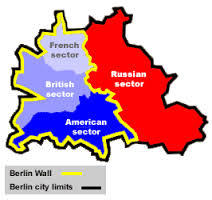
The Berlin Wall
- Between 1949 and 1961, more than 2.5 million people left East Germany for the West through East Berlin.
- The communist government of East Germany were worried by this trend.
- AUGUST 1961 - a 30 mile barrier was built across the city of Berlin overnight.
- It separated East Berlin from West Berlin
- It was fortified with:
- Barbed wire
- Machine gun posts
- Anyone who tried to escape East Berlin was shot
- West Berliners were separated from their relatives in the East - for the next 30 years.
- Between 1949 and 1961, more than 2.5 million people left East Germany for the West through East Berlin.
Imágenes y archivos del mapa
Información
- Descripción
- Mapa Mental sobre Crisis in the Cold War, creado por ldft el 13/05/2014.
- Creado por
- ldft
- Visitas
- 90
- Etiquetas
- Valoración