
Mapa mental
Cognitive Theories
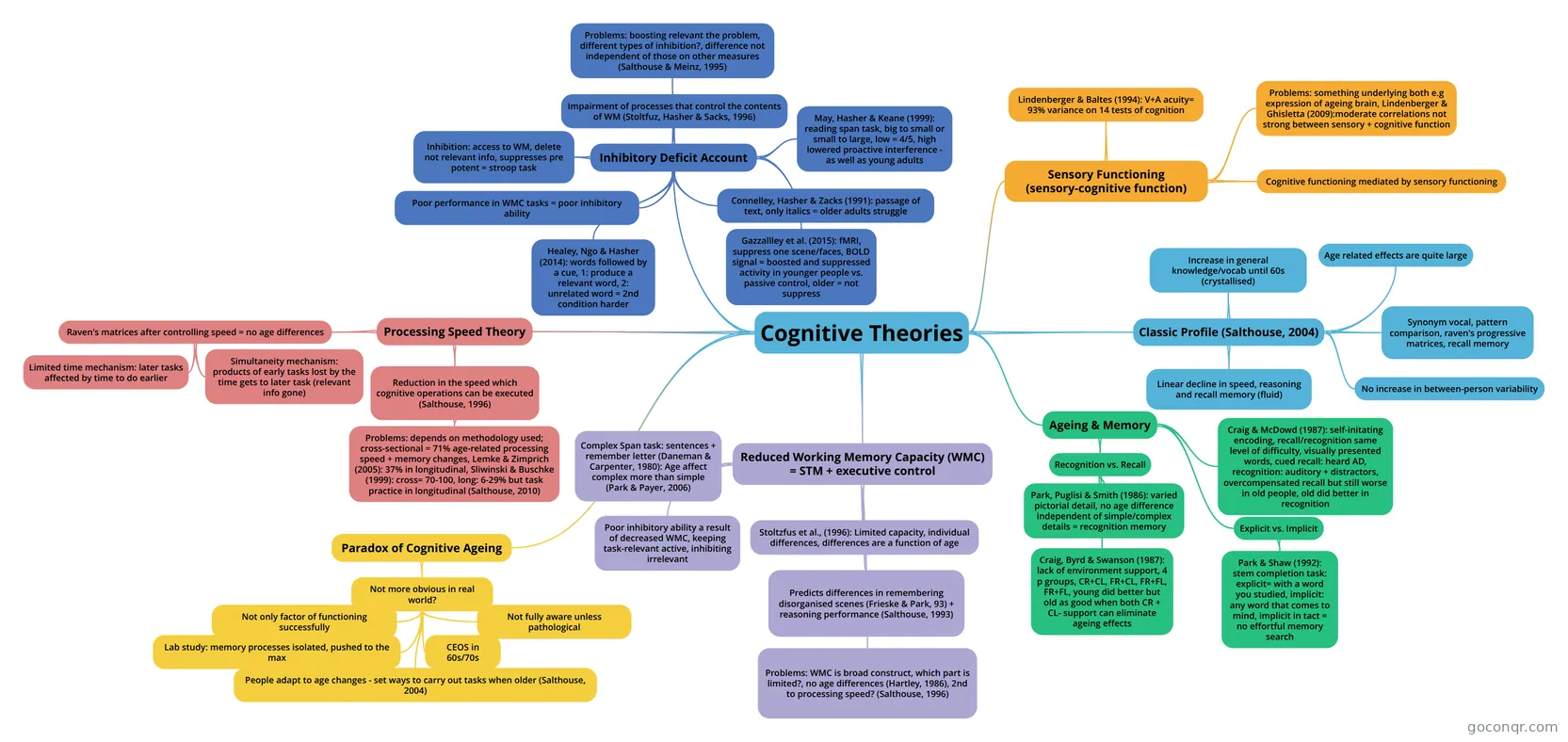
Mind map: Cognitive Theories
Contenido del mapa
Cognitive Theories
Classic Profile (Salthouse, 2004)
- Increase in general knowledge/vocab until 60s (crystallised)
- Linear decline in speed, reasoning and recall memory (fluid)
- Synonym vocal, pattern comparison, raven's progressive matrices, recall memory
- Age related effects are quite large
- No increase in between-person variability
Ageing & Memory
- Recognition vs. Recall
- Park, Puglisi & Smith (1986): varied pictorial detail, no age difference independent of simple/complex details = recognition memory
- Craig, Byrd & Swanson (1987): lack of environment support, 4 p groups, CR+CL, FR+CL, FR+FL, FR+FL, young did better but old as good when both CR + CL- support can eliminate ageing effects
- Craig & McDowd (1987): self-initating encoding, recall/recognition same level of difficulty, visually presented words, cued recall: heard AD, recognition: auditory + distractors, overcompensated recall but still worse in old people, old did better in recognition
- Explicit vs. Implicit
- Park & Shaw (1992): stem completion task: explicit= with a word you studied, implicit: any word that comes to mind, implicit in tact = no effortful memory search
- Recognition vs. Recall
Reduced Working Memory Capacity (WMC) = STM + executive control
- Stoltzfus et al., (1996): Limited capacity, individual differences, differences are a function of age
- Complex Span task: sentences + remember letter (Daneman & Carpenter, 1980): Age affect complex more than simple (Park & Payer, 2006)
- Poor inhibitory ability a result of decreased WMC, keeping task-relevant active, inhibiting irrelevant
- Predicts differences in remembering disorganised scenes (Frieske & Park, 93) + reasoning performance (Salthouse, 1993)
- Problems: WMC is broad construct, which part is limited?, no age differences (Hartley, 1986), 2nd to processing speed? (Salthouse, 1996)
Processing Speed Theory
- Reduction in the speed which cognitive operations can be executed (Salthouse, 1996)
- Problems: depends on methodology used; cross-sectional = 71% age-related processing speed + memory changes, Lemke & Zimprich (2005): 37% in longitudinal, Sliwinski & Buschke (1999): cross= 70-100, long: 6-29% but task practice in longitudinal (Salthouse, 2010)
- Raven's matrices after controlling speed = no age differences
- Limited time mechanism: later tasks affected by time to do earlier
- Simultaneity mechanism: products of early tasks lost by the time gets to later task (relevant info gone)
- Reduction in the speed which cognitive operations can be executed (Salthouse, 1996)
Inhibitory Deficit Account
- Impairment of processes that control the contents of WM (Stoltfuz, Hasher & Sacks, 1996)
- Inhibition: access to WM, delete not relevant info, suppresses pre potent = stroop task
- Poor performance in WMC tasks = poor inhibitory ability
- Connelley, Hasher & Zacks (1991): passage of text, only italics = older adults struggle
- Gazzallley et al. (2015): fMRI, suppress one scene/faces, BOLD signal = boosted and suppressed activity in younger people vs. passive control, older = not suppress
- May, Hasher & Keane (1999): reading span task, big to small or small to large, low = 4/5, high lowered proactive interference - as well as young adults
- Healey, Ngo & Hasher (2014): words followed by a cue, 1: produce a relevant word, 2: unrelated word = 2nd condition harder
- Problems: boosting relevant the problem, different types of inhibition?, difference not independent of those on other measures (Salthouse & Meinz, 1995)
Sensory Functioning (sensory-cognitive function)
- Cognitive functioning mediated by sensory functioning
- Lindenberger & Baltes (1994): V+A acuity= 93% variance on 14 tests of cognition
- Problems: something underlying both e.g expression of ageing brain, Lindenberger & Ghisletta (2009):moderate correlations not strong between sensory + cognitive function
Paradox of Cognitive Ageing
- Not more obvious in real world?
- Not fully aware unless pathological
- CEOS in 60s/70s
- Not only factor of functioning successfully
- Lab study: memory processes isolated, pushed to the max
- People adapt to age changes - set ways to carry out tasks when older (Salthouse, 2004)
- Not more obvious in real world?
Información
- Descripción
- Ageing Brain (PS3061) Mapa Mental sobre Cognitive Theories, creado por Eleni Blakemore el 30/04/2017.
- Creado por
- Eleni Blakemore
- Visitas
- 5
- Valoración
Más sobre Cognitive ageing and memory