
Mapa mental
Macroeconomic Problems
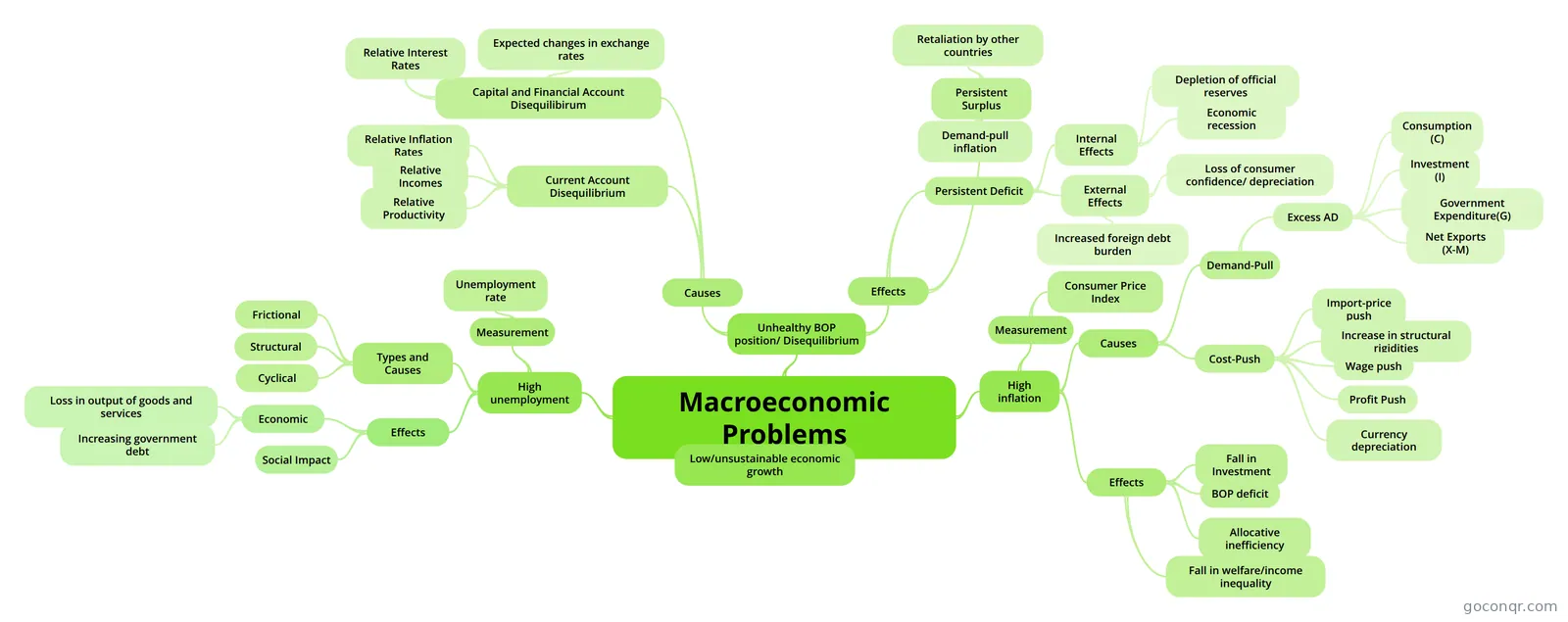
Mind map: Macroeconomic problems
Contenido del mapa
Macroeconomic Problems
Low/unsustainable economic growth
High unemployment
- Measurement
- Unemployment rate
- Expressed as a percentage of the total labour force
- Unemployment rate
- Types and Causes
- Frictional
- Occurs when people leave their jobs (either voluntarily or because they are sacked) or when new graduates enter the workforce and are unemployed for a period of time while looking for a job Caused by imperfect information. A graduate may not have the resources to find a company is suitable for him. Firms may abstain from hiring workers because they think there are no qualified personnel when in fact there are capable and qualified people.
- Structural
- Unemployment due to a mismatch of skills or a change in the structure of economy 1. Change in pattern of demand change in consumer tastes and preferences = shift in demand for goods and services. Workers in the former industry become structurally unemployed since they lack the skills to move to the new industry (e.g. from coal to renewable energy sources) 2. Conditions of supply technological unemployment: due to new labour saving techniques, allowing the same level of output to be produced with fewer workers. OR workers are no longer skilled enough to handle the new machinery
- Cyclical
- Due to lack of demand, which arises in times of economic recession. AD falls, which results in a fall in national income and output. Fewer goods and services are produced, requiring fewer workers to produce them which results in layoffs and an increase in cyclical unemployment
- Frictional
- Effects
- Economic
- Loss in output of goods and services
- Increasing government debt
- Lower tax revenue Increase in welfare payments
- Social Impact
- Economic
- Measurement
High inflation
- Causes
- Demand-Pull
- Excess AD
- Consumption (C)
- Excess Consumption due to consumer optimism: Consumers save less and spend more as they expect their incomes to rise. Hence C rises
- Investment (I)
- Excess Investment due to opening of new export markets or technological innovations. To provide for the new export markets, firms may need to invest in new plan equipment or stock up on inputs, semi-finished goods or finished goods
- Government Expenditure(G)
- Increase in national defence expenditure or social needs such as healthcare or education. This could be due to aging population/threats of imminent war
- Net Exports (X-M)
- Increasing national incomes of trading partners, hence they are able to buy more of our exports
- Consumption (C)
- Excess AD
- Cost-Push
- Import-price push
- As small city-state with no natural resources, Singapore is highly dependent on imports for raw materials and consumer goods for production and consumption purposes. When the price of imports increases, this results in increased cost of raw materials, hence increasing COP. SRAS falls
- Increase in structural rigidities
- Wage push
- Profit Push
- Currency depreciation
- To be edited
- Import-price push
- Demand-Pull
- Effects
- Fall in Investment
- BOP deficit
- Allocative inefficiency
- Fall in welfare/income inequality
- Fixed wage earners and pensioners earn less (to be edited)
- Measurement
- Consumer Price Index
- Causes
Unhealthy BOP position/ Disequilibrium
- Causes
- Current Account Disequilibrium
- Relative Inflation Rates
- If domestic costs and prices rise faster than that of other countries, exports will be relatively more expensive and imports relatively cheaper. This results in a fall in the (demand) for exports and increased (demand) for imports. Worsens trade balance and eventually a BOP deficit
- Relative Incomes
- A rise in the national income of a country relative to another leads to an increase in the volume of imports relative to exports. Foreign countries with relatively lower incomes will import less and export more. Hence a worsening of the trade balance
- Relative Productivity
- Unproductive capital and production inefficiencies reduce the competitiveness of domestic goods and services compared to other countries
- Relative Inflation Rates
- Capital and Financial Account Disequilibirum
- Relative Interest Rates
- Higher interest rates overseas to an outflow of hot money to other these countries, which counts as a worsening of the capital and financial account
- Expected changes in exchange rates
- If the foreign exchange value of a country is expected to drop, investors will convert their assets into other currencies to avoid a loss of capital, leading to deficit in the capital and financial account
- Relative Interest Rates
- Current Account Disequilibrium
- Effects
- Persistent Deficit
- Internal Effects
- Depletion of official reserves
- Economic recession
- If deficit is caused by current account deficit, this may reflect a lack in the competitiveness of domestic goods and services. Fall in AD and contractionary effect on economy. However, if it is caused by long-term capital outflow, the current k&CA deficit may be compensated by a CA surplus in the future
- External Effects
- Loss of consumer confidence/ depreciation
- Increased foreign debt burden
- If the country does not devalue its currency, it may resort to international borrowing to finance its deficit. Persistent deficit leads to more borrowing, which leads to an increasing debt which will be harder to pay off in the long run
- Internal Effects
- Persistent Surplus
- Demand-pull inflation
- Injection into the economy will, if economy is already operating close to or at full employment will result in demand pull-inflation
- Retaliation by other countries
- Protectionist methods (to be edited)
- Demand-pull inflation
- Persistent Deficit
- Causes
Información
- Descripción
- Mapa Mental sobre Macroeconomic Problems, creado por John Lim el 16/05/2014.
- Creado por
- John Lim
- Visitas
- 15
- Valoración