
Mapa mental
Exchange surfaces and breathing
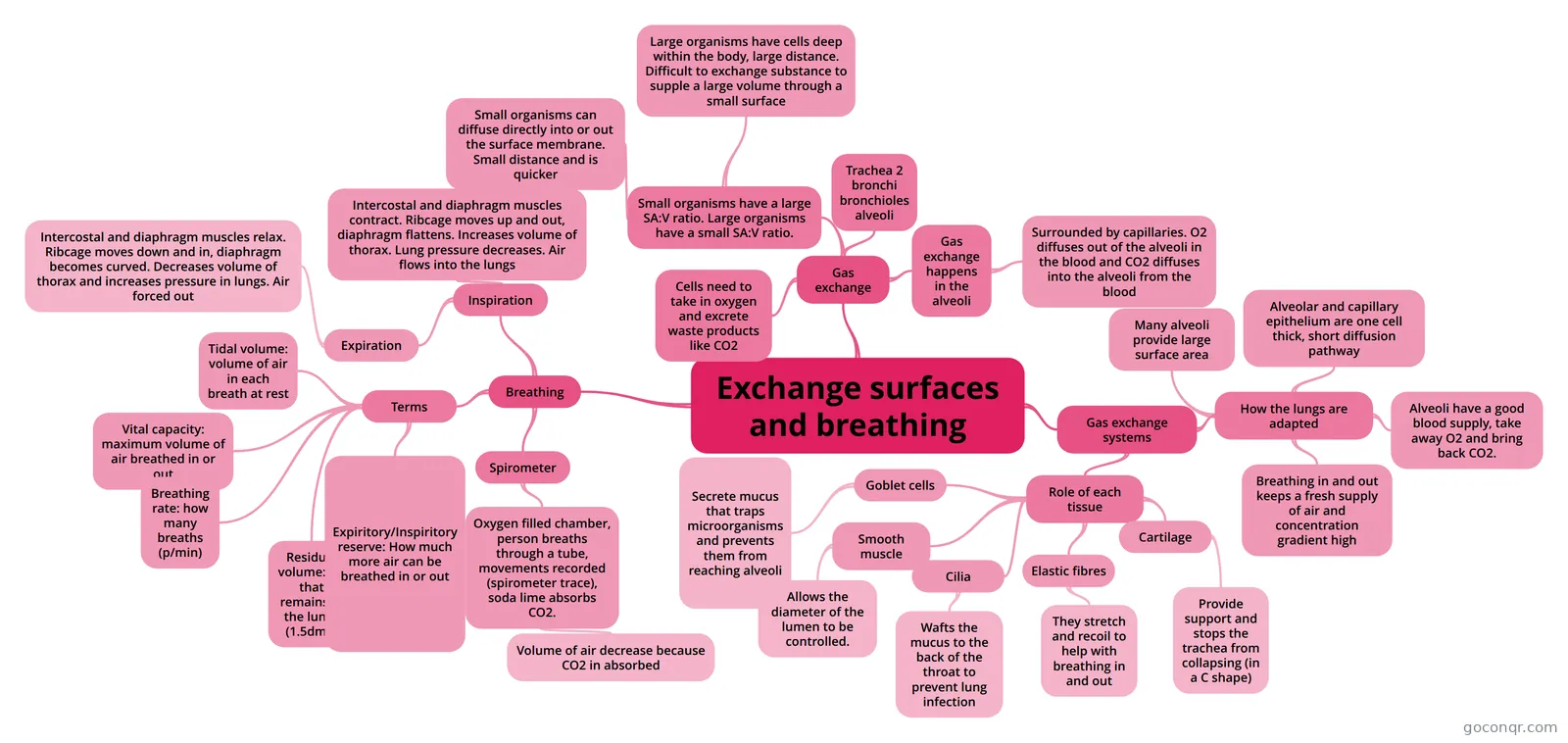
Mind map: Exchange surfaces and breathing
Contenido del mapa
Exchange surfaces and breathing
Gas exchange
- Cells need to take in oxygen and excrete waste products like CO2
- Small organisms have a large SA:V ratio. Large organisms have a small SA:V ratio.
- Small organisms can diffuse directly into or out the surface membrane. Small distance and is quicker
- Large organisms have cells deep within the body, large distance. Difficult to exchange substance to supple a large volume through a small surface
- Trachea 2 bronchi bronchioles alveoli
- Gas exchange happens in the alveoli
- Surrounded by capillaries. O2 diffuses out of the alveoli in the blood and CO2 diffuses into the alveoli from the blood
Gas exchange systems
- How the lungs are adapted
- Many alveoli provide large surface area
- Alveolar and capillary epithelium are one cell thick, short diffusion pathway
- Alveoli have a good blood supply, take away O2 and bring back CO2.
- Breathing in and out keeps a fresh supply of air and concentration gradient high
- Role of each tissue
- Goblet cells
- Secrete mucus that traps microorganisms and prevents them from reaching alveoli
- Cilia
- Wafts the mucus to the back of the throat to prevent lung infection
- Elastic fibres
- They stretch and recoil to help with breathing in and out
- Smooth muscle
- Allows the diameter of the lumen to be controlled.
- Cartilage
- Provide support and stops the trachea from collapsing (in a C shape)
- Goblet cells
- How the lungs are adapted
Breathing
- Inspiration
- Expiration
- Intercostal and diaphragm muscles relax. Ribcage moves down and in, diaphragm becomes curved. Decreases volume of thorax and increases pressure in lungs. Air forced out
- Intercostal and diaphragm muscles contract. Ribcage moves up and out, diaphragm flattens. Increases volume of thorax. Lung pressure decreases. Air flows into the lungs
- Expiration
- Terms
- Tidal volume: volume of air in each breath at rest
- Vital capacity: maximum volume of air breathed in or out
- Breathing rate: how many breaths (p/min)
- Residual volume: air that remains in the lungs (1.5dm3)
- Expiritory/Inspiritory reserve: How much more air can be breathed in or out
- Spirometer
- Oxygen filled chamber, person breaths through a tube, movements recorded (spirometer trace), soda lime absorbs CO2.
- Volume of air decrease because CO2 in absorbed
- Oxygen filled chamber, person breaths through a tube, movements recorded (spirometer trace), soda lime absorbs CO2.
- Inspiration
Información
- Descripción
- (F211) Biology Mapa Mental sobre Exchange surfaces and breathing, creado por Nikita96 el 14/05/2013.
- Creado por
- Nikita96
- Visitas
- 145
- Etiquetas
- Valoración