
Mapa mental
Music Tech: Noise Gates etc
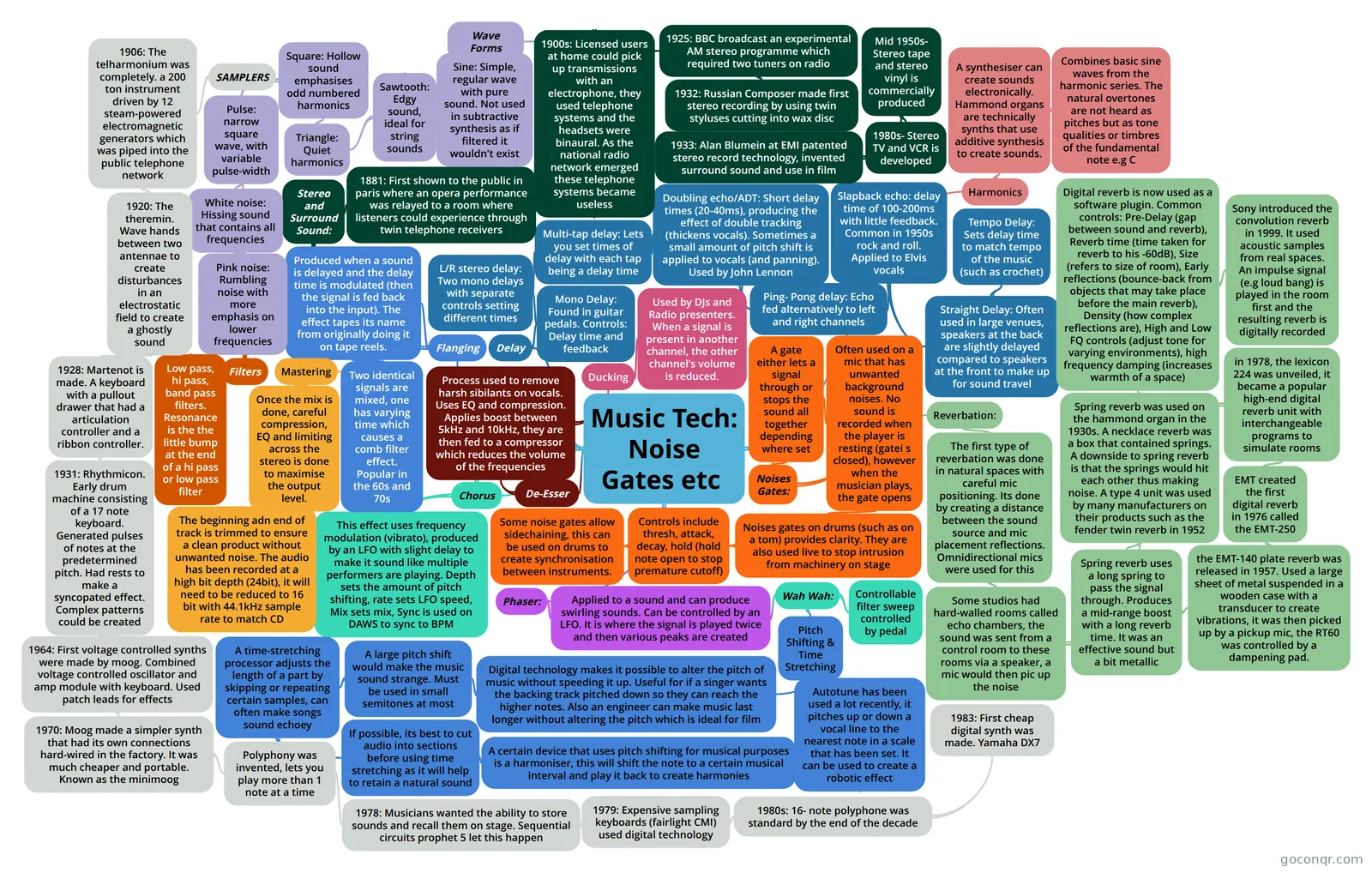
Mind map: Music tech noise gates and effects
Contenido del mapa
Music Tech: Noise Gates etc
Noises Gates:
- A gate either lets a signal through or stops the sound all together depending where set
- Often used on a mic that has unwanted background noises. No sound is recorded when the player is resting (gatei s closed), however when the musician plays, the gate opens
- Noises gates on drums (such as on a tom) provides clarity. They are also used live to stop intrusion from machinery on stage
- Controls include thresh, attack, decay, hold (hold note open to stop premature cutoff)
- Some noise gates allow sidechaining, this can be used on drums to create synchronisation between instruments.
- Controls include thresh, attack, decay, hold (hold note open to stop premature cutoff)
- Noises gates on drums (such as on a tom) provides clarity. They are also used live to stop intrusion from machinery on stage
- Often used on a mic that has unwanted background noises. No sound is recorded when the player is resting (gatei s closed), however when the musician plays, the gate opens
- Reverbation:
- The first type of reverbation was done in natural spaces with careful mic positioning. Its done by creating a distance between the sound source and mic placement reflections. Omnidirectional mics were used for this
- Some studios had hard-walled rooms called echo chambers, the sound was sent from a control room to these rooms via a speaker, a mic would then pic up the noise
- Spring reverb was used on the hammond organ in the 1930s. A necklace reverb was a box that contained springs. A downside to spring reverb is that the springs would hit each other thus making noise. A type 4 unit was used by many manufacturers on their products such as the fender twin reverb in 1952
- Spring reverb uses a long spring to pass the signal through. Produces a mid-range boost with a long reverb time. It was an effective sound but a bit metallic
- the EMT-140 plate reverb was released in 1957. Used a large sheet of metal suspended in a wooden case with a transducer to create vibrations, it was then picked up by a pickup mic, the RT60 was controlled by a dampening pad.
- EMT created the first digital reverb in 1976 called the EMT-250
- in 1978, the lexicon 224 was unveiled, it became a popular high-end digital reverb unit with interchangeable programs to simulate rooms
- Digital reverb is now used as a software plugin. Common controls: Pre-Delay (gap between sound and reverb), Reverb time (time taken for reverb to his -60dB), Size (refers to size of room), Early reflections (bounce-back from objects that may take place before the main reverb), Density (how complex reflections are), High and Low FQ controls (adjust tone for varying environments), high frequency damping (increases warmth of a space)
- Sony introduced the convolution reverb in 1999. It used acoustic samples from real spaces. An impulse signal (e.g loud bang) is played in the room first and the resulting reverb is digitally recorded
- Digital reverb is now used as a software plugin. Common controls: Pre-Delay (gap between sound and reverb), Reverb time (time taken for reverb to his -60dB), Size (refers to size of room), Early reflections (bounce-back from objects that may take place before the main reverb), Density (how complex reflections are), High and Low FQ controls (adjust tone for varying environments), high frequency damping (increases warmth of a space)
- in 1978, the lexicon 224 was unveiled, it became a popular high-end digital reverb unit with interchangeable programs to simulate rooms
- EMT created the first digital reverb in 1976 called the EMT-250
- the EMT-140 plate reverb was released in 1957. Used a large sheet of metal suspended in a wooden case with a transducer to create vibrations, it was then picked up by a pickup mic, the RT60 was controlled by a dampening pad.
- Spring reverb uses a long spring to pass the signal through. Produces a mid-range boost with a long reverb time. It was an effective sound but a bit metallic
- Spring reverb was used on the hammond organ in the 1930s. A necklace reverb was a box that contained springs. A downside to spring reverb is that the springs would hit each other thus making noise. A type 4 unit was used by many manufacturers on their products such as the fender twin reverb in 1952
- Some studios had hard-walled rooms called echo chambers, the sound was sent from a control room to these rooms via a speaker, a mic would then pic up the noise
- The first type of reverbation was done in natural spaces with careful mic positioning. Its done by creating a distance between the sound source and mic placement reflections. Omnidirectional mics were used for this
- A gate either lets a signal through or stops the sound all together depending where set
De-Esser
- Process used to remove harsh sibilants on vocals. Uses EQ and compression. Applies boost between 5kHz and 10kHz, they are then fed to a compressor which reduces the volume of the frequencies
- Ducking
- Used by DJs and Radio presenters. When a signal is present in another channel, the other channel's volume is reduced.
- Ducking
- Process used to remove harsh sibilants on vocals. Uses EQ and compression. Applies boost between 5kHz and 10kHz, they are then fed to a compressor which reduces the volume of the frequencies
Delay
- Mono Delay: Found in guitar pedals. Controls: Delay time and feedback
- L/R stereo delay: Two mono delays with separate controls setting different times
- Multi-tap delay: Lets you set times of delay with each tap being a delay time
- Doubling echo/ADT: Short delay times (20-40ms), producing the effect of double tracking (thickens vocals). Sometimes a small amount of pitch shift is applied to vocals (and panning). Used by John Lennon
- Ping- Pong delay: Echo fed alternatively to left and right channels
- Slapback echo: delay time of 100-200ms with little feedback. Common in 1950s rock and roll. Applied to Elvis vocals
- Straight Delay: Often used in large venues, speakers at the back are slightly delayed compared to speakers at the front to make up for sound travel
- Tempo Delay: Sets delay time to match tempo of the music (such as crochet)
- Straight Delay: Often used in large venues, speakers at the back are slightly delayed compared to speakers at the front to make up for sound travel
- Slapback echo: delay time of 100-200ms with little feedback. Common in 1950s rock and roll. Applied to Elvis vocals
- Ping- Pong delay: Echo fed alternatively to left and right channels
- Doubling echo/ADT: Short delay times (20-40ms), producing the effect of double tracking (thickens vocals). Sometimes a small amount of pitch shift is applied to vocals (and panning). Used by John Lennon
- Multi-tap delay: Lets you set times of delay with each tap being a delay time
- L/R stereo delay: Two mono delays with separate controls setting different times
- Mono Delay: Found in guitar pedals. Controls: Delay time and feedback
Chorus
- This effect uses frequency modulation (vibrato), produced by an LFO with slight delay to make it sound like multiple performers are playing. Depth sets the amount of pitch shifting, rate sets LFO speed, Mix sets mix, Sync is used on DAWS to sync to BPM
- Flanging
- Produced when a sound is delayed and the delay time is modulated (then the signal is fed back into the input). The effect tapes its name from originally doing it on tape reels.
- Two identical signals are mixed, one has varying time which causes a comb filter effect. Popular in the 60s and 70s
- Mastering
- Once the mix is done, careful compression, EQ and limiting across the stereo is done to maximise the output level.
- The beginning adn end of track is trimmed to ensure a clean product without unwanted noise. The audio has been recorded at a high bit depth (24bit), it will need to be reduced to 16 bit with 44.1kHz sample rate to match CD
- Once the mix is done, careful compression, EQ and limiting across the stereo is done to maximise the output level.
- Mastering
- Two identical signals are mixed, one has varying time which causes a comb filter effect. Popular in the 60s and 70s
- Stereo and Surround Sound:
- 1881: First shown to the public in paris where an opera performance was relayed to a room where listeners could experience through twin telephone receivers
- 1900s: Licensed users at home could pick up transmissions with an electrophone, they used telephone systems and the headsets were binaural. As the national radio network emerged these telephone systems became useless
- 1925: BBC broadcast an experimental AM stereo programme which required two tuners on radio
- 1932: Russian Composer made first stereo recording by using twin styluses cutting into wax disc
- 1933: Alan Blumein at EMI patented stereo record technology, invented surround sound and use in film
- Mid 1950s- Stereo tape and stereo vinyl is commercially produced
- 1980s- Stereo TV and VCR is developed
- Mid 1950s- Stereo tape and stereo vinyl is commercially produced
- 1933: Alan Blumein at EMI patented stereo record technology, invented surround sound and use in film
- 1932: Russian Composer made first stereo recording by using twin styluses cutting into wax disc
- Wave Forms
- Sine: Simple, regular wave with pure sound. Not used in subtractive synthesis as if filtered it wouldn't exist
- Sawtooth: Edgy sound, ideal for string sounds
- Triangle: Quiet harmonics
- Square: Hollow sound emphasises odd numbered harmonics
- Pulse: narrow square wave, with variable pulse-width
- White noise: Hissing sound that contains all frequencies
- Pink noise: Rumbling noise with more emphasis on lower frequencies
- White noise: Hissing sound that contains all frequencies
- Pulse: narrow square wave, with variable pulse-width
- Square: Hollow sound emphasises odd numbered harmonics
- Triangle: Quiet harmonics
- Sawtooth: Edgy sound, ideal for string sounds
- Sine: Simple, regular wave with pure sound. Not used in subtractive synthesis as if filtered it wouldn't exist
- 1925: BBC broadcast an experimental AM stereo programme which required two tuners on radio
- 1900s: Licensed users at home could pick up transmissions with an electrophone, they used telephone systems and the headsets were binaural. As the national radio network emerged these telephone systems became useless
- Filters
- Low pass, hi pass, band pass filters. Resonance is the the little bump at the end of a hi pass or low pass filter
- SAMPLERS
- 1906: The telharmonium was completely. a 200 ton instrument driven by 12 steam-powered electromagnetic generators which was piped into the public telephone network
- 1920: The theremin. Wave hands between two antennae to create disturbances in an electrostatic field to create a ghostly sound
- 1928: Martenot is made. A keyboard with a pullout drawer that had a articulation controller and a ribbon controller.
- 1931: Rhythmicon. Early drum machine consisting of a 17 note keyboard. Generated pulses of notes at the predetermined pitch. Had rests to make a syncopated effect. Complex patterns could be created
- 1964: First voltage controlled synths were made by moog. Combined voltage controlled oscillator and amp module with keyboard. Used patch leads for effects
- 1970: Moog made a simpler synth that had its own connections hard-wired in the factory. It was much cheaper and portable. Known as the minimoog
- Polyphony was invented, lets you play more than 1 note at a time
- 1978: Musicians wanted the ability to store sounds and recall them on stage. Sequential circuits prophet 5 let this happen
- 1979: Expensive sampling keyboards (fairlight CMI) used digital technology
- 1980s: 16- note polyphone was standard by the end of the decade
- 1983: First cheap digital synth was made. Yamaha DX7
- 1980s: 16- note polyphone was standard by the end of the decade
- 1979: Expensive sampling keyboards (fairlight CMI) used digital technology
- 1978: Musicians wanted the ability to store sounds and recall them on stage. Sequential circuits prophet 5 let this happen
- Polyphony was invented, lets you play more than 1 note at a time
- 1970: Moog made a simpler synth that had its own connections hard-wired in the factory. It was much cheaper and portable. Known as the minimoog
- 1964: First voltage controlled synths were made by moog. Combined voltage controlled oscillator and amp module with keyboard. Used patch leads for effects
- 1931: Rhythmicon. Early drum machine consisting of a 17 note keyboard. Generated pulses of notes at the predetermined pitch. Had rests to make a syncopated effect. Complex patterns could be created
- 1928: Martenot is made. A keyboard with a pullout drawer that had a articulation controller and a ribbon controller.
- 1920: The theremin. Wave hands between two antennae to create disturbances in an electrostatic field to create a ghostly sound
- 1906: The telharmonium was completely. a 200 ton instrument driven by 12 steam-powered electromagnetic generators which was piped into the public telephone network
- 1881: First shown to the public in paris where an opera performance was relayed to a room where listeners could experience through twin telephone receivers
- Produced when a sound is delayed and the delay time is modulated (then the signal is fed back into the input). The effect tapes its name from originally doing it on tape reels.
Phaser:
- Applied to a sound and can produce swirling sounds. Can be controlled by an LFO. It is where the signal is played twice and then various peaks are created
- Wah Wah:
- Controllable filter sweep controlled by pedal
- Pitch Shifting & Time Stretching
- Digital technology makes it possible to alter the pitch of music without speeding it up. Useful for if a singer wants the backing track pitched down so they can reach the higher notes. Also an engineer can make music last longer without altering the pitch which is ideal for film
- A large pitch shift would make the music sound strange. Must be used in small semitones at most
- A time-stretching processor adjusts the length of a part by skipping or repeating certain samples, can often make songs sound echoey
- If possible, its best to cut audio into sections before using time stretching as it will help to retain a natural sound
- A certain device that uses pitch shifting for musical purposes is a harmoniser, this will shift the note to a certain musical interval and play it back to create harmonies
- Autotune has been used a lot recently, it pitches up or down a vocal line to the nearest note in a scale that has been set. It can be used to create a robotic effect
- A certain device that uses pitch shifting for musical purposes is a harmoniser, this will shift the note to a certain musical interval and play it back to create harmonies
- If possible, its best to cut audio into sections before using time stretching as it will help to retain a natural sound
- A time-stretching processor adjusts the length of a part by skipping or repeating certain samples, can often make songs sound echoey
- A large pitch shift would make the music sound strange. Must be used in small semitones at most
- Digital technology makes it possible to alter the pitch of music without speeding it up. Useful for if a singer wants the backing track pitched down so they can reach the higher notes. Also an engineer can make music last longer without altering the pitch which is ideal for film
- Wah Wah:
- Applied to a sound and can produce swirling sounds. Can be controlled by an LFO. It is where the signal is played twice and then various peaks are created
Harmonics
- A synthesiser can create sounds electronically. Hammond organs are technically synths that use additive synthesis to create sounds.
- Combines basic sine waves from the harmonic series. The natural overtones are not heard as pitches but as tone qualities or timbres of the fundamental note e.g C
- A synthesiser can create sounds electronically. Hammond organs are technically synths that use additive synthesis to create sounds.
Información
- Descripción
- Mapa Mental sobre Music Tech: Noise Gates etc , creado por James Burns el 28/05/2017.
- Creado por
- James Burns
- Visitas
- 0
- Valoración
Más sobre Compression and Dynamics Processing