
Mapa mental
Cochlea
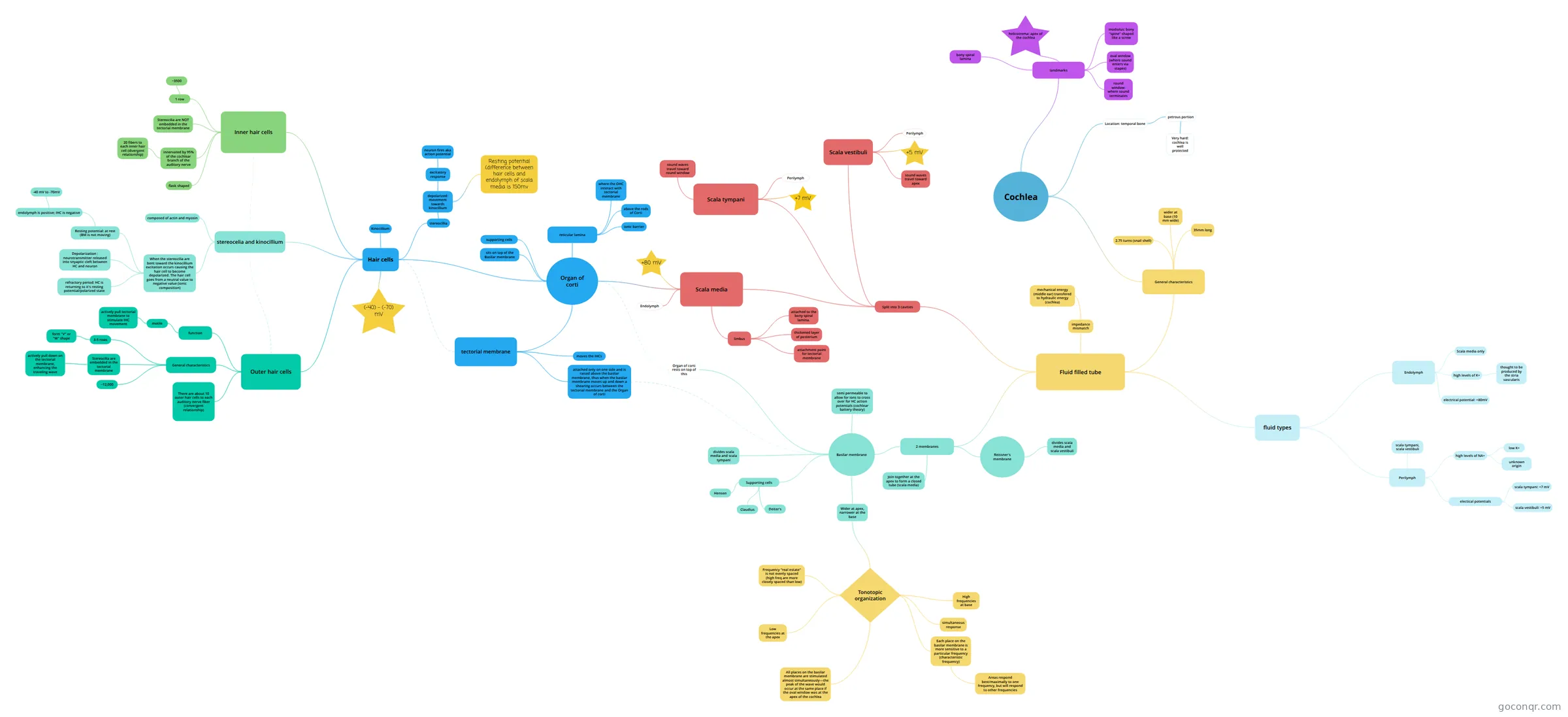
Mind map: Cochlea
Contenido del mapa
Cochlea
Location: temporal bone
- petrous portion
- Very hard: cochlea is well protected
- petrous portion
General characteristics
- 2.75 turns (snail shell)
- wider at base (10 mm wide)
- 35mm long
- Fluid filled tube
- Split into 3 cavities
- Scala vestibuli
- Perilymph
- +5 mV
- sound waves travel toward apex
- Scala media
- Endolymph
- +80 mV
- Organ of corti
- tectorial membrane
- moves the IHCs
- attached only on one side and is raised above the basilar membrane, thus when the basilar membrane moves up and down a shearing occurs between the tectorial membrane and the Organ of corti
- supporting cells
- reticular lamina
- above the rods of Corti
- where the OHC interact with tectorial membrane
- ionic barrier
- Hair cells
- Inner hair cells
- 1 row
- ~3500
- Stereocilia are NOT embedded in the tectorial membrane
- Instead, the stereocilia are sheered/veered (bent) by: 1.The tectorial membrane being pulled on top of them 2.Viscous drag of the fluid
- flask shaped
- innervated by 95% of the cochlear branch of the auditory nerve
- 20 fibers to each inner hair cell (divergent relationship)
- 1 row
- Outer hair cells
- There are about 10 outer hair cells to each auditory nerve fiber (convergent relationship)
- function
- motile
- actively pull tectorial membrane to stimulate IHC movement
- motile
- General characteristics
- 3-5 rows
- form "V" or "W" shape
- ~12,000
- Stereocilia are embedded in the tectorial membrane
- actively pull down on the tectorial membrane, enhancing the traveling wave
- 3-5 rows
- stereocillia
- depolarized: movement towards kinocillium
- excitatory response
- neuron fires aka action potential
- Resting potential (difference between hair cells and endolymph of scala media is 150mv
- excitatory response
- depolarized: movement towards kinocillium
- Kinocillium
- (-40) - (-70) mV
- stereocelia and kinocillium
- composed of actin and myosin
- When the stereocilia are bent toward the kinocillium excitation occurs causing the hair cell to become depolarized. The hair cell goes from a neutral value to negative value (ionic composition)
- Resting potential: at rest (BM is not moving)
- endolymph is positive; IHC is negative
- -40 mV to -70mV
- endolymph is positive; IHC is negative
- Depolarization : neurotransmitter released into snyaptic cleft between HC and neuron
- refractory period: HC is returning to it's resting potential/polarized state
- Resting potential: at rest (BM is not moving)
- Inner hair cells
- sits on top of the Basilar membrane
- tectorial membrane
- limbus
- attachment point for tectorial membrane
- thickened layer of posterium
- attached to the bony spiral lamina.
- Scala tympani
- Perilymph
- +7 mV
- sound waves travel toward round window
- Scala vestibuli
- 2 membranes
- Reissner's membrane
- divides scala media and scala vestibuli
- Basilar membrane
- Wider at apex, narrower at the base
- Tonotopic organization
- Low frequencies at the apex
- High frequencies at base
- simultaneous response
- Each place on the basilar membrane is more sensitive to a particular frequency (characteristic frequency)
- Areas respond best/maximally to one frequency, but will respond to other frequencies
- All places on the basilar membrane are stimulated almost simultaneously—the peak of the wave would occur at the same place if the oval window was at the apex of the cochlea
- Frequency "real estate" is not evenly spaced (high freq are more closely spaced than low)
- Tonotopic organization
- Organ of corti rests on top of this
- divides scala media and scala tympani
- Supporting cells
- Hensen
- Claudius
- Deiter's
- semi permeable to allow for ions to cross over for HC action potentials (cochlear battery theory)
- Wider at apex, narrower at the base
- Join together at the apex to form a closed tube (scala media)
- Reissner's membrane
- impedance mismatch
- mechanical energy (middle ear) transfered to hydraulic energy (cochlea)
- fluid types
- Endolymph
- Scala media only
- high levels of K+
- thought to be produced by the stria vascularis
- electrical potential: +80mV
- Perilymph
- high levels of NA+
- low K+
- unknown origin
- electical potentials
- scala tympani: +7 mV
- scala vestibuli: +5 mV
- scala tympani, scala vestibuli
- high levels of NA+
- Endolymph
- Split into 3 cavities
landmarks
- oval window (where sound enters via stapes)
- round window: where sound terminates
- modiolus: bony "spine" shaped like a screw
- helicotrema: apex of the cochlea
- bony spiral lamina
- bony shelf or ledge which projects from the modiolus into the interior of the canal, and, like the canal, takes two-and-three-quarter turns around the modiolus
Información
- Descripción
- Hearing Science Mapa Mental sobre Cochlea, creado por Stashia Casimir el 24/06/2017.
- Creado por
- Stashia Casimir
- Visitas
- 1
- Valoración