
Mapa mental
Atomic Number, Isotopes, Mass Number, Atomic Molar Mass
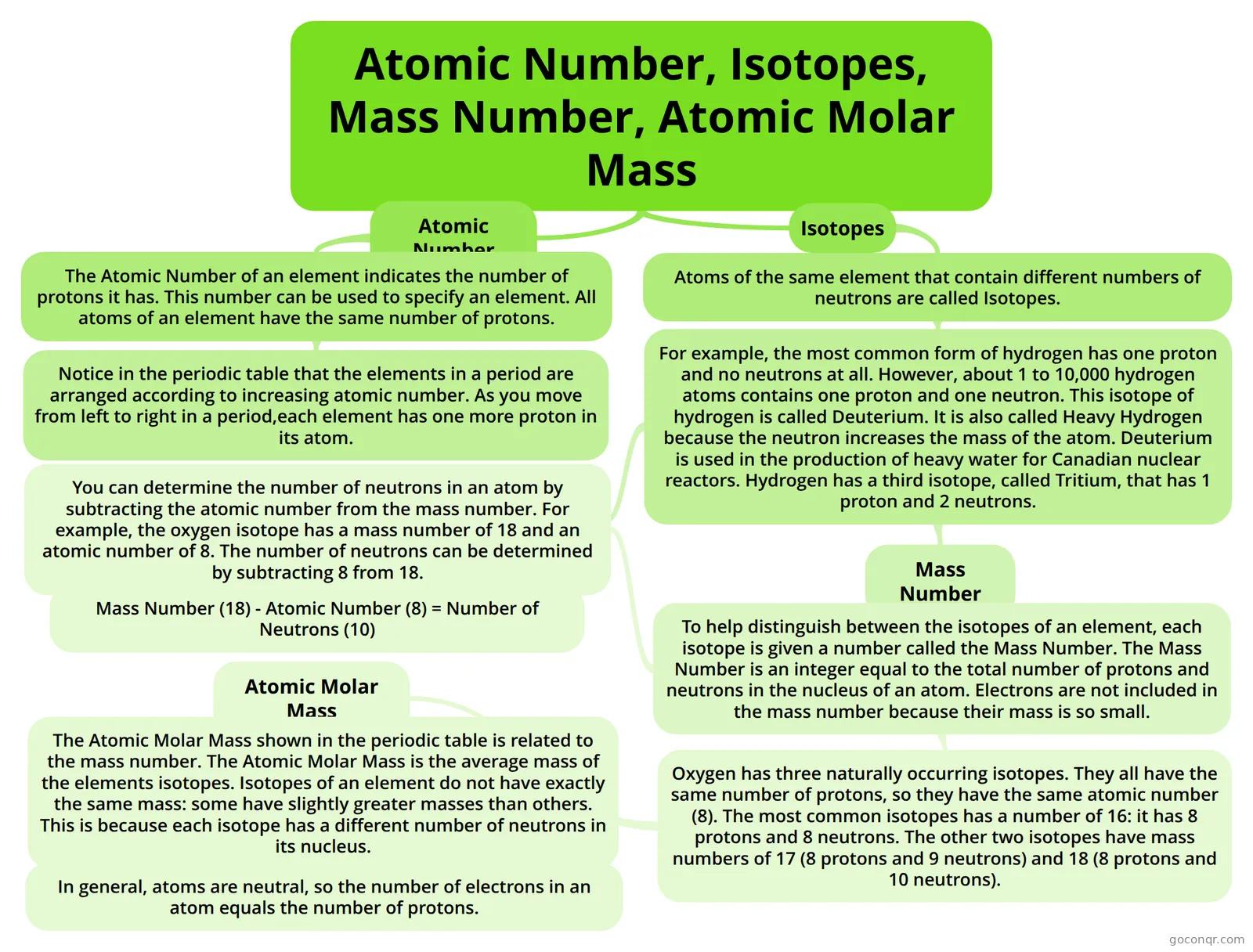
Mind map: atomic number, isotopes and mass number
Contenido del mapa
Atomic Number, Isotopes, Mass Number, Atomic Molar Mass
Atomic Number
- The Atomic Number of an element indicates the number of protons it has. This number can be used to specify an element. All atoms of an element have the same number of protons.
- Notice in the periodic table that the elements in a period are arranged according to increasing atomic number. As you move from left to right in a period,each element has one more proton in its atom.
- The Atomic Number of an element indicates the number of protons it has. This number can be used to specify an element. All atoms of an element have the same number of protons.
Isotopes
- Atoms of the same element that contain different numbers of neutrons are called Isotopes.
- For example, the most common form of hydrogen has one proton and no neutrons at all. However, about 1 to 10,000 hydrogen atoms contains one proton and one neutron. This isotope of hydrogen is called Deuterium. It is also called Heavy Hydrogen because the neutron increases the mass of the atom. Deuterium is used in the production of heavy water for Canadian nuclear reactors. Hydrogen has a third isotope, called Tritium, that has 1 proton and 2 neutrons.
- Mass Number
- To help distinguish between the isotopes of an element, each isotope is given a number called the Mass Number. The Mass Number is an integer equal to the total number of protons and neutrons in the nucleus of an atom. Electrons are not included in the mass number because their mass is so small.
- Oxygen has three naturally occurring isotopes. They all have the same number of protons, so they have the same atomic number (8). The most common isotopes has a number of 16: it has 8 protons and 8 neutrons. The other two isotopes have mass numbers of 17 (8 protons and 9 neutrons) and 18 (8 protons and 10 neutrons).
- Atomic Molar Mass
- The Atomic Molar Mass shown in the periodic table is related to the mass number. The Atomic Molar Mass is the average mass of the elements isotopes. Isotopes of an element do not have exactly the same mass: some have slightly greater masses than others. This is because each isotope has a different number of neutrons in its nucleus.
- In general, atoms are neutral, so the number of electrons in an atom equals the number of protons.
- The Atomic Molar Mass shown in the periodic table is related to the mass number. The Atomic Molar Mass is the average mass of the elements isotopes. Isotopes of an element do not have exactly the same mass: some have slightly greater masses than others. This is because each isotope has a different number of neutrons in its nucleus.
- Atomic Molar Mass
- You can determine the number of neutrons in an atom by subtracting the atomic number from the mass number. For example, the oxygen isotope has a mass number of 18 and an atomic number of 8. The number of neutrons can be determined by subtracting 8 from 18.
- Mass Number (18) - Atomic Number (8) = Number of Neutrons (10)
- Oxygen has three naturally occurring isotopes. They all have the same number of protons, so they have the same atomic number (8). The most common isotopes has a number of 16: it has 8 protons and 8 neutrons. The other two isotopes have mass numbers of 17 (8 protons and 9 neutrons) and 18 (8 protons and 10 neutrons).
- To help distinguish between the isotopes of an element, each isotope is given a number called the Mass Number. The Mass Number is an integer equal to the total number of protons and neutrons in the nucleus of an atom. Electrons are not included in the mass number because their mass is so small.
- Mass Number
- For example, the most common form of hydrogen has one proton and no neutrons at all. However, about 1 to 10,000 hydrogen atoms contains one proton and one neutron. This isotope of hydrogen is called Deuterium. It is also called Heavy Hydrogen because the neutron increases the mass of the atom. Deuterium is used in the production of heavy water for Canadian nuclear reactors. Hydrogen has a third isotope, called Tritium, that has 1 proton and 2 neutrons.
- Atoms of the same element that contain different numbers of neutrons are called Isotopes.
Información
- Descripción
- Science 10 Mapa Mental sobre Atomic Number, Isotopes, Mass Number, Atomic Molar Mass, creado por syylex403 el 21/05/2013.
- Creado por
- syylex403
- Visitas
- 277
- Etiquetas
- Valoración