
Quiz
Science 10 Unit 2 - Physics MEGA QUIZ
This quiz has question types that open in the usual player.
Questions in this quiz (24)
1What is the Phlogiston Theory and when was it created?
- ASimilar to previous theory, but states that it doesn't have mass. It cannot be created nor destroyed. lt flows from warm to cold substances; late 1700s
- BHeat is a fluid known as phlogiston, flows between different objects as "heat". This was disproved because it would mean heat has mass, which it doesn't.; 1700s
- CHeat is a form of energy and can be converted to different forms (kinetic, chemical, etc.). Specific heat capacity was created at this time; 1800s
- DThe more particles move, the more thermal energy is created. Energy cannot be created nor destroyed and it comes in many forms; modern day
2What is the Caloric Theory and when was it created?
- ASimilar to previous theory, but states that it doesn't have mass. It cannot be created nor destroyed. lIt flows from warm to cold substances; late 1700s
- BHeat is a fluid known as phlogiston, flows between different objects as "heat". This was disproved because it would mean heat has mass, which it doesn't; 1700s
- CHeat is a form of energy and can be converted to different forms (kinetic, chemical, etc.). Specific heat capacity was created at this time; 1800s
- DThe more particles move, the more thermal energy is created. Energy cannot be created nor destroyed and it comes in many forms; modern day
3What did Count Rumford find out and when?
- AThe more particles move, the more thermal energy is created. Energy cannot be created nor destroyed and it comes in many forms; modern day
- BHeat is a fluid known as phlogiston, flows between different objects as "heat". This was disproved because it would mean heat has mass, which it doesn't; 1700s
- CSimilar to previous theory, but states that it doesn't have mass. It cannot be created nor destroyed. lIt flows from warm to cold substances; late 1700s
- DHeat is a form of energy and can be converted to different forms (kinetic, chemical, etc.). Specific heat capacity was created at this time; 1800s
4What is the Kinetic Molecular theory and when was it created?
- AHeat is a fluid known as phlogiston, flows between different objects as "heat". This was disproved because it would mean heat has mass, which it doesn't; 1700s
- BHeat is a form of energy and can be converted to different forms (kinetic, chemical, etc.). Specific heat capacity was created at this time; 1800s
- CSimilar to previous theory, but states that it doesn't have mass. It cannot be created nor destroyed. lIt flows from warm to cold substances; late 1700s
- DThe more particles move, the more thermal energy is created. Energy cannot be created nor destroyed and it comes in many forms; modern day
5Heat is the [blank_start]total[blank_end] kinetic energy of the particles. Temperature is the [blank_start]average[blank_end] kinetic energy of the particles.
- Atotal
- Baverage
- Cproduct of the
- Dsum of the
- Eaverage
- Ftotal
- Gsum of the
- Hproduct of the
6Check all the units that heat is measured in:
- AKilojoules
- BJoules
- CCelcius
- DFarenhiet
- EKelvin
7Check all of the units that temperature is measured in:
- AFarenhiet
- BCelcius
- CJoules
- DKilojoules
- EKelvin
8Someone moved an object. They applied a force of 12 N and it moved 800 cm. What was the work being done on the object?
- A9600 J
- B960 J
- C96 J
- D9.6 J
9It took 1300 J to move an object 3.2 m. What was the force applied?
- A2.4615 x 10(-3) N
- B406.25 N
- C4.0625 N
- D4160 N
10Someone is holding a suitcase above the ground and walking down the flat hallway. Work is being applied in this situation.
- ATrue
- BFalse
11Check all that are scalar quantities:
- ADistance
- BTime
- CSpeed
- DVelocity
- EAcceleration
- FDisplacement
12Check all that are vector quantities:
- ADisplacement
- BDistance
- CSpeed
- DAcceleration
- EVelocity
- FTime
13An object moved 500 m in 3 seconds, what is the object's speed?
- A167 m/s
- B1.66 m/s
- C0.6 m/s
- D0.006 m/s
14- Displacement is [blank_start]the shortest distance[blank_end] between two points
- Distance is [blank_start]any path[blank_end] between two points
- With vector quantities, North, East and Up are [blank_start]POSITIVE[blank_end] directions, while South, West and Down are [blank_start]NEGATIVE[blank_end] directions- Athe shortest distance
- Bthe longest path
- Cany path
- Dany path
- Ethe longest distance
- Fthe shortest distance
- Gpositive
- Hnegative
- Iscalar
- Jvector
- Knegative
- Lpositive
- Mvector
- Nscalar
15Point 1 is at 8.0 m[N] and point 2 is at 3.0 m [S]. I ride my bike and it takes 4.5 seconds to go from point 1 to point 2. What is my bike's velocity?
- A- 2.44 m/s
- B2.44 m/s
- C0.36 m/s
- D- 0.36 m/s
16I start speeding up on a highway. At first, I am going 40 km/h[E] and after 5 seconds I make it to 95 k/m[E]. What is my acceleration?
- A39855 km/h(2)
- B39855072 km/h(2)
- C39855 m/s(2)
- D39855072 m/s(2)
17Kinetic energy is the energy of [blank_start]MOVEMENT[blank_end]
Potential energy is [blank_start]STORED[blank_end] energy:
- [blank_start]Elastic[blank_end] potential energy is when an object is bend/compressed and has stored energy to return to its original shape
- [blank_start]Chemical[blank_end] potential energy is the stored energy in the bonds of chemicals
- [blank_start]Gravitational[blank_end] potential energy is the stored energy from the attraction between two objects
Mass is measured in [blank_start]kg[blank_end] and is the [blank_start]amount of space something takes up[blank_end]. Weight is the [blank_start]mass + gravity[blank_end].- Amovement
- Blight
- Cchemical bonds
- Dair waves
- Estored
- Fchemically bonded
- Ginvisible
- HElastic
- IChemical
- JGravitational
- KChemical
- LElastic
- MGravitational
- NGravitational
- OElastic
- PChemical
- Qkg
- RL
- SmL
- TN
- Uamount of space something takes up
- Vamount of space + gravity
- Wamount of energy something has
- Xamount of space + gravity
- Yamount of space something takes up
- Zamount of energy something has
18Some rules of energy:
- [blank_start]No[blank_end] machine is 100% efficient
- Energy [blank_start]cannot[blank_end] be [blank_start]created nor destroyed[blank_end], only [blank_start]transferred[blank_end]- ANo
- BSome
- CAll
- Dcannot
- Ecan
- Fcreated nor destroyed
- Gcreated
- Hdestroyed
- Iconverted
- Jtransferred
- Kcreated and destroyed
- Lcreated
- Mdestroyed
19What are the energy conversions in this situation?
A diver jumps off a spring board into the water below.- AChemical > Elastic > Gravitational > Kinetic
- BKinetic > Gravitational > Elastic > Chemical
- CGravitation > Chemical > Kinetic > Elastic
- DGravitational > Elastic > Kinetic > Chemical
20A 2kg ball is held above a table. It is 0.30 m above the table, and the table is 300 cm above the ground. What is the ball's gravitational potential energy relative to the ground?
- A64.746 J
- B7445.8 J
- C64746 J
- D7.4458 J
21A 4.2 kg ball was thrown and moved 0.7 m/s. What is the ball's kinetic energy?
- A2.058 J
- B1.029 J
- C2.940 J
- D1.470 J
22Label the Pendulum with the different forms of energy present.
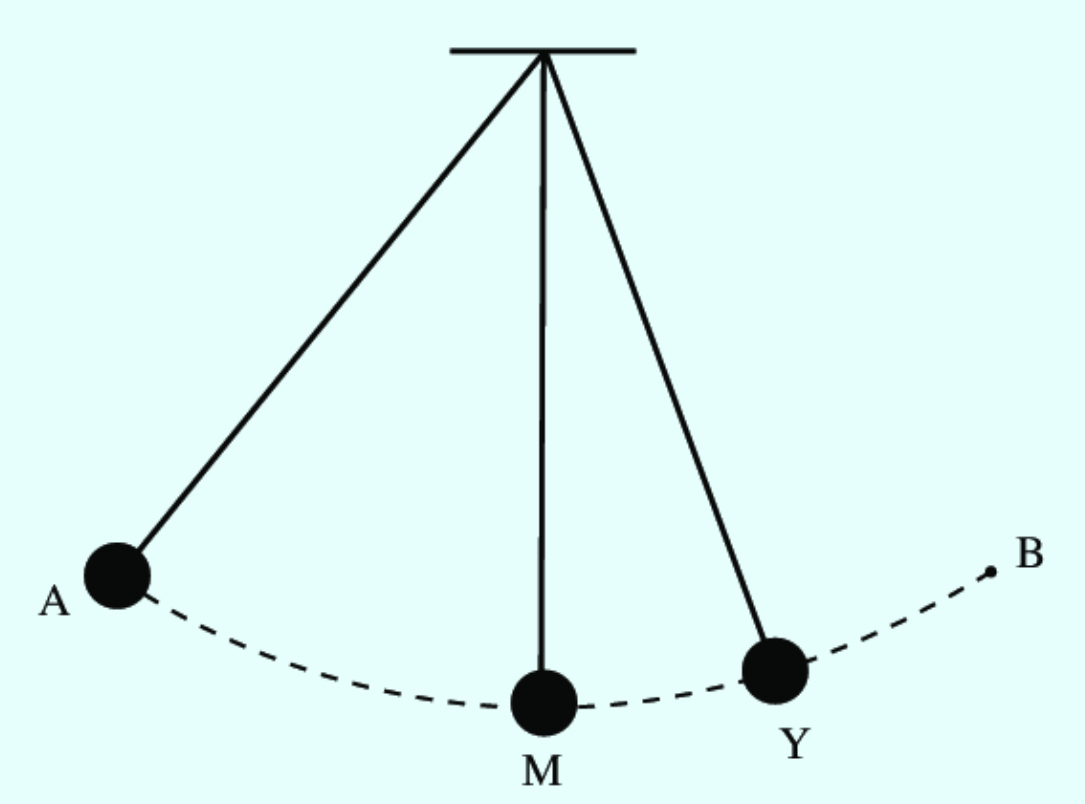
- AAll gravitational, no kinetic
- BAll kinetic, no gravitational
- C50/50 gravitational and kinetic
- D50/50 gravitational and kinetic
- EAll kinetic, no gravitational
- FAll gravitational, no kinetic
- G50/50 gravitational and kinetic
- HAll kinetic, no gravitational
- IAll gravitational, no kinetic
23A car takes in 12000 J of chemical energy to run. 8900 J is converted to kinetic energy to make the wheels turn. What is the efficiency of this machine?
- A0.742 %
- B74.2 %
- C7.42%
- D742%
24Someone drops a 23 kg rock down a cliff. The cliff is 400 m high. If the rock has 89,000 J of kinetic energy when breaking apart at the bottom, how much energy is converted to other forms?
- A0.986 %
- B98.6 %
- C1.38 %
- D0.014 %
Information
- Description
- Use this to study for exams.
- Author
- Riley Babuik
- Language
- English
- Views
- 28
- Tags
- Rating
- No ratings yet Rate this quiz