
Mapa mental
Software Development Life CycleModel
Contenido del mapa
Software Development Life CycleModel
Software Development Life Cycle Model
- provides a simplified illustration of general software life cycle model of development. Each phase produces feedback that affects the next phase.
- Requirements
- . Administrators and users make their "wish lists" what kind of data will be processed, how the software should handle the data, and how data can be accessed once in the system.
- Design
- during the design phase, designers try to to convert the dreams of managers and users into reality. During this phase, emphasis is placed on the implementation of a practical study, working which has been outlined in the compilation phase of requirements
- Implementation
- the results of the design phase are translated into programs code. During this programmers must make their core objective meet the requirements of the company and comply with the design described in the design phase.
- Testing
- the results of the implementation phase are carried out through tests to verify that it works and that it meets the objectives of the requirements phase
Waterfall Life Cycle Model
- Is one of the easiest to understand and use.It is characterized by a series of steps that must be completed in a linear and sequential order. Each phase is completed and verified before development progresses to the next phase
- Requirements
- Design
- Implementation and Unit Testing
- Integration and System Testing
- Operation
- Integration and System Testing
- Implementation and Unit Testing
- Design
- Disadvantages of the Waterfall model
- su utilidad es limitada. Debido a la rigidez del modelo, deben indicarse todos los requisitos antes de que empiece el desarrollo. Si los requisitos cambian o se agregan, el proyecto debe comenzar de nuevo desde el principio. Debido a estos problemas, el modelo Waterfall es inapropiado para proyectos complejos.
- Advantages of the Waterfall model
- This model can be easy to implement and manage because each phase has a specific purpose, and development occurs in only one phase at a time. The Waterfall model is appropriate for small development projects in the requirements are well known
V-Shaped Life Cycle Model
- Like the Waterfall model, the V-shaped life cycle model provides a sequential phases to be completed each before the development phase. Phase test plans are developed during each level of development and once the coding is completed, the tests are carried out.
- Requirements
- High Level Design
- Low Level Design
- Implementation
- Unit Test Planning
- Unit Testing
- Integration Test Planning
- Integration Testing
- Low Level Design
- System Test Planning
- System Testing
- High Level Design
- Advantages of the V-Shaped model
- Specific goals are defined for each phase. Like the Waterfall model the V-shaped model is suitable for small development projects in which the requirements are well understood
- Disadvantages of the V-Shaped model
- The rigidity d makes it unsuitable for most projects. As the Waterfall Model, all requirements must be stated at the beginning of the project.
Incremental Life Cycle Model
- constructs an iterative approach in the cascade model. Development projects are divided into smaller iterations and each iteration passes through a mini cascade process. Requirement, design, implementation and the test phases are completed for each iteration.
- Requirements
- Design
- Implementation and Unit Testing
- Integration and System Testing
- Operation
- Integration and System Testing
- Implementation and Unit Testing
- Design
- Advantages of the Incremental model
- generate prototype early in the development process. The iterative nature of The model makes it more flexible by adding or changing requirements. The Incremental model is an effective tool to manage risk.
- Disadvantages of the Incremental model
- Like the Cascada model, the Incremental model presents some rigidity in those phases can not be superimposed. Since requirements collection and design are performed each iteration and not before development begins, the projects developed
SPIRAL LIFE CYCLE MODEL
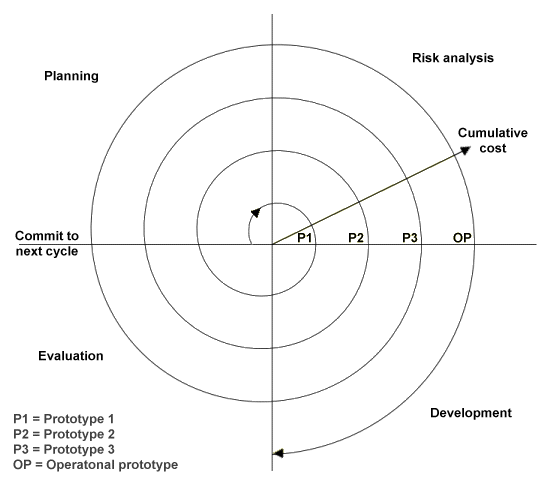
- is similar to the incremental model but incorporates risk analysis. It is divided into four phases: planning, risk analysis, engineering and evaluation. A project goes through each of these phases in sequence, repeatedly, in a series of iterations called spirals
- Advantages of the Spiral model
- ideal for large-scale and mission- critical products. At its core, the spiral model is based on previous software development
- Disadvantages of the Spiral model
- can cost much more to implement than other life-cycle models. The risk analysis phase requires highly specific knowledge and project success depends on the output of this phase. The spiral model is unsuitable for use in medium-scale non-mission critical projects
Imágenes y archivos del mapa
Información
- Descripción
- Undécimo Inglés Mapa Mental sobre Software Development Life CycleModel, creado por luis guillermo rodriguez gonzalez el 07/09/2017.
- Creado por
- luis guillermo rodriguez gonzalez
- Visitas
- 0
- Valoración