
Mapa mental
Management accounting
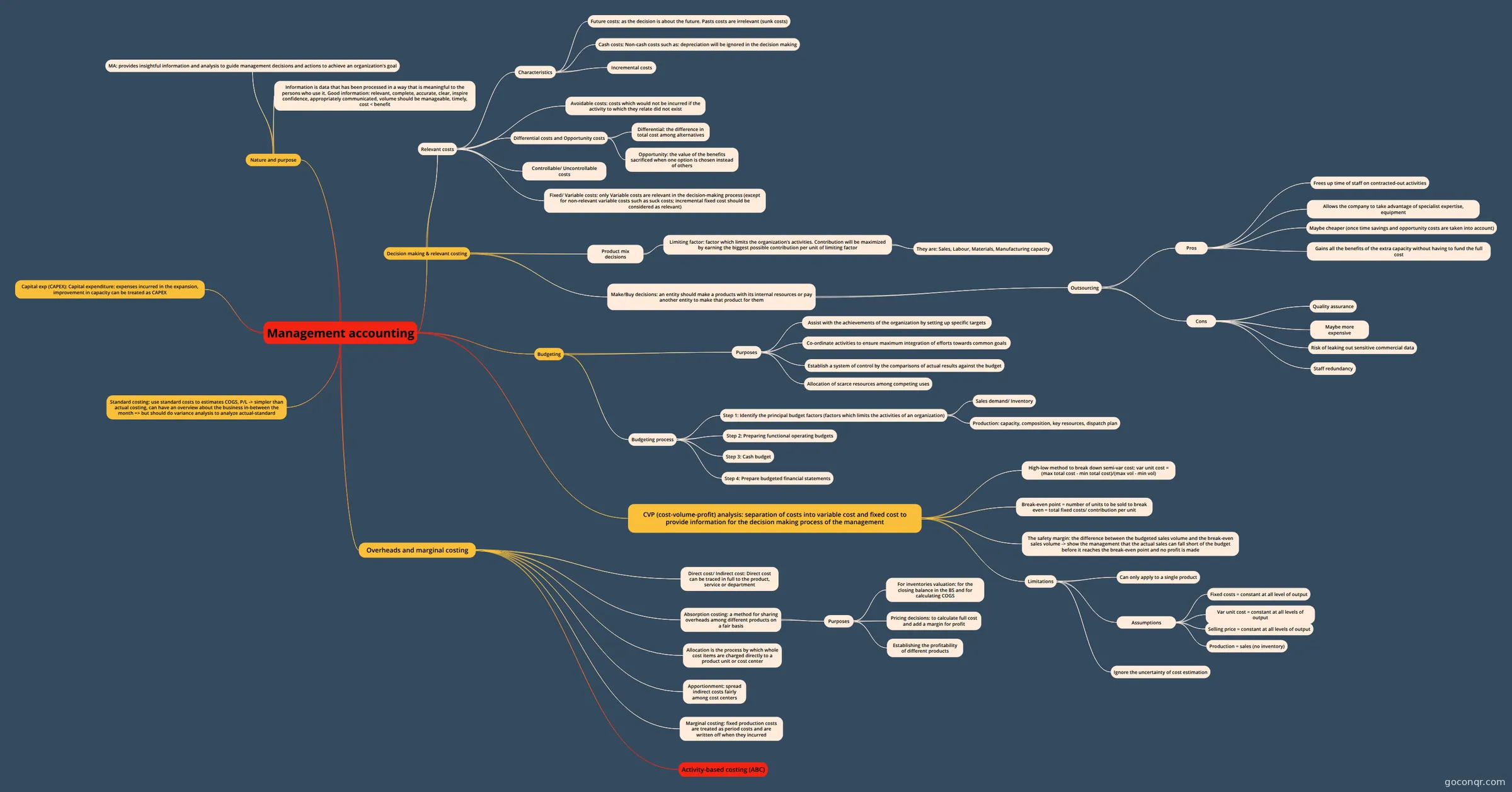
Mind map: Management accounting
Contenido del mapa
Management accounting
Nature and purpose
- MA: provides insightful information and analysis to guide management decisions and actions to achieve an organization's goal
- Information is data that has been processed in a way that is meaningful to the persons who use it. Good information: relevant, complete, accurate, clear, inspire confidence, appropriately communicated, volume should be manageable, timely, cost < benefit
Decision making & relevant costing
- Relevant costs
- Characteristics
- Future costs: as the decision is about the future. Pasts costs are irrelevant (sunk costs)
- Cash costs: Non-cash costs such as: depreciation will be ignored in the decision making
- Incremental costs
- Avoidable costs: costs which would not be incurred if the activity to which they relate did not exist
- Differential costs and Opportunity costs
- Differential: the difference in total cost among alternatives
- Opportunity: the value of the benefits sacrificed when one option is chosen instead of others
- Controllable/ Uncontrollable costs
- Fixed/ Variable costs: only Variable costs are relevant in the decision-making process (except for non-relevant variable costs such as suck costs; incremental fixed cost should be considered as relevant)
- Characteristics
- Product mix decisions
- Limiting factor: factor which limits the organization's activities. Contribution will be maximized by earning the biggest possible contribution per unit of limiting factor
- They are: Sales, Labour, Materials, Manufacturing capacity
- Limiting factor: factor which limits the organization's activities. Contribution will be maximized by earning the biggest possible contribution per unit of limiting factor
- Make/Buy decisions: an entity should make a products with its internal resources or pay another entity to make that product for them
- Outsourcing
- Pros
- Frees up time of staff on contracted-out activities
- Allows the company to take advantage of specialist expertise, equipment
- Maybe cheaper (once time savings and opportunity costs are taken into account)
- Gains all the benefits of the extra capacity without having to fund the full cost
- Cons
- Quality assurance
- Maybe more expensive
- Risk of leaking out sensitive commercial data
- Staff redundancy
- Pros
- Outsourcing
- Relevant costs
Budgeting
- Purposes
- Assist with the achievements of the organization by setting up specific targets
- Co-ordinate activities to ensure maximum integration of efforts towards common goals
- Establish a system of control by the comparisons of actual results against the budget
- Allocation of scarce resources among competing uses
- Budgeting process
- Step 1: Identify the principal budget factors (factors which limits the activities of an organization)
- Sales demand/ Inventory
- Production: capacity, composition, key resources, dispatch plan
- Step 2: Preparing functional operating budgets
- Step 3: Cash budget
- Step 4: Prepare budgeted financial statements
- Step 1: Identify the principal budget factors (factors which limits the activities of an organization)
- Purposes
CVP (cost-volume-profit) analysis: separation of costs into variable cost and fixed cost to provide information for the decision making process of the management
- High-low method to break down semi-var cost: var unit cost = (max total cost - min total cost)/(max vol - min vol)
- Break-even point = number of units to be sold to break even = total fixed costs/ contribution per unit
- The safety margin: the difference between the budgeted sales volume and the break-even sales volume -> show the management that the actual sales can fall short of the budget before it reaches the break-even point and no profit is made
- Limitations
- Can only apply to a single product
- Assumptions
- Fixed costs = constant at all level of output
- Var unit cost = constant at all levels of output
- Selling price = constant at all levels of output
- Production = sales (no inventory)
- Ignore the uncertainty of cost estimation
Overheads and marginal costing
- Direct cost/ Indirect cost: Direct cost can be traced in full to the product, service or department
- Absorption costing: a method for sharing overheads among different products on a fair basis
- Purposes
- For inventories valuation: for the closing balance in the BS and for calculating COGS
- Pricing decisions: to calculate full cost and add a margin for profit
- Establishing the profitability of different products
- Purposes
- Allocation is the process by which whole cost items are charged directly to a product unit or cost center
- Apportionment: spread indirect costs fairly among cost centers
- Marginal costing: fixed production costs are treated as period costs and are written off when they incurred
- Activity-based costing (ABC)
Standard costing: use standard costs to estimates COGS, P/L -> simpler than actual costing, can have an overview about the business in-between the month => but should do variance analysis to analyze actual-standard
Capital exp (CAPEX): Capital expenditure: expenses incurred in the expansion, improvement in capacity can be treated as CAPEX
Información
- Descripción
- APS APS Accounting Mapa Mental sobre Management accounting, creado por Ngan Ha Nguyen el 10/09/2017.
- Creado por
- Ngan Ha Nguyen
- Visitas
- 58
- Etiquetas
- Valoración