
Mapa mental
Communicating Narrative
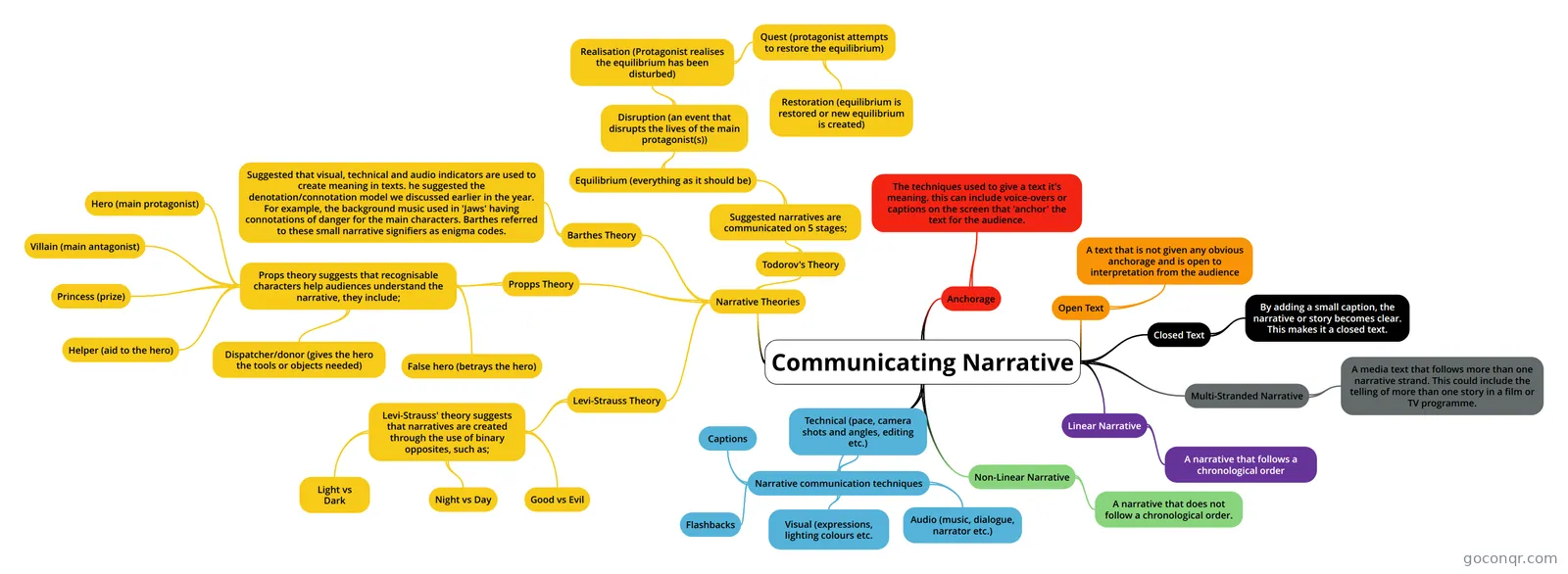
Mind map: Communicating narrative
Contenido del mapa
Communicating Narrative
Anchorage
- The techniques used to give a text it's meaning. this can include voice-overs or captions on the screen that 'anchor' the text for the audience.
Open Text
- A text that is not given any obvious anchorage and is open to interpretation from the audience
Closed Text
- By adding a small caption, the narrative or story becomes clear. This makes it a closed text.
Multi-Stranded Narrative
- A media text that follows more than one narrative strand. This could include the telling of more than one story in a film or TV programme.
Linear Narrative
- A narrative that follows a chronological order
Non-Linear Narrative
- A narrative that does not follow a chronological order.
Narrative communication techniques
- Audio (music, dialogue, narrator etc.)
- Visual (expressions, lighting colours etc.
- Technical (pace, camera shots and angles, editing etc.)
- Captions
- Flashbacks
Narrative Theories
- Todorov's Theory
- Suggested narratives are communicated on 5 stages;
- Equilibrium (everything as it should be)
- Disruption (an event that disrupts the lives of the main protagonist(s))
- Realisation (Protagonist realises the equilibrium has been disturbed)
- Quest (protagonist attempts to restore the equilibrium)
- Restoration (equilibrium is restored or new equilibrium is created)
- Quest (protagonist attempts to restore the equilibrium)
- Realisation (Protagonist realises the equilibrium has been disturbed)
- Disruption (an event that disrupts the lives of the main protagonist(s))
- Equilibrium (everything as it should be)
- Suggested narratives are communicated on 5 stages;
- Barthes Theory
- Suggested that visual, technical and audio indicators are used to create meaning in texts. he suggested the denotation/connotation model we discussed earlier in the year. For example, the background music used in 'Jaws' having connotations of danger for the main characters. Barthes referred to these small narrative signifiers as enigma codes.
- Propps Theory
- Props theory suggests that recognisable characters help audiences understand the narrative, they include;
- Hero (main protagonist)
- Villain (main antagonist)
- Princess (prize)
- Helper (aid to the hero)
- Dispatcher/donor (gives the hero the tools or objects needed)
- False hero (betrays the hero)
- Props theory suggests that recognisable characters help audiences understand the narrative, they include;
- Levi-Strauss Theory
- Levi-Strauss' theory suggests that narratives are created through the use of binary opposites, such as;
- Good vs Evil
- Night vs Day
- Light vs Dark
- Levi-Strauss' theory suggests that narratives are created through the use of binary opposites, such as;
- Todorov's Theory
Información
- Descripción
- Mapa Mental sobre Communicating Narrative, creado por Lewis Taylor-Maddocks el 02/11/2017.
- Creado por
- Lewis Taylor-Maddocks
- Visitas
- 0
- Valoración