
Mapa mental
c4
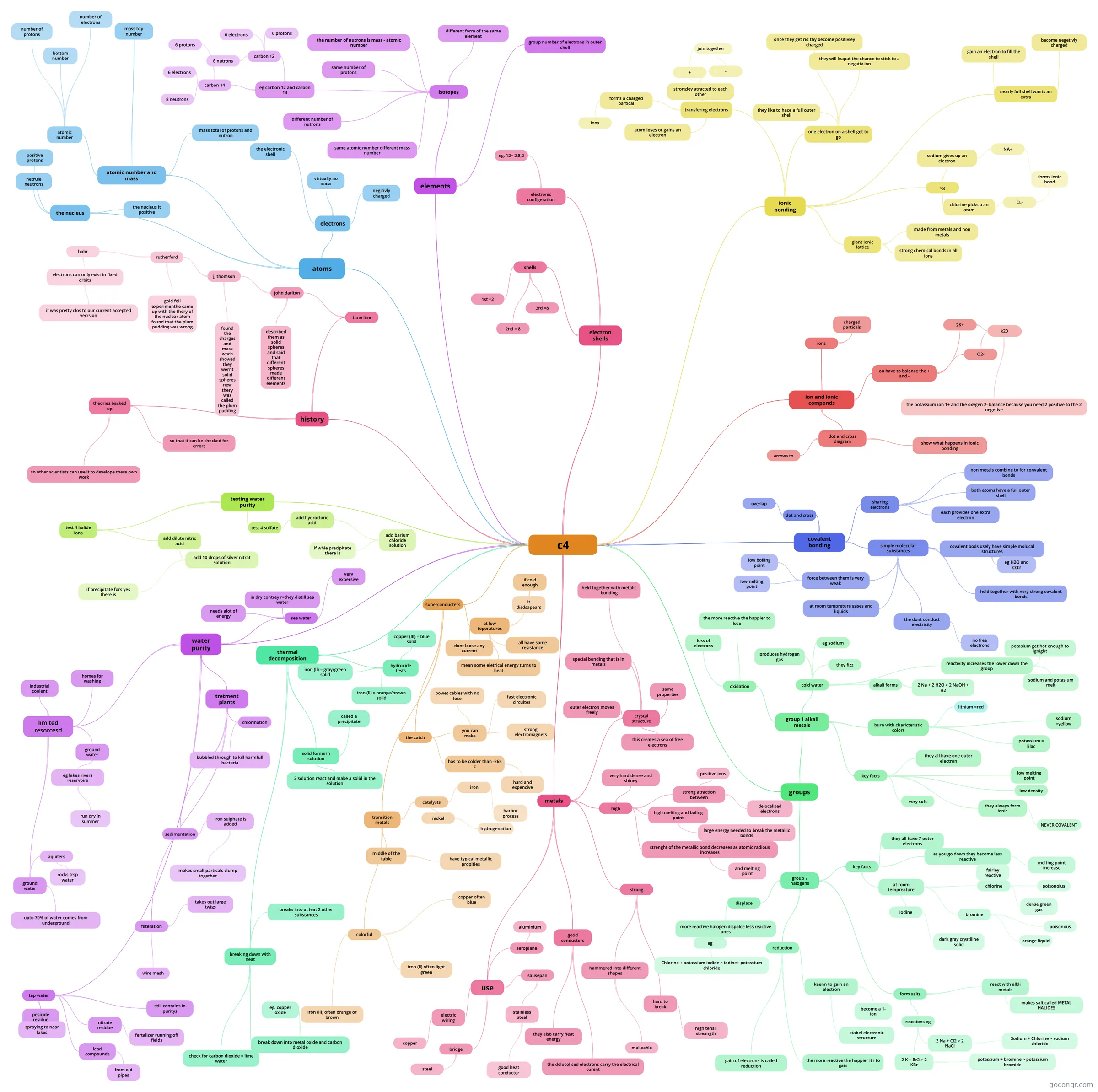
Mind map: atoms and bonding chemistry
Contenido del mapa
c4
testing water purity
- test 4 sulfate
- add hydrocloric acid
- add barium chloride solution
- if whie precipitate there is
- add barium chloride solution
- add hydrocloric acid
- test 4 halide ions
- add dilute nitric acid
- add 10 drops of silver nitrat solution
- if precipitate fors yes there is
- add 10 drops of silver nitrat solution
- add dilute nitric acid
- test 4 sulfate
elements
- isotopes
- different form of the same element
- same number of protons
- different number of nutrons
- same atomic number different mass number
- eg carbon 12 and carbon 14
- carbon 12
- 6 protons
- 6 electrons
- 6 nutrons
- carbon 14
- 6 protons
- 6 electrons
- 8 neutrons
- carbon 12
- the number of nutrons is mass - atomic number
- group number of electrons in outer shell
- isotopes
metals
- crystal structure
- same properties
- special bonding that is in metals
- held together with metalic bonding
- outer electron moves freely
- this creates a sea of free electrons
- high
- very hard dense and shiney
- strong atraction between
- positive ions
- delocalised electrons
- high melting and boling point
- large energy needed to break the metallic bonds
- strenght of the metallic bond decreases as atomic radious increases
- and melting point
- strong
- hard to break
- high tensil streangth
- hammered into different shapes
- malleable
- hard to break
- good conducters
- the delocolised electrons carry the electrical curent
- they also carry heat energy
- use
- sausepan
- stainless steal
- good heat conducter
- stainless steal
- electric wiring
- copper
- aeroplane
- aluminium
- bridge
- steel
- sausepan
- crystal structure
ion and ionic componds
- ions
- charged particals
- ou have to balance the + and -
- 2K+
- k20
- the potassium ion 1+ and the oxygen 2- balance because you need 2 positive to the 2 negetive
- k20
- O2-
- 2K+
- dot and cross diagram
- show what happens in ionic bonding
- arrows to
- ions
electron shells
- shells
- 2nd = 8
- 3rd =8
- 1st =2
- electronic configeration
- eg. 12= 2,8,2
- shells
superconducters
- at low teperatures
- all have some resistance
- mean some eletrical energy turns to heat
- if cold enough
- it disdsapears
- dont loose any current
- the catch
- you can make
- powet cables with no lose
- fast electronic circuites
- strong electromagnets
- has to be colder than -265 c
- hard and expencive
- you can make
- transition metals
- catalysts
- iron
- harbor process
- nickel
- hydrogenation
- iron
- colorful
- copper often blue
- iron (ll) often light green
- iron (lll) often orange or brown
- middle of the table
- have typical metallic propities
- catalysts
- at low teperatures
atoms
- the nucleus
- positive protons
- netrule neutrons
- the nucleus it positive
- electrons
- negitivly charged
- the electronic shell
- virtually no mass
- atomic number and mass
- mass top number
- mass total of protons and nutron
- atomic number
- number of protons
- bottom number
- number of electrons
- the nucleus
ionic bonding
- transfering electrons
- atom loses or gains an electron
- forms a charged partical
- ions
- strongley atracted to each other
- +
- join together
- -
- +
- one electron on a shell got to go
- they like to hace a full outer shell
- once they get rid thy become positivley charged
- they will leapat the chance to stick to a negativ ion
- nearly full shell wants an extra
- gain an electron to fill the shell
- become negetivly charged
- eg
- sodium gives up an electron
- NA+
- NA+
- chlorine picks p an atom
- CL-
- forms ionic bond
- CL-
- sodium gives up an electron
- giant ionic lattice
- made from metals and non metals
- strong chemical bonds in all ions
- transfering electrons
groups
- group 1 alkali metals
- oxidation
- loss of electrons
- the more reactive the happier to lose
- cold water
- produces hydrogen gas
- eg sodium
- they fizz
- reactivity increases the lower down the group
- potasium get hot enough to ignight
- sodium and potasium melt
- alkali forms
- 2 Na + 2 H2O > 2 NaOH + H2
- burn with charicteristic colors
- lithium =red
- sodium =yellow
- potassium = lilac
- key facts
- they all have one outer electron
- low melting point
- low density
- very soft
- they always form ionic
- NEVER COVALENT
- oxidation
- group 7 halogens
- key facts
- they all have 7 outer electrons
- as you go down they become less reactive
- melting point increase
- at room tempreature
- chlorine
- poisonoius
- dense green gas
- fairley reactive
- iodine
- dark gray crystlline solid
- bromine
- poisonous
- orange liquid
- chlorine
- reduction
- keenn to gain an electron
- become a 1- ion
- stabel electronic structure
- the more reactive the happier it i to gain
- gain of electrons is called reduction
- keenn to gain an electron
- form salts
- react with alkli metals
- makes salt called METAL HALIDES
- reactions eg
- 2 Na + Cl2 > 2 NaCl
- Sodium + Chlorine > sodium chloride
- 2 K + Br2 > 2 KBr
- potassium + bromine > potassium bromide
- 2 Na + Cl2 > 2 NaCl
- react with alkli metals
- displace
- more reactive halogen dispalce less reactive ones
- eg
- Chlorine + potassium iodide > iodine+ potassium chloride
- eg
- more reactive halogen dispalce less reactive ones
- key facts
- group 1 alkali metals
covalent bonding
- sharing electrons
- non metals combine to for convalent bonds
- both atoms have a full outer shell
- each provides one extra electron
- dot and cross
- overlap
- simple molecular substances
- covalent bods usely have simple molucal structures
- eg H2O and CO2
- held together with very strong covalent bonds
- force between them is very weak
- low boiling point
- lowmelting point
- at room tempreture gases and liquids
- the dont conduct electricity
- no free electrons
- covalent bods usely have simple molucal structures
- sharing electrons
water purity
- sea water
- very expersive
- in dry contrey r=they distill sea water
- needs alot of energy
- limited resorcesd
- industrial coolent
- homes for washing
- ground water
- aquifers
- rocks trsp water
- upto 70% of water comes from underground
- aquifers
- ground water
- eg lakes rivers reservoirs
- run dry in summer
- eg lakes rivers reservoirs
- tap water
- still contains in puritys
- nitrate residue
- fertalizer running off fields
- lead compounds
- from old pipes
- pesicide residue
- spraying to near lakes
- tretment plants
- filteration
- wire mesh
- takes out large twigs
- sedimentation
- iron sulphate is added
- makes small particals clump together
- iron sulphate is added
- chlorination
- bubbled through to kill harmfull bacteria
- filteration
- sea water
thermal decomposition
- hydroxide tests
- copper (lll) = blue solid
- iron (ll) = gray/green solid
- iron (ll) = orange/brown solid
- solid forms in solution
- 2 solution react and make a solid in the solution
- called a precipitate
- breaking down with heat
- breaks into at leat 2 other substances
- break down into metal oxide and carbon dioxide
- eg. copper oxide
- check for carbon dioxide = lime water
- hydroxide tests
history
- theories backed up
- so that it can be checked for errors
- so other scientists can use it to develope there own work
- time line
- john darlton
- jj thomson
- rutherford
- gold foil experimenthe came up with the thery of the nuclear atom found that the plum pudding was wrong
- bohr
- electrons can only exist in fixed orbits
- it was pretty clos to our current accepted verrsion
- electrons can only exist in fixed orbits
- found the charges and mass whch showed they wernt solid spheres new thery was called the plum pudding
- rutherford
- described them as solid spheres and said that different spheres made different elements
- jj thomson
- john darlton
- theories backed up
Información
- Descripción
- science Mapa Mental sobre c4, creado por zoetoffee el 29/05/2013.
- Creado por
- zoetoffee
- Visitas
- 151
- Etiquetas
- Valoración