
Mapa mental
Pressure
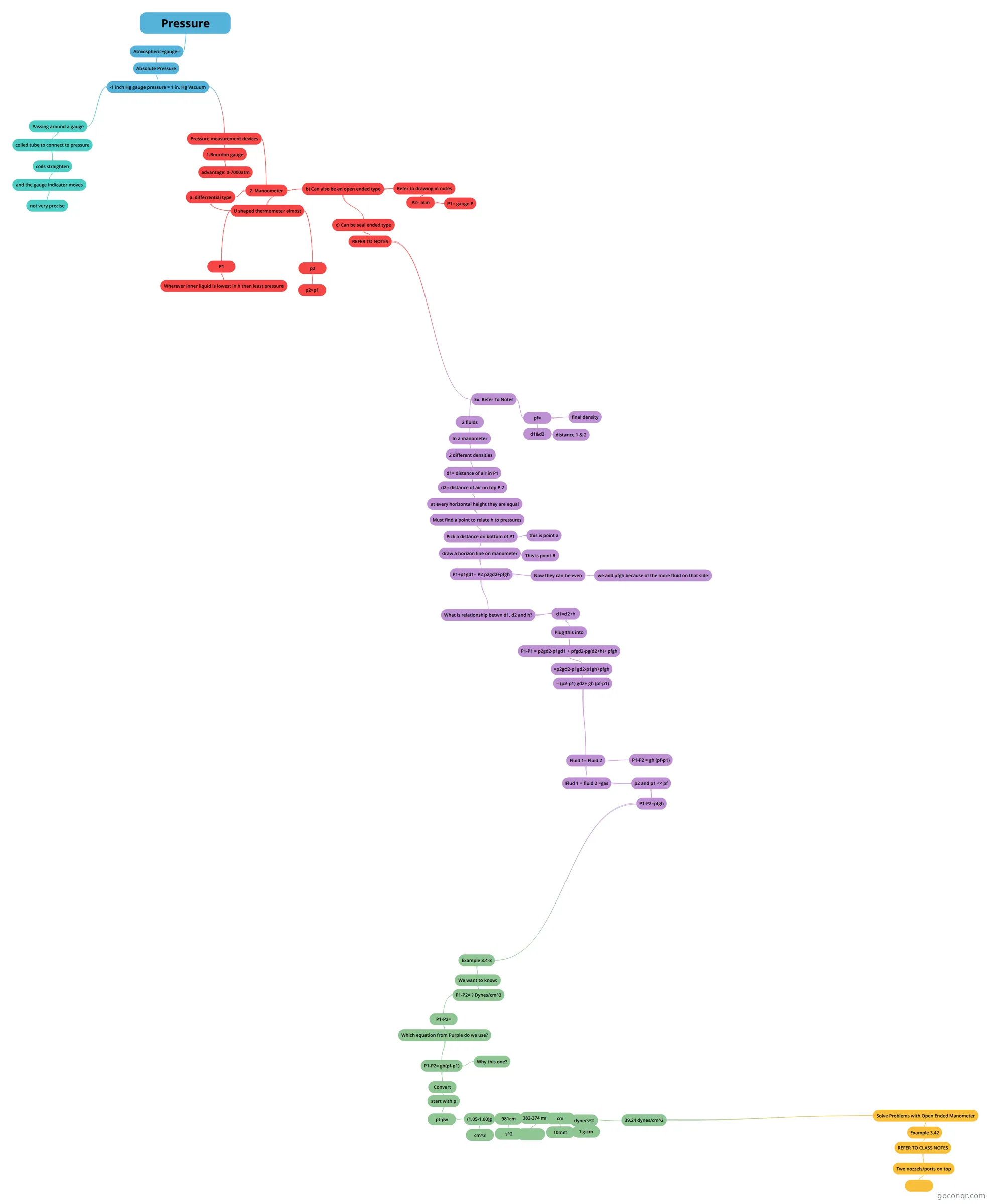
Mind map: Pressure
Contenido del mapa
Pressure
Atmospheric+gauge=
- Absolute Pressure
- -1 inch Hg gauge pressure = 1 in. Hg Vacuum
- Passing around a gauge
- coiled tube to connect to pressure
- coils straighten
- and the gauge indicator moves
- not very precise
- and the gauge indicator moves
- coils straighten
- coiled tube to connect to pressure
- Pressure measurement devices
- 1.Bourdon gauge
- advantage: 0-7000atm
- 2. Manoometer
- a. differrential type
- U shaped thermometer almost
- P1
- Wherever inner liquid is lowest in h than least pressure
- p2
- p2>p1
- b) Can also be an open ended type
- c) Can be seal ended type
- REFER TO NOTES
- Ex. Refer To Notes
- 2 fluids
- In a manometer
- 2 different densities
- d1= distance of air in P1
- d2= distance of air on top P 2
- at every horizontal height they are equal
- Must find a point to relate h to pressures
- Pick a distance on bottom of P1
- draw a horizon line on manometer
- This is point B
- P1+p1gd1= P2 p2gd2+pfgh
- Now they can be even
- we add pfgh because of the more fluid on that side
- What is relationship betwn d1, d2 and h?
- d1=d2+h
- Plug this into
- P1-P1 = p2gd2-p1gd1 + pfgd2-pg(d2+h)+ pfgh
- =p2gd2-p1gd2-p1gh+pfgh
- = (p2-p1) gd2+ gh (pf-p1)
- Fluid 1= Fluid 2
- Flud 1 = fluid 2 =gas
- p2 and p1 << pf
- P1-P2=pfgh
- Example 3.4-3
- We want to know:
- P1-P2= ? Dynes/cm^3
- P1-P2=
- Which equation from Purple do we use?
- P1-P2= gh(pf-p1)
- Why this one?
- Convert
- start with p
- pf-pw
- (1.05-1.00)g
- cm^3
- 981cm
- s^2
- 382-374 mm
- cm
- 10mm
- 1 g-cm
- dyne/s^2
- 39.24 dynes/cm^2
- Solve Problems with Open Ended Manometer
- Example 3.42
- REFER TO CLASS NOTES
- Two nozzels/ports on top
- Two nozzels/ports on top
- REFER TO CLASS NOTES
- Example 3.42
- Solve Problems with Open Ended Manometer
- 39.24 dynes/cm^2
- dyne/s^2
- 1 g-cm
- 10mm
- cm
- 382-374 mm
- s^2
- (1.05-1.00)g
- pf-pw
- start with p
- P1-P2= gh(pf-p1)
- Which equation from Purple do we use?
- P1-P2=
- P1-P2= ? Dynes/cm^3
- We want to know:
- Example 3.4-3
- P1-P2=pfgh
- p2 and p1 << pf
- P1-P2 = gh (pf-p1)
- Flud 1 = fluid 2 =gas
- Fluid 1= Fluid 2
- = (p2-p1) gd2+ gh (pf-p1)
- =p2gd2-p1gd2-p1gh+pfgh
- P1-P1 = p2gd2-p1gd1 + pfgd2-pg(d2+h)+ pfgh
- Plug this into
- d1=d2+h
- Now they can be even
- this is point a
- draw a horizon line on manometer
- Pick a distance on bottom of P1
- Must find a point to relate h to pressures
- at every horizontal height they are equal
- d2= distance of air on top P 2
- d1= distance of air in P1
- 2 different densities
- In a manometer
- pf=
- final density
- d1&d2
- distance 1 & 2
- 2 fluids
- Ex. Refer To Notes
- REFER TO NOTES
- Refer to drawing in notes
- P2= atm
- P1= gauge P
- P2= atm
- c) Can be seal ended type
- P1
- U shaped thermometer almost
- a. differrential type
- 1.Bourdon gauge
- Passing around a gauge
- -1 inch Hg gauge pressure = 1 in. Hg Vacuum
- Absolute Pressure