
Mapa mental
IAS 38 Intangible Assets
Contenido del mapa
IAS 38 Intangible Assets
An intangible asset is an identifiable non-monetary asset without physical substance (Computer software, brands, licences and patents
- An intangible asset may be recognised in the financial statements if:
- It is probable that the entity will receive future economic benefits from the asset
- The cost of the asset can be measured reliably.
- An intangible asset may be recognised in the financial statements if:
Measurement at recognition
- Intangible assets may be purchased or generated internally within the entity. This determines how they should be measured.
- Intangible assets purchased separately
- cost (purchase price plus any directly attributable costs.
- Acquired as part of business combination
- fair value ( value of the intangible given by an active market.)
- Intangible assets purchased separately
- Intangible assets may be purchased or generated internally within the entity. This determines how they should be measured.
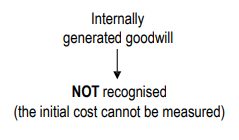
Internally generated intangible assets
- Research
- costs incurred to gain new scientific or technical knowledge and understanding
- not recognised as an intangible asset, but shown as an expense in the income statement
- no certainty of future economic benefits
- Development
- application of research findings to a plan/design for the production of new or substantially improved materials, products or processes prior to commercial production or use
- must be recognised as an intangible asset once all PIRATE criteria are met
- P - Probable future economic benefits will be generated by the asset
- I - Intention to complete and use/sell asset
- R - Resources (technical, financial) adequate to complete asset
- A - Ability to use/sell asset
- T - Technical feasibility of completing asset
- E - Expenditure can be measured reliably
- Research
Amortisation
- Assets with a finite useful life
- The depreciable amount (cost or revalued amount, less residual value) is allocated on a systematic basis over useful life.
- The residual value is normally assumed to be zero.
- Amortisation begins when the asset is available for use.
- The useful life and amortisation method must be reviewed at least at each year end and adjusted where necessary.
- Amortisation begins when the asset is available for use.
- The residual value is normally assumed to be zero.
- The depreciable amount (cost or revalued amount, less residual value) is allocated on a systematic basis over useful life.
- Assets with an indefinite useful life
- Not amortised.
- The appropriateness of the indefinite useful life assessment is reviewed each period to determine whether it is still appropriate.
- Impairment tests are conducted at least annually (IAS 36: Impairment of assets).
- The appropriateness of the indefinite useful life assessment is reviewed each period to determine whether it is still appropriate.
- Not amortised.
- Assets with a finite useful life
Imágenes y archivos del mapa
Información
- Descripción
- Mapa Mental sobre IAS 38 Intangible Assets, creado por Tony Thorne el 07/03/2018.
- Creado por
- Tony Thorne · mar 2018
- Actualizado
- 7 mar 2018
- Visitas
- 24
- Valoración