
Mapa mental
Capacitors
Contenido del mapa
Capacitors
Structure of Capacitor: A capacitor is a device which stores electrical charge. It is made of two metal plates separated by an insulator know as a dielectric. The dielectric is usually made of oil, paper or air.
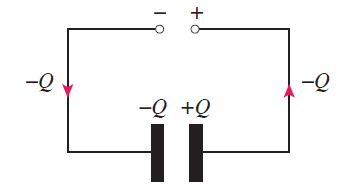
- Charging a capacitor: As the plates of the capacitor are separated by an insulator, the charge cannot fllow across the plates when connected to a potential difference.
- Electrons flow from the +Q plate of the capacitor to the positive end of the battery.
- Electrons flow from the negative side of the battery to the -Q plate of the capacitor.
- Current flows for a short time and stops when the potential difference across the capacitor is the same as the p.d across the battery
- Electrons flow from the +Q plate of the capacitor to the positive end of the battery.
- Charging a capacitor: As the plates of the capacitor are separated by an insulator, the charge cannot fllow across the plates when connected to a potential difference.
Capacitance definition: The charge stored per volt.
- C = Q / V
- C in Farads, F Q in Coulombs, C V in Volts, V
- Farad definition: A Coulomb per Volt
- Energy stored in a capacitor can be derived from this equation:
- E = 1/2 QV
- C in Farads, F Q in Coulombs, C V in Volts, V
- C = Q / V
In Series
- 1 / C = 1 / C1 + 1 / C2 + 1 / C3
- Charge is the same everywhere Voltage spilts
- Smallest Capacitor = Largest P.D
- Charge is the same everywhere Voltage spilts
- 1 / C = 1 / C1 + 1 / C2 + 1 / C3
In Parallel
- C = C1 + C2 + C3
- Voltage is the same everywhere Charge splits
- Largest capacitor = Largest charge
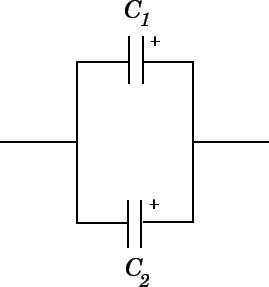
- If capacitors look like image on right: They are joined in parallel; there is no change to the total charge stored; the p.d. across the capacitors becomes equal; the combined capacitance in parallel is C1 + C2
- Voltage is the same everywhere Charge splits
- C = C1 + C2 + C3
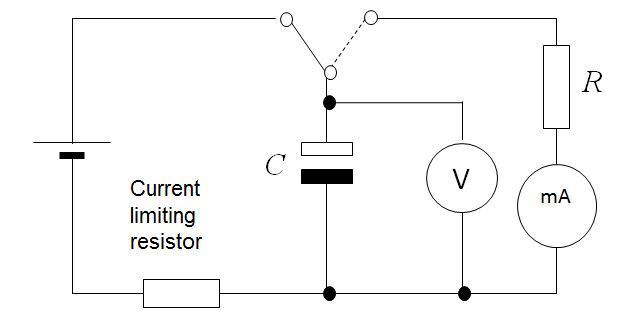
1) Set up apparatus as shown. Initially charge the capacitor by flicking the switch to position 1, connecting the capacitor to the power supply. 2) Discharge the capacitor by flicking the switch to position 2. Record current values at 10s intervals for 100s using stopwatch. 3) Plot graph of current against time.
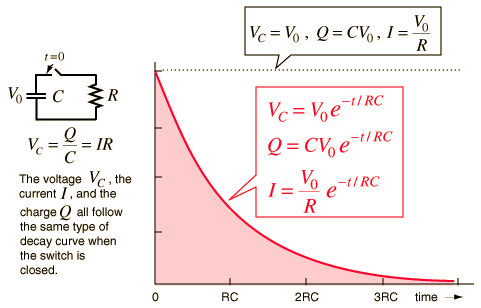
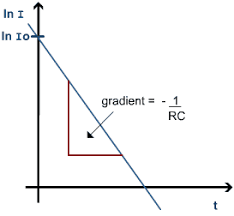
- I = Io e^ -t/RC Q = Qo e^ -t/RC V = Vo e^ -t/RC
- τ = RC
- Time constant is the time taken for the current / charge / voltage to fall to 0.368 of its initial value.
- The larger the value of RC, the longer a capacitor will take to discharge.
- Resolving the exponential curve to a straight line graph, results in the graph to the right.
- Why the exponential shape? Intially, the -ve side of the battery is more -ve than -Q plate of the capacitor so e- flow from the battery to the -Q plate. Likewise the Q+ plate is more -ve than the =ve side of the battery so e- flow from Q+ to +ve of battery. This means at initally the capacitor is at 0V (uncharged) and the battery is at 6V. Because of the large p.d, there is a large flow of current. Over time, the capacitor becomes charged so the p.d between the battery and the capacitor is decreased. This means that the flow of current will also decrease. Eventually, the p.d across the capacitor is equal to the p.d across the battery. At this point, current stops flowing.
- When t = RC; I = 0.368 Io
- Half life is the time taken for current/ charge/ voltage to fall to half its original value.
- If at t½, I = ½Io, t = 0.693 RC
- Time constant is the time taken for the current / charge / voltage to fall to 0.368 of its initial value.
Applications
- Flash Gun
- Capacitor stores very little charge. However when discharged in a very short space of time, the electrical energy is converted to light very quickly, giving a flash gun a large power output.
- Defibrillator
- Capacitor stores a large amount of energy in the form of electrical charge. It is then released over a short period of time. For a successful defibrillation, the current delivered must be maintained for several milliseconds. However, the current and charge delivered by a discharging capacitor decay rapidly. Therefore inductors are used to prolong the duration of current flow.
- Flash Gun
Imágenes y archivos del mapa
Información
- Descripción
- A2 CCEA Physics Capacitor Revision Mindmap; a summary of the entire topic. I hope it helps some people!
- Creado por
- Emily Keenan
- Visitas
- 528
- Etiquetas
- Valoración