
Mapa mental
Relations
Contenido del mapa
Relations
To define subsets of Cartesian products with certain properties, and to understand the predicates "=" (equality) and other predicates in predicate logic in a more abstract light.
General Relations
- Take x = y for example.
- The elements x is some notation R to y (equality in this case).
- We can also denote it as xRy or (x, y) ∈ E.
- Let x, y in R, then E = {(x, x) | x ∈ R} ⊂ R x R.
- The "diagonal" in R x R gives exactly the elements equal to each other.
- Let A, B be sets. A subset of the Cartesian product A x B is called a relation between A and B. A subset of the Cartesian product A x A is called a relation on A.
- A = {1, 3, 7}
- B = {1, 2, 5}
- S = {(1, 1), (1, 5), (3, 2)}
- 1S1, 1S5, 3S2 and no other ordered pairs in A x B satisify S.
- Binary Relation
- The "diagonal" in R x R gives exactly the elements equal to each other.
- The elements x is some notation R to y (equality in this case).
- Take x = y for example.
Equivalence Relations
- Reflexive
- iff ∀x ∈ A, xRx
- Symmetric
- ∀x, y ∈ A, xRy → yRx
- Transitive
- ∀x, y, z ∈ A, xRy ∧ yRz → xRz
- xRy, x ≡ y, x ~ y
- Example 1: Equality
- x = x
- x = y ⇒ y = x
- x = y ∧ y = z ⇒ x = z
- Therefore equality, =, is an equivalence relation
- x = y ∧ y = z ⇒ x = z
- x = y ⇒ y = x
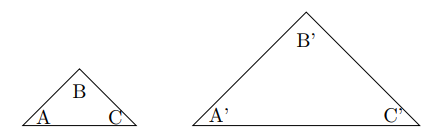
- Example 2: Triangles
- Let Γ be the set of all triangles in the plane. ABC ~ A'B'C' if ABC and A'B'C' are similar triangles i.e. have equal angles.
- ∀ABC ∈ Γ, ABC ∼ ABC
- ABC ∼ A′B′C' ⇒ A′B′C′ ∼ ABC
- ABC ∼ A′B′C' and A′B′C′ ∼ A”B”C” ⇒ ABC ∼ A”B”C”
- ABC ∼ A′B′C' ⇒ A′B′C′ ∼ ABC
- x = x
- Reflexive
Partitions
- Collection of non-empty sets, any two of which are disjoint s.t. their union is A
- If R is an equivalence relation on a set A, and x ∈ A, the equivalence class of x, denoted [x]R, is the set {y | xRy}. The collection of all equivalence classes is called A modulo R, and denoted A/R.
- When the elements of some set S have a notion of equivalence (an equivalence relation) defined on them, then one may naturally split the set S into equivalence classes.
- If X is the set of all cars, and ~ is the equivalence relation "has the same colour as", then one particular equivalence class consists of all green cars. X/~ could be naturally identified with the set of all car colours.
- For any equivalence relation R on a set A, its equivalence classes form a partition of A
- ∀x ∈ A, ∃y ∈ A s.t. x ∈ [y] (every element of A sits somewhere)
- xRy ⇔ [x] = [y] (all elements related by R belong to the same equivalence class)
- ¬(xRy) ⇔ [x] ∩ [y] = ∅ (if two elements are not related by R, the they belong to disjoint equivalence classes)
- When the elements of some set S have a notion of equivalence (an equivalence relation) defined on them, then one may naturally split the set S into equivalence classes.
- If R is an equivalence relation on a set A, and x ∈ A, the equivalence class of x, denoted [x]R, is the set {y | xRy}. The collection of all equivalence classes is called A modulo R, and denoted A/R.
- {(n, n + 1 | n ∈ Z} is a partition of R
- A = N (natural numbers)
- x ≡ y mod 3
- We have the equivalence classes [0]R, [1]R and [2]R given by the three possible remainders under division by 3.
- [0]R = {0, 3, 6, 9, ... }
- [1]R = {1, 4, 7, 10, ... }
- [2]R = {2, 5, 8, 11, ... }
- [0]R ∪ [1]R ∪ [2]R = N
- Mutually disjoint ⇒ R gives a partition of N.
- We have the equivalence classes [0]R, [1]R and [2]R given by the three possible remainders under division by 3.
- x ≡ y mod 3
- Collection of non-empty sets, any two of which are disjoint s.t. their union is A
Partial Orders
- Anti-Symmetric
- A relation R on A is called anti-symmetric if ∀x, y ∈ A s.t. xRy ∧ yRx, then x = y
- A partial order is a relation on a set A that is reflexive, anti-symmetric and transitive.
- ≤
- Reflexive
- ∀x ∈ R, x ≤ x
- Anti-Symmetric
- ∀x, y ∈ R s.t. x ≤ y ∧ y ≤ x ⇒ x = y
- Transitive
- ∀x, y, z ∈ R s.t. x ≤ y ∧ y ≤ z ⇒ x ≤ z
- A = R
- Same conclusion is A = Z or A = N
- Reflexive
- ≤
- Most important example is the relation ⊆ "being a subset of" as a partial order.
- Anti-Symmetric
Imágenes y archivos del mapa
Información
- Descripción
- Senior Freshman Mathematics Mapa Mental sobre Relations, creado por Luke Byrne el 22/04/2018.
- Creado por
- Luke Byrne
- Visitas
- 37
- Etiquetas
- Valoración