
Mapa mental
Changing Cities Unit
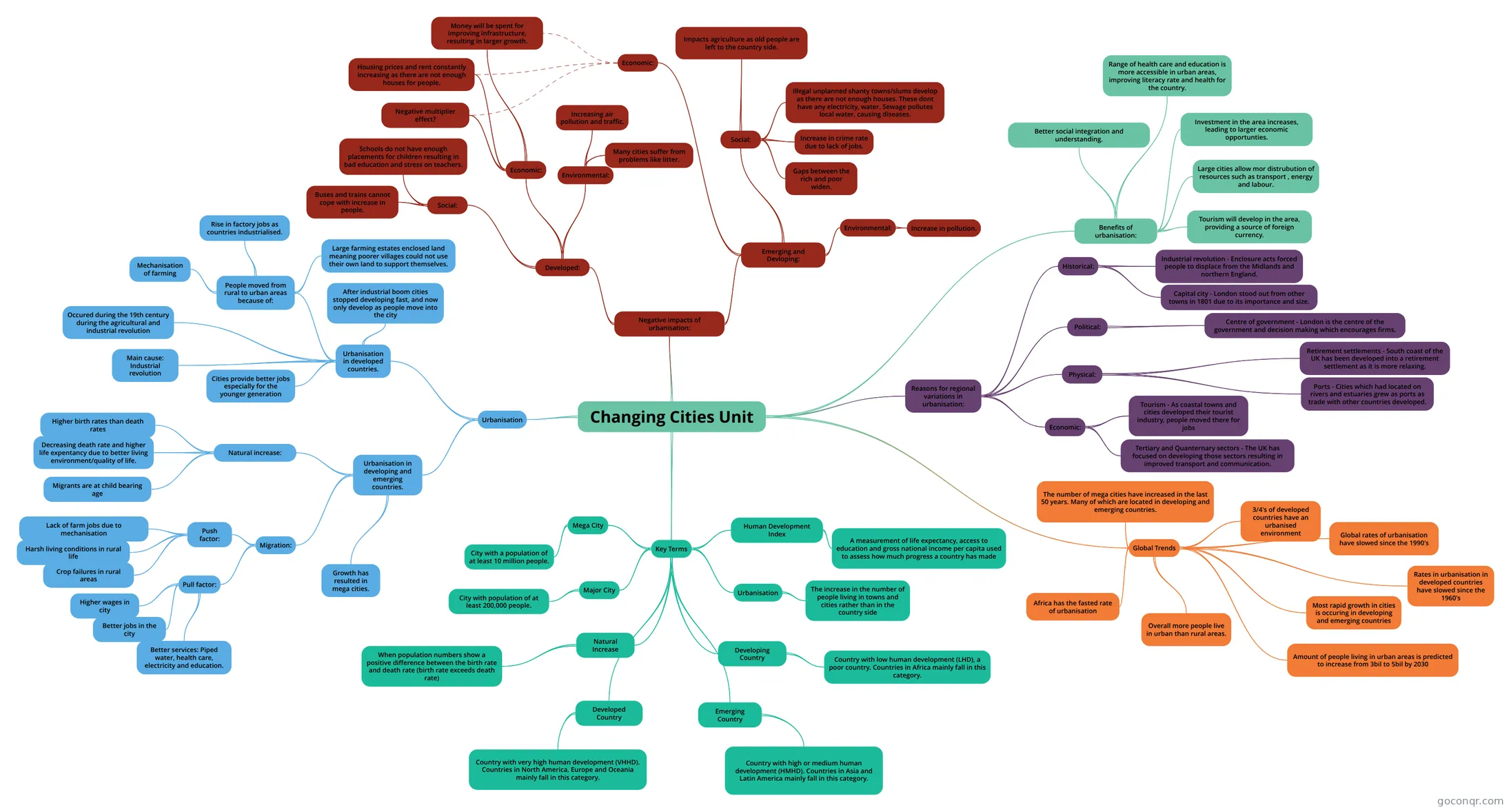
Mind map: Changing Cities unit
Contenido del mapa
Changing Cities Unit
Key Terms
- Developing Country
- Country with low human development (LHD), a poor country. Countries in Africa mainly fall in this category.
- Emerging Country
- Country with high or medium human development (HMHD). Countries in Asia and Latin America mainly fall in this category.
- Developed Country
- Country with very high human development (VHHD). Countries in North America, Europe and Oceania mainly fall in this category.
- Natural Increase
- When population numbers show a positive difference between the birth rate and death rate (birth rate exceeds death rate)
- Urbanisation
- The increase in the number of people living in towns and cities rather than in the country side
- Major City
- City with population of at least 200,000 people.
- Mega City
- City with a population of at least 10 million people.
- Human Development Index
- A measurement of life expectancy, access to education and gross national income per capita used to assess how much progress a country has made
- Developing Country
Global Trends
- Overall more people live in urban than rural areas.
- Amount of people living in urban areas is predicted to increase from 3bil to 5bil by 2030
- Most rapid growth in cities is occuring in developing and emerging countries
- Rates in urbanisation in developed countries have slowed since the 1960's
- Global rates of urbanisation have slowed since the 1990's
- Africa has the fasted rate of urbanisation
- 3/4's of developed countries have an urbanised environment
- The number of mega cities have increased in the last 50 years. Many of which are located in developing and emerging countries.
Urbanisation
- Urbanisation in developing and emerging countries.
- Natural increase:
- Higher birth rates than death rates
- Migrants are at child bearing age
- Decreasing death rate and higher life expentancy due to better living environment/quality of life.
- Migration:
- Push factor:
- Lack of farm jobs due to mechanisation
- Harsh living conditions in rural life
- Crop failures in rural areas
- Pull factor:
- Higher wages in city
- Better jobs in the city
- Better services: Piped water, health care, electricity and education.
- Push factor:
- Growth has resulted in mega cities.
- Natural increase:
- Urbanisation in developed countries.
- Main cause: Industrial revolution
- Occured during the 19th century during the agricultural and industrial revolution
- People moved from rural to urban areas because of:
- Mechanisation of farming
- Large farming estates enclosed land meaning poorer villages could not use their own land to support themselves.
- Rise in factory jobs as countries industrialised.
- After industrial boom cities stopped developing fast, and now only develop as people move into the city
- Cities provide better jobs especially for the younger generation
- Urbanisation in developing and emerging countries.
Negative impacts of urbanisation:
- Developed:
- Social:
- Buses and trains cannot cope with increase in people.
- Schools do not have enough placements for children resulting in bad education and stress on teachers.
- Economic:
- Housing prices and rent constantly increasing as there are not enough houses for people.
- Money will be spent for improving infrastructure, resulting in larger growth.
- Negative multiplier effect?
- Environmental:
- Increasing air pollution and traffic.
- Many cities suffer from problems like litter.
- Social:
- Emerging and Devloping:
- Social:
- Impacts agriculture as old people are left to the country side.
- Illegal unplanned shanty towns/slums develop as there are not enough houses. These dont have any electricity, water. Sewage pollutes local water, causing diseases.
- Increase in crime rate due to lack of jobs.
- Gaps between the rich and poor widen.
- Economic:
- Environmental:
- Increase in pollution.
- Social:
- Developed:
Benefits of urbanisation:
- Better social integration and understanding.
- Range of health care and education is more accessible in urban areas, improving literacy rate and health for the country.
- Investment in the area increases, leading to larger economic opportunties.
- Tourism will develop in the area, providing a source of foreign currency.
- Large cities allow mor distrubution of resources such as transport , energy and labour.
Reasons for regional variations in urbanisation:
- Historical:
- Industrial revolution - Enclosure acts forced people to displace from the Midlands and northern England.
- Capital city - London stood out from other towns in 1801 due to its importance and size.
- Political:
- Centre of government - London is the centre of the government and decision making which encourages firms.
- Physical:
- Retirement settlements - South coast of the UK has been developed into a retirement settlement as it is more relaxing.
- Ports - Cities which had located on rivers and estuaries grew as ports as trade with other countries developed.
- Economic:
- Tourism - As coastal towns and cities developed their tourist industry, people moved there for jobs
- Tertiary and Quanternary sectors - The UK has focused on developing those sectors resulting in improved transport and communication.
- Historical:
Información
- Descripción
- All about changing cities, no case studys.
- Creado por
- Parth Shetty
- Visitas
- 102
- Etiquetas
- Valoración