
Mapa mental
Chromatography
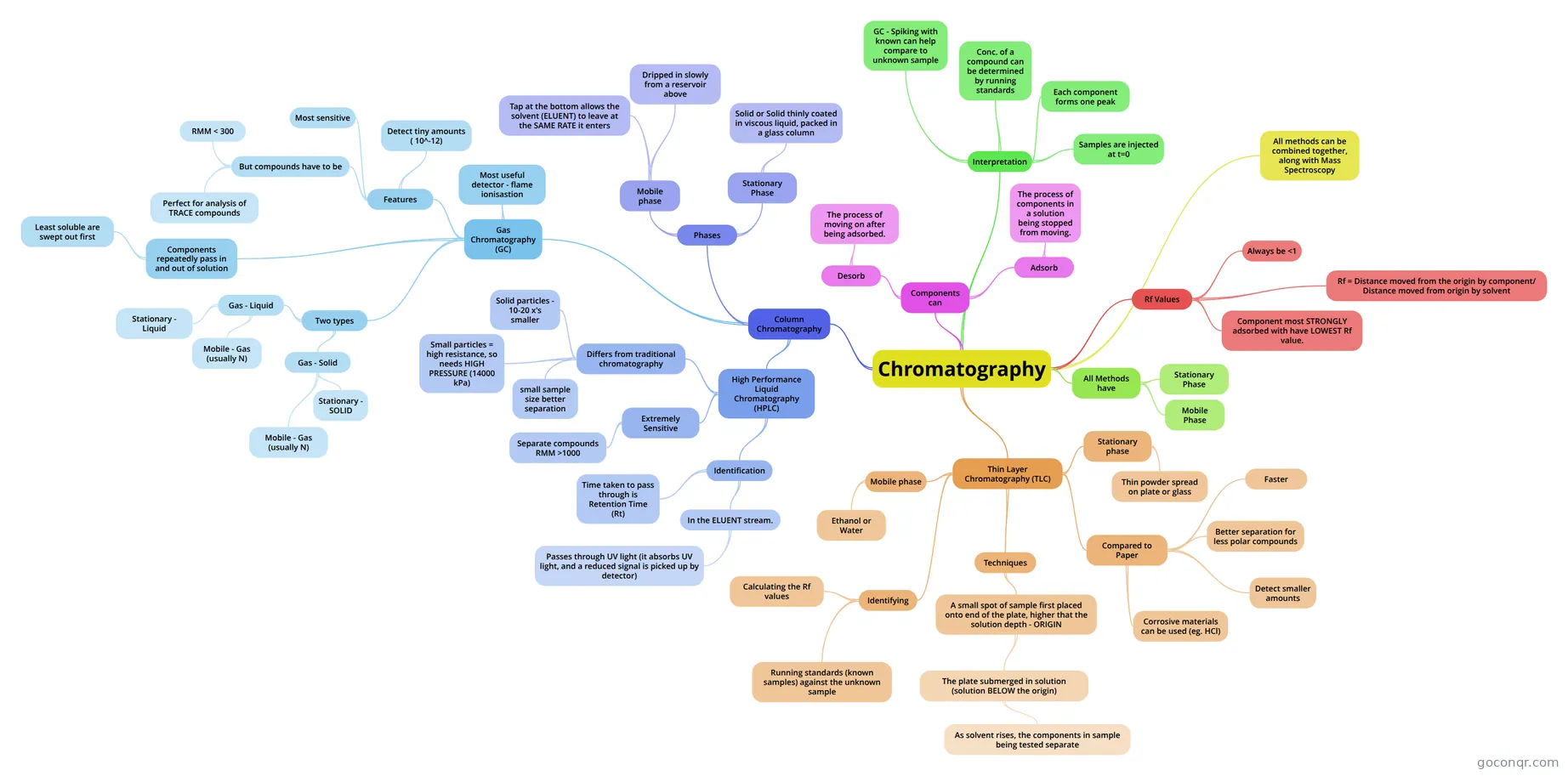
Mind map: chromatography
Contenido del mapa
Chromatography
All Methods have
- Stationary Phase
- Mobile Phase
Components can
- Adsorb
- The process of components in a solution being stopped from moving.
- Desorb
- The process of moving on after being adsorbed.
- Adsorb
Thin Layer Chromatography (TLC)
- Stationary phase
- Thin powder spread on plate or glass
- Mobile phase
- Ethanol or Water
- Techniques
- A small spot of sample first placed onto end of the plate, higher that the solution depth - ORIGIN
- The plate submerged in solution (solution BELOW the origin)
- As solvent rises, the components in sample being tested separate
- The plate submerged in solution (solution BELOW the origin)
- A small spot of sample first placed onto end of the plate, higher that the solution depth - ORIGIN
- Identifying
- Running standards (known samples) against the unknown sample
- Calculating the Rf values
- Compared to Paper
- Faster
- Detect smaller amounts
- Better separation for less polar compounds
- Corrosive materials can be used (eg. HCl)
- Stationary phase
Rf Values
- Always be <1
- Component most STRONGLY adsorbed with have LOWEST Rf value.
- Rf = Distance moved from the origin by component/ Distance moved from origin by solvent
Column Chromatography
- Phases
- Stationary Phase
- Solid or Solid thinly coated in viscous liquid, packed in a glass column
- Mobile phase
- Dripped in slowly from a reservoir above
- Tap at the bottom allows the solvent (ELUENT) to leave at the SAME RATE it enters
- Stationary Phase
- High Performance Liquid Chromatography (HPLC)
- Extremely Sensitive
- Separate compounds RMM >1000
- Differs from traditional chromatography
- Solid particles - 10-20 x's smaller
- small sample size better separation
- Small particles = high resistance, so needs HIGH PRESSURE (14000 kPa)
- Identification
- In the ELUENT stream.
- Passes through UV light (it absorbs UV light, and a reduced signal is picked up by detector)
- Time taken to pass through is Retention Time (Rt)
- In the ELUENT stream.
- Extremely Sensitive
- Gas Chromatography (GC)
- Features
- Most sensitive
- Detect tiny amounts ( 10^-12)
- But compounds have to be
- RMM < 300
- Perfect for analysis of TRACE compounds
- Two types
- Gas - Liquid
- Stationary - Liquid
- Mobile - Gas (usually N)
- Gas - Solid
- Stationary - SOLID
- Mobile - Gas (usually N)
- Gas - Liquid
- Components repeatedly pass in and out of solution
- Least soluble are swept out first
- Most useful detector - flame ionisastion
- Features
- Phases
Interpretation
- Samples are injected at t=0
- Each component forms one peak
- Conc. of a compound can be determined by running standards
- GC - Spiking with known can help compare to unknown sample
All methods can be combined together, along with Mass Spectroscopy
Información
- Descripción
- Chemistry Mapa Mental sobre Chromatography, creado por Crystal D'Souza el 05/07/2013.
- Creado por
- Crystal D'Souza
- Visitas
- 419
- Etiquetas
- Valoración